How To Choose A Suction Cup
Industrial processes demand precise movement and positioning of objects and materials. To achieve this, vacuum gripping technology is used in automated handling systems.

This article was first published on
www.rowse-pneumatics.co.ukThe grips on the tools have suction cups that lock onto the surface of the object, enabling the secure gripping and manipulation of items ranging from small cans to entire vehicles.
Vacuum cups are available in different shapes, sizes, designs, and materials to suit various industrial applications. The following guide provides a general overview to help you select a vacuum cup:
Construction
Flat
Flat suction cups are well-suited for gripping flat or slightly domed surfaces. Their compact internal volume and low profile allow for quick attachment, while their flat shape provides excellent stability, enabling them to withstand lateral forces and rapid movements. These suction cups are commonly used with smooth or lightly textured materials such as metal, glass, and plastic components.
Bellows
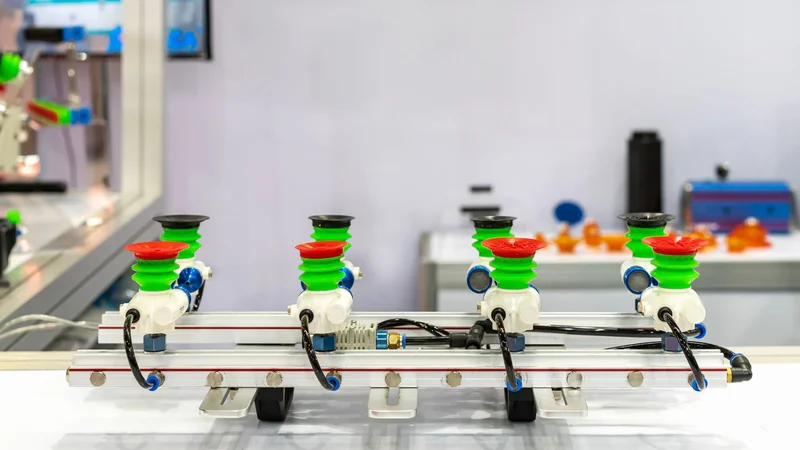
Bellows suction cups are specifically designed to grip uneven, curved, or bevelled surfaces, making them suitable for handling large or irregularly shaped objects. Their flexible, accordion-like structure allows them to conform to surface variations while providing a cushioning effect. In addition, their damping capability means they can handle fragile items such as light bulbs, electronic components, and blister packs, ensuring secure yet gentle gripping.
Oval
Oval suction cups are ideal for handling objects like profiles, pipes, and other elongated or curved workpieces. Despite their compact size, they can generate greater holding forces than standard circular cups, making them particularly well-suited for gripping thin, narrow, or contoured materials with precision and stability.
Extra-Deep
Extra-deep suction cups are specifically designed for handling round, domed, or highly contoured objects. They serve as a compromise between flat cups and bellows cups, offering the stability of flat designs and the flexibility to adapt to uneven surfaces. Their extended depth allows for a more secure grip, making them especially useful in applications where surface variability is present but extreme flexibility is not required.
Interior Volume
The interior volume of a suction cup is an important consideration. It represents the space that must be evacuated to create the vacuum necessary for generating holding force and securely gripping objects.
Flat suction cups have a smaller internal volume, allowing them to evacuate more quickly. As a result, they can establish a strong grip in less time.
To calculate the total volume of a gripper system, engineers must consider the internal volume of all suction cups and the volume of the connecting tubing. This total volume is essential for determining the system’s evacuation time, which depends on the vacuum flow capacity, meaning how quickly the system can grip a part. Engineers should also account for the time it takes to deliver air to the cup, purge the vacuum, and release the object in the system.
Materials
Vacuum suction cups are available in a variety of designs and materials to meet specific applications:
Nitrile rubber (NBR): NBR is an economical and widely used material known for its excellent resistance to oils, fuels, and other petroleum-based substances. Its durability and versatility make it the first choice for general-purpose applications across various industries, including automotive, manufacturing, and packaging. In addition to its oil resistance, NBR also offers good abrasion resistance.
Silicone rubber (Silicone): Silicone is highly suitable for food-grade gripping applications due to its non-toxic, odourless, and heat-resistant properties. Additionally, silicone maintains its flexibility and performance across a wide temperature range and resists UV exposure and environmental factors, ensuring long-term reliability in sensitive environments.
Polyurethane (Polyurethane): Has excellent resistance to wear due to its high strength. This material provides a long service life, maintains its shape under pressure and offers flexibility, allowing for secure gripping – even on slightly uneven surfaces. Additionally, PU cups perform well in both dry and oily environments, making them a versatile choice for industrial automation and material handling systems.
Fluoroelastomers (Viton): This material is well-suited for use in harsh industrial environments where exposure to high temperatures and aggressive chemicals is common. These resistance qualities ensure long-term durability and reliable performance, even under demanding operating conditions.
Other industry materials for vacuum suction cups include PVC and EPDM. Speciality formulations are also available for anti-static requirements, such as those required for handling electronics.
Environment
When selecting suction cups, it’s essential to consider the operating environment. Suction cups must be able to withstand exposure to oils, solvents, ozone and other harsh industrial conditions. Temperature is another critical factor, for both the ambient operating temperature and the temperature of the objects being handled. For instance, certain silicone suction cups can operate within a temperature range of approximately -20°F to 250°F (–30°C to 180°C). Alternatively, fluoroelastomer (FKM) options can tolerate temperatures approaching 400°F (200°C).
Aside from environmental considerations, engineers should evaluate the appropriate suction cup type and the required holding force. This depends on several conditions, including cup size, vacuum level, leakage rate, product weight, and ambient air pressure.
Additional considerations involve the object’s surface coefficient of friction, as well as the load size and the direction and magnitude of acceleration forces.
Choosing The Best Suction Cup For The Task
Vacuum suction cups are widely used in pick-and-place operations and a variety of other industrial automation processes. Selecting the right type of suction cup depends on the specific task at hand. Depending on the shape, surface texture, and orientation of the object being handled, you may need a flat, bellows, oval, or extra-deep suction cup.
Carefully evaluate both the task and the operating environment to ensure the type and material of the vacuum suction cup suit the purpose. NBR (nitrile rubber) is suited to environments involving oils and fuels due to its excellent resistance properties, while silicone is better suited for food handling and high-temperature applications.