How Do Time Delay Relays Work?
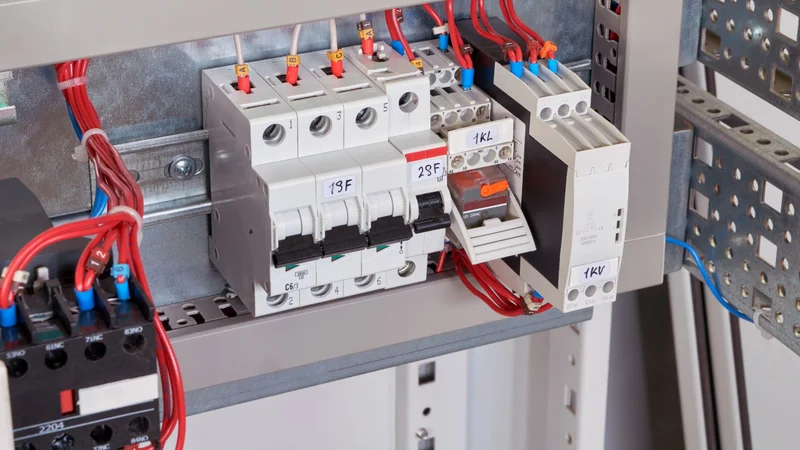
A time delay relay is an electronic device used to control the opening and shutting of contacts following a preset time interval.

This article was first published on
www.rowse-automation.co.ukUnlike standard relays that activate immediately upon receiving an input signal, time delay relays introduce a programmable delay before activating or deactivating. This delay can be precisely configured to suit various applications, from milliseconds to several hours, providing flexible timing control across various systems.
Time delay relays are designed to provide precise control over the timing of operations, ensuring that circuits and devices activate in a coordinated manner. They are used in industrial automation, security setups, and HVAC systems where having exact timing control is important. The delayed activation is particularly useful in applications that require a controlled pause before initiating an action, such as safety mechanisms, or timed lighting and alarms.
How Time Delay Relays Work
Time delay relays operate according to a timing mechanism that configures the activation and deactivation of their contact points. The delay interval for time relays is controlled through customisable components such as programmable logic controllers (PLCs), digital settings, and potentiometers.
The following steps outline how an on-delay time delay relay works. This type of device delays before a switch occurs.
Step 1: The relay receives an input signal from an electrical voltage or mechanical switch.
Step 2: The timing mechanism activates when the input signal is received. The timing mechanism can be electronic (uses resistors or microcontrollers) or electromechanical (uses a clockwork mechanism or motor).
Step 3: The timing mechanism runs the preset delay period. During this time, the relay remains in its original state – normally open or closed. If the input signal is interrupted during the countdown, the relay may start over and not make the intended switch.
Step 4: Once the delay period ends, the relay’s contacts switch. In normally open relays, the contacts close for the current to flow. In the normally closed relay, the contacts open, disrupting the current flow.
Step 5: The relay remains in its new state until such time that the input signal is removed or another signal is received.
Step 6: With some delay relays, there is a reset function that allows the timing mechanism to reset before the delay interval’s completion, returning it to its original state.
Types Of Time Delay Relays
There are many types of time delay relays. They can generally be categorised into single-function and multi-function time delay relays:
Single-function time delay relays
On-Delay Relays
On-delay relays are a common type of delay relay that delays for a set time period before executing an action. Uses include motor control circuits.
Off-Delay Relays
Off-delay relays are designed to continue running even after the control signal is terminated. This relay will remain active for a determined time before switching off.
Single-Shot Relays
Single-shot relays omit a single output pulse for a set period when activated. This type of relay is typically used for applications which require a short-term action. For example, triggering alarms or processes in industrial automation.
Repeat Cycle Relays
This type of relay switches between on and off states at pre-programmed intervals, making it well-suited for intermittent cycling applications such as flashing lights or pump operation.
Interval Relays
When the input signal is received, the contacts switch on immediately and remain in that state for a preset time. Interval relays are commonly used to control heating elements.
Multi-Function Time Relays
Multi-function relays integrate several timing functions into a single device, offering versatile control for a range of applications. They can be configured for on-delay, off-delay, and one-shot operations, providing enhanced flexibility and adaptability for more complex control tasks.
Applications Of Time Relays
Time delay relays are used across industries for various time delay relay applications. The following are common uses:
HVAC system: For HVAC systems, time delay relays stop short cycling of compressors by adding a consistent delay between the powering-up phases of the compressor. They also control the starting and stopping of fans, helping to conserve energy and improve temperature control.
Lighting control: Time delay relays are widely used in both industrial and everyday lighting, including streetlights and property lighting. One of their key benefits is energy efficiency. They can be programmed to activate lights only at specific times, reducing unnecessary power consumption. In emergency situations, such as power outages, delay relays help ensure that lights remain on for a set period, providing safety and visibility.
Security systems: Delay relays are especially useful in security settings where a time period is required before triggering an alarm. In this way, personnel have enough time to disarm a control system or activate door locks to prevent or allow access. In elevator systems, delay relays enable doors to open for a set time to allow for safe entry and exit.
Industrial automation: Delay relays are widely used in industrial automation to control conveyor belts and other sequential operations, ensuring smooth system performance. They also play a vital role in shutdown procedures, where precise timing is essential to prevent equipment damage and safeguard personnel.
Switchboards: Switchboards are equipped with delay relays to precisely control the timing of safety mechanisms, such as circuit breakers for safe power distribution. They work by introducing a delay to stop the simultaneous switching of numerous circuits, reducing system faults and improving reliability.
Time Delay Relays In Automation
Time delay relays are essential components in automation and a wide range of everyday operations. They are used in numerous applications, from managing delays in pick-and-place manufacturing processes to triggering fire alarms. Their broad utility has led to the development of various types, including on-delay, off-delay, single-shot, and repeat-cycle relays. For more complex tasks, multi-function relays offer the flexibility to combine several timing functions into a single device, streamlining control in intricate systems.