Getting Vertical Farming into the Green
Engineering Reliability for Indoor Food Production

03 Nov, 2026. 7 minutes read
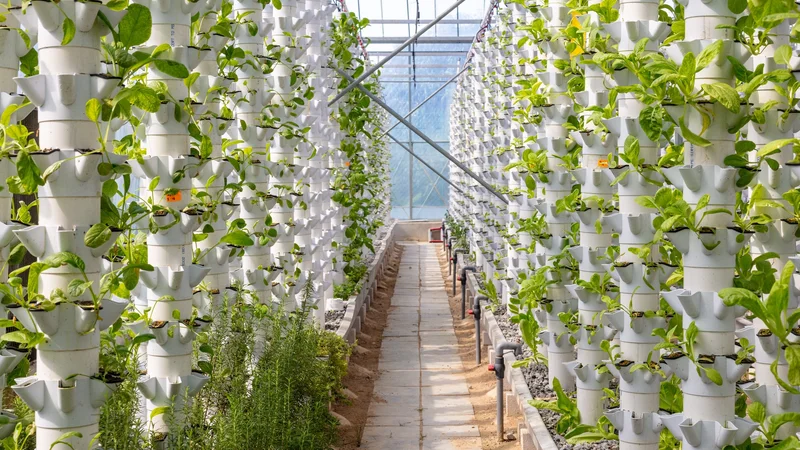
The vertical farming industry has faced significant challenges over the past decade. Despite substantial venture funding and advanced technological innovations, numerous indoor agricultural operations struggled to build long-term, profitable business models. Analyzing these failures reveals that the underlying issues were rarely tied to insufficient technology or a lack of innovation. Instead, the primary vulnerability was operational reliability. The core objective for the next generation of facility design must be bridging the gap between high-tech engineering and stable, repeatable agricultural execution.
Farms that struggled were often built around what was impressive rather than what could run continuously under real-world conditions. Engineering frameworks derived from software product development—iterating fast, optimizing later, and accepting failure as a routine cost of progress—are fundamentally unsuitable for facilities producing perishable crops on rigid schedules. Commercial buyers enforce strict quality standards, where an entire delivery can be rejected based on minor inconsistencies in the first inspected box. In vertical farming, operational reliability is the foundational product.
Every major engineering choice—spanning automation, environmental monitoring, facility layout, component selection, and energy utilization—must be evaluated based on how the facility responds after a system failure and how rapidly it can return to steady-state operations. Recognizing failure as a baseline condition highlights where economic models break down, starting with operational edge cases.
Edge Cases Define the Economics
Standard engineering metrics often focus on average uptime, but in biological systems, edge cases define profitability. Plants continue growing continuously regardless of whether mechanical, electrical, or software infrastructure is functioning normally.
Automated handling systems frequently operate with fixed upper limits on total daily movements. If a system experiences a 24-hour outage, the subsequent operational cycle theoretically requires twice the standard movement capacity to process delayed crops. Without built-in mechanical redundancy or surge capacity, catching up becomes mathematically impossible within a single crop cycle. Plants that miss their intended harvest windows fall out of commercial specification, leading to overgrowth, altered leaf profiles, or environmental stress that compromises post-harvest shelf life.
System reliability of 95 to 98 percent may seem acceptable in general industrial contexts, but in high-density indoor agriculture, the remaining 2 to 5 percent downtime dictates commercial viability. Unplanned outages that interrupt irrigation or lighting for brief periods directly compromise crop uniformity and leaf structure. Strict retail standards mean minor dimensional variances can lead to complete shipment rejections. Over time, these recurring yield losses erode already tight operating margins.
Design decisions that appear neutral during initial planning—such as hard-coded throughput limits, fixed irrigation schedules, and rigid logical dependencies—become severe liabilities during real-world disruptions. Financial losses stem not just from the initial equipment failure, but from slow system recovery. Because recovery speed is directly determined by system design, facilities must prioritize resilience over static efficiency optimization.
Build for Maintenance and Failure, Not Peak Density
Maintenance access and failure planning are key to determining whether a vertical farm can run continuously.
Physical accessibility directly affects maintenance efficiency and recovery times. High-density rack configurations that require specialized climbing gear or complex lift equipment delay routine maintenance and emergency repairs. Incorporating integrated service corridors and dedicated catwalks dramatically improves technician response times, allowing equipment issues to be diagnosed and resolved before crop quality is impacted.
A floor plan that trades a small percentage of maximum growth density for direct maintenance access yields higher sellable output over the facility's lifecycle. Poorly accessible components lead to delayed inspections, transforming routine maintenance into major production bottlenecks that disrupt harvest timing.
Every subsystem must be designed with failure modes established prior to facility commissioning. Effective facility architecture incorporates functional redundancy, enabling operations to bypass offline stations, reroute material flows, and maintain harvesting schedules while repairs occur.
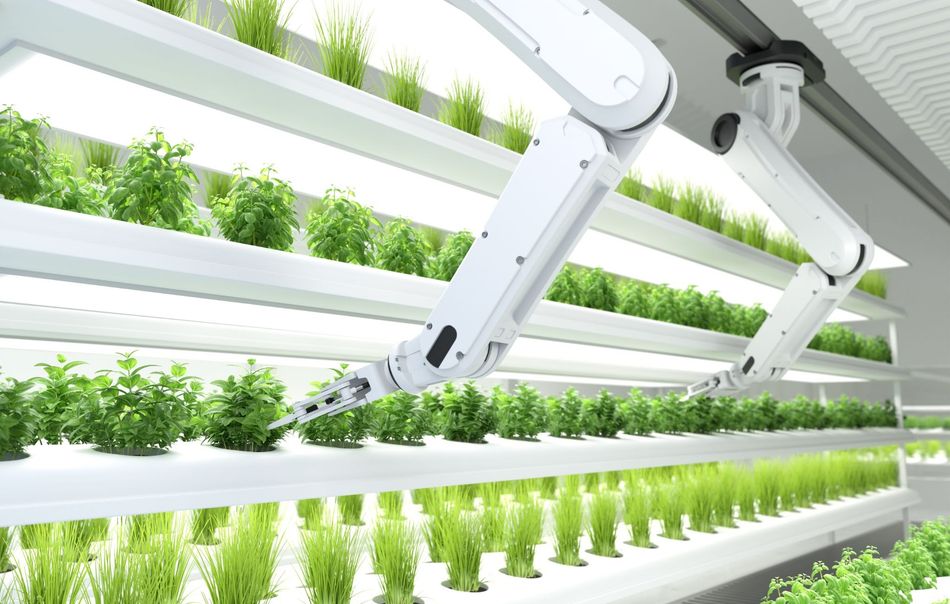
Automate to Support Human Workers
While advanced automation offers distinct operational benefits, introducing complex robotics before core operational processes are fully stabilized adds failure points without improving unit economics. Automation strategy must focus on supporting human labor rather than prematurely replacing human oversight.
Manual tasks, such as moving plant trays or inspecting harvests, double as critical quality control points. Trained operators continuously detect early indicators of nutrient imbalances, pest pressures, uneven growth, and food safety risks. Replacing these touchpoints with automated hardware before computer vision and sensing tools achieve equivalent adaptive judgment removes essential quality safeguards.
Complex computer vision systems deployed for automated crop culling often demand extensive calibration while delivering lower accuracy than skilled manual labor. Furthermore, when complex automated sorting equipment experiences downtime, facilities must revert to manual processes, requiring trained staff as a baseline fallback.
Automation investments should strictly align with proven performance metrics and clear ROI, rather than technological novelty. Even when automation is justified, system evaluation must prioritize spare parts availability, repair simplicity, and recovery speed to protect the biological process.
Standardize Components Around Local Supply Chains
Component standardization directly governs downtime duration. Standardizing equipment around locally accessible supply chains ensures that critical replacement parts can be sourced rapidly without interrupting crop cycles.
Facilities relying on specialized international components, such as custom metric plumbing or proprietary actuators, face prolonged lead times when parts fail. If a facility cannot maintain required environmental specifications during a multi-day wait for imported spares, the underlying design must integrate local substitutes or redundant parallel circuits.
Supply chain risks extend to high-volume operational consumables, including germination trays and growth media. Disrupted trade routes or raw material shortages can halt planting operations entirely. Engineering reviews must evaluate the complete supply chain, establishing local sourcing options for consumables that sustain continuous biological production.
Energy: The Constraint That Makes Every Other Decision Harder
Energy is one of the highest operating costs in a vertical farm and largely determines the minimum cost to produce a pound of product. It also amplifies reliability failures. A system that consumes extra energy during recovery from downtime, or an over-automated facility that adds electrical load without adding output, hits margins twice.
Horticultural lighting efficiency has improved substantially over time. Early LED systems provided approximately 2.75 micromoles of photosynthetically active radiation (PAR) per joule of electricity consumed (μmol/J). Modern commercial fixtures approach 4.0 μmol/J, representing roughly a 45 percent gain in photon efficiency. However, as lighting technology approaches theoretical physical limits, future gains in efficiency will yield diminishing returns, shifting focus to other facility energy demands.
Climate control, specifically HVAC and dehumidification, remains a major operating expense that is frequently underestimated during initial design. Plants continually transpire water vapor into sealed growth rooms. Without aggressive humidity management, microclimates form, escalating disease risks and reducing crop uniformity. Unlike LEDs, HVAC efficiency has not experienced rapid step-change improvements, making robust climate engineering essential to preventing hidden operational costs.
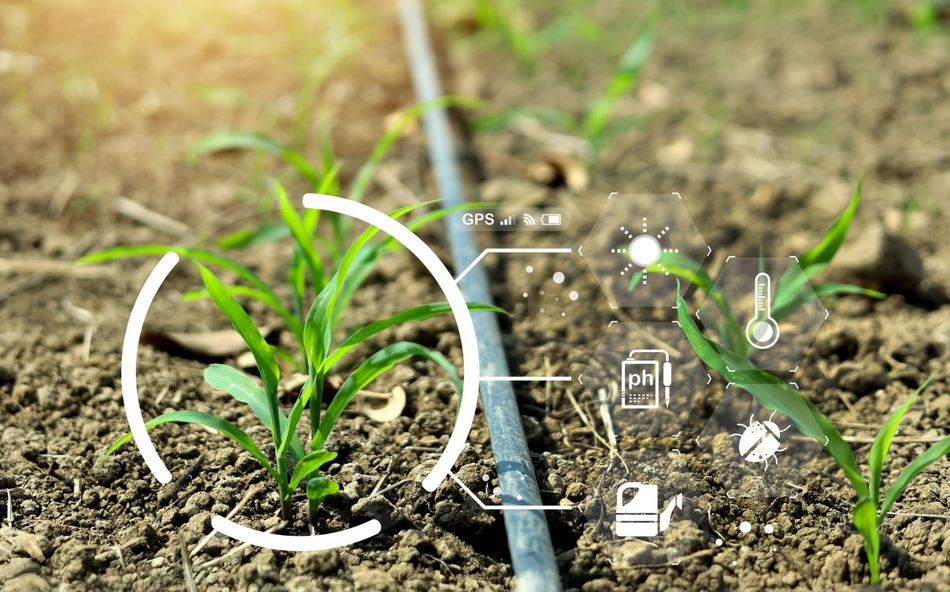 IIoT monitoring growth, soil moisture, pH levels, and climate. Source: AdobeStock.
IIoT Irrigation Monitoring: What It Tells You and What It Misses
Most vertical farms grow hydroponically, where plants are cultivated in nutrient solution rather than soil, making irrigation the only delivery mechanism for both water and nutrients. If the flow is inconsistent, plants decline quickly. The practical question is not whether to monitor irrigation but whether the monitoring accurately reflects what is actually happening at the crop level.
Hydroponic systems rely on circulating nutrient solutions as the sole vehicle for hydration and fertilization. Standard monitoring uses Electrical Conductivity (EC) to evaluate dissolved solid levels. However, EC is a bulk metric that measures overall solution conductivity without identifying individual nutrient depletion levels. Consequently, a solution can display a target EC value while suffering from severe nutrient imbalances.
Crops absorb individual elements, such as nitrogen and calcium, at varying rates. A variance in calcium concentration, for instance, can cause significant recipe drift while remaining undetected by basic EC sensors. Advanced ion-specific sensing tools are essential for flagging elemental imbalances before crop quality suffers.
Better sensing tools are emerging that estimate specific ion concentrations and flag recipe drift before it affects crop quality. These tools offer a real improvement over EC-only monitoring, but success depends on accuracy and calibration discipline.
Sensor placement is as critical as sensor selection. Fixed-schedule irrigation lines can result in newly loaded plant trays missing watering windows if timing logic does not account for loading offsets. IIoT sensor networks must verify zone-level delivery conditions directly at the plant tray rather than simply confirming signal transmission from the main controller.
Monitoring Should Verify Outcomes, Not Commands
Most facilities track temperature, humidity, CO₂, and light intensity at the room level. However, airflow at the canopy (i.e., the layer of leaves and plant growth where gas exchange and transpiration occur) and light delivery at the crop surface are consistently under-monitored. A command being sent does not mean the crop received what was intended.
High-density vertical racks generate complex local microclimates. Overall room-level environmental readings do not accurately reflect micro-environmental conditions at the plant canopy. Insufficient canopy airflow creates localized humidity spikes, leading to uneven transpiration, disease risk, and variable crop growth.
Relying on control signals or wide-angle camera feeds to verify lighting delivery often misses localized fixture failures. Optical distortion and leaf canopy coverage can obscure underlit zones until crop damage becomes visible. Installing PAR sensors directly at crop canopy level provides real-time verification of actual light absorption, ensuring operational errors are caught early.
Engineers specifying sensor networks must determine whether the measurements at each monitoring point reflect what the crop is receiving, rather than what the system is sending. Putting all of this together points to a practical approach: Start with a system you can understand, operate, and recover, then scale only after it is stable.
Start Simple, Scale What Works
Vertical farms building profitable businesses tend to scale in steps, with stability as the gating factor.
Adopting an iterative, "build as you go" approach creates systemic vulnerability in commercial farming. Biological production requires predictable execution; harvest delays directly jeopardize retail agreements regardless of underlying technological challenges.
Long-term commercial viability favors a phased expansion model. Facilities should start with modular, controllable growth units to refine crop recipes, standardize workflows, and establish stable yields. Scaling should occur only after core operating systems prove profitable at baseline capacities.
The optimal control stack is the simplest system capable of maintaining consistent crop quality and environmental parameters. Additional automation and sensing systems should be integrated selectively to resolve verified bottlenecks, ensuring measurable returns on investment and sustained operational reliability.
Vertical farming becomes viable when engineering supports day-to-day execution. That means reliable output, maintainable equipment, and consistent product quality. It also means designing for failures as a normal operating condition, and measuring how fast the farm returns to spec.