EpoQ Wins Global Photonics Engineering Contest 2026
EpoQ is working on a trapped-ion clock with on-chip photonics and will receive services worth up to 100,000EUR from the PhotonDelta ecosystem.

05 Nov, 2026. 4 minutes read
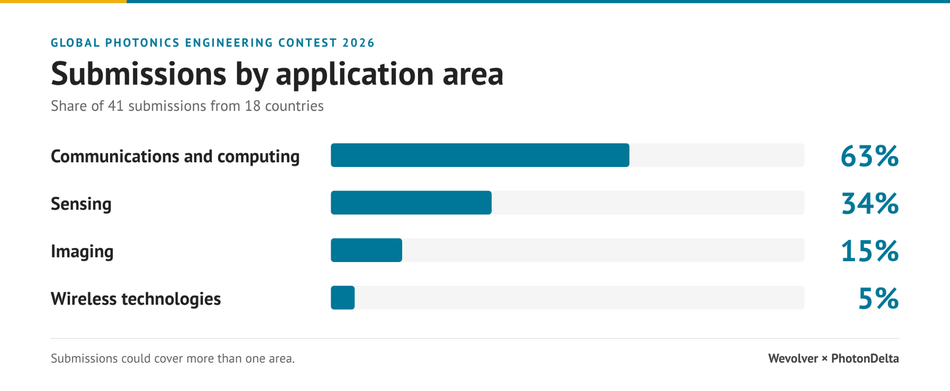
The Global Photonics Engineering Contest 2026 saw participation from engineers, innovators, and startups from across the world to develop practical applications for photonic integrated circuits (PICs). With 41 entries from 18 countries, this year's contest showcased ideas addressing engineering challenges across communications and computing, sensing, imaging, and wireless technologies.
A jury of experts from PhotonDelta and 12 partner organizations, including foundries, design houses, packaging specialists, and investors, reviewed the entries.
Wevolver is pleased to announce EpoQ as the winner of the Global Photonics Engineering Contest 2026!
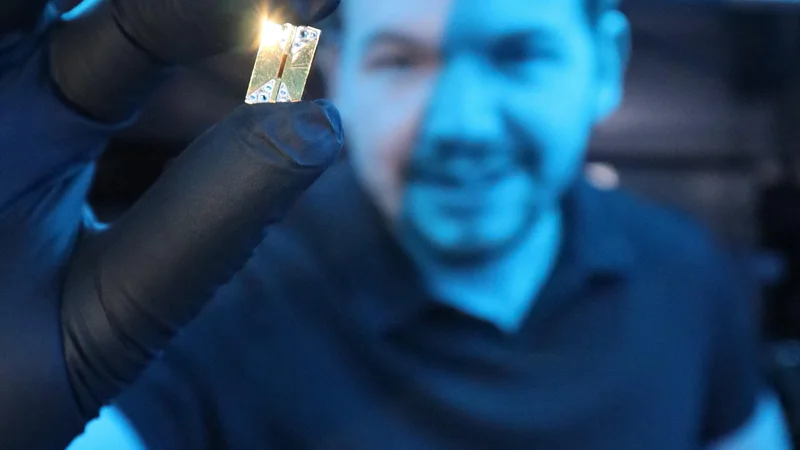
The Amsterdam-based venture, co-founded by Louis Gallagher, is developing a photonic chip-based trapped-ion atomic clock designed to bring high-performance precision timing out of the laboratory and into real-world applications.
As the winner, EpoQ will receive up to €100,000 in technology services through PhotonDelta's ecosystem, helping the team advance its photonic chip design, prototyping, and system integration. The prize package also includes the opportunity to receive up to €2 million in pre-seed investment, subject to PhotonDelta's investment process and applicable conditions, as well as international public relations (PR) support and an opportunity to pitch at PIC Summit Europe 2026. .
EpoQ's winning project stood out for an ambitious use of integrated photonics with a clearly defined engineering challenge and potential commercial applications.
Where Photonic Chip Innovation Is Focused
Entries covered a broad range of potential uses, including transceivers, quantum technologies, advanced computing, biochips, gas sensing, LiDAR, augmented reality, and 6G. Projects were assessed on their innovation, technical and commercial feasibility, and ability to address existing industry challenges.
The Winning Project: A Portable Trapped-Ion Clock
EpoQ's winning submission applies integrated photonics to precision timekeeping, demonstrating how photonic chips could help overcome the size and complexity limitations of existing atomic clock systems.
Trapped-ion clocks are among the most precise timekeeping systems available. They use ions confined by electromagnetic fields and measure specific atomic transitions to establish highly stable frequency references. According to EpoQ's submission, trapped-ion optical clocks have achieved fractional frequency uncertainties below 10-18.
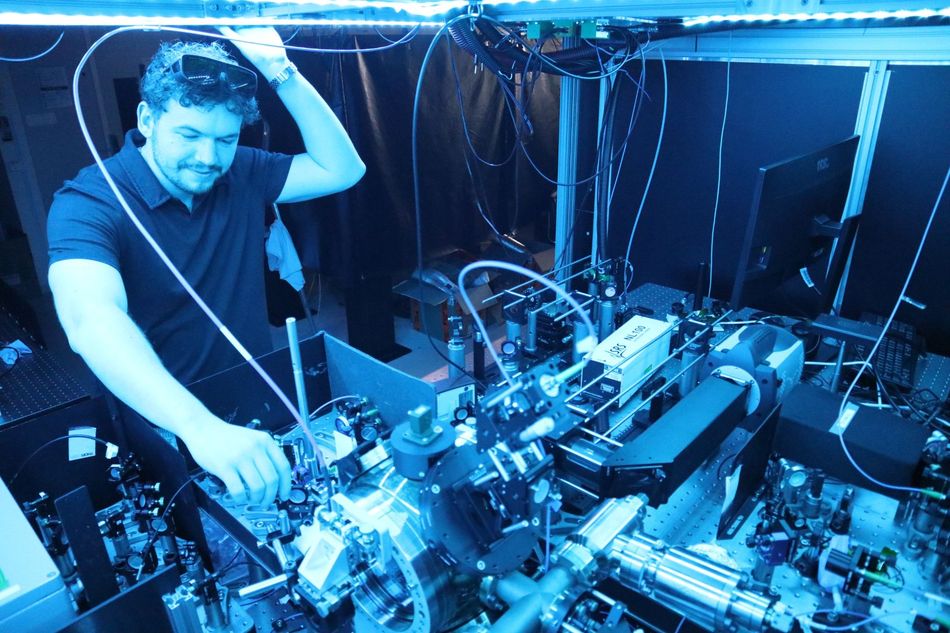
Despite their impressive performance, these systems are still largely confined to laboratories. Conventional setups depend on bulky free-space optical arrangements, external laser systems, and carefully aligned components. They can occupy several square meters and require specialist personnel to assemble, operate, and maintain them.
These requirements make trapped-ion clocks difficult to deploy in applications where size, weight, power consumption, and operational complexity are important constraints.
EpoQ aims to address this challenge by integrating photonic components directly with a microfabricated ion trap. Rather than relying on separate optical equipment and free-space beam paths, the proposed system will use a photonic integrated circuit to generate, control, and route the light needed to operate the trapped ions.
The planned photonic circuit includes several components that work together to deliver and control light:
Optical waveguides route light through the chip.
Diffractive gratings direct light from the chip towards the trapped ions.
Optical modulators control the amplitude and phase of light.
An integrated laser source generates the wavelengths required for ion trapping and control.
The team plans to use an aluminum oxide (Al₂O₃) photonic platform designed for operation in the near-ultraviolet wavelength range required by its ytterbium-ion system. By integrating these photonic functions with the ion-trap hardware, EpoQ aims to reduce the number of separate optical components and simplify the overall architecture.
The longer-term goal is a compact trapped-ion clock with a core system volume below one liter. By shifting much of the optical complexity into chip-based components, EpoQ aims to make high-performance atomic timing systems easier to manufacture and deploy beyond specialist laboratories.
The integrated clock is still under development. The team has existing microfabricated ion-trap hardware that they have characterized and tested while they are still developing the PIC. Initial work will focus on fabricating and characterizing the photonic chips before integrating them with the ion trap and testing the combined system.
Where Could a Portable Trapped-Ion Clock Be Used?
Accurate timing is important for navigation, communications, and infrastructure that depends on synchronized systems. However, reliance on satellite signals can create vulnerabilities when those signals are disrupted, unavailable, or affected by jamming and spoofing.
A compact trapped-ion clock could provide a stable local timing reference when external synchronization cannot be maintained. EpoQ identifies several potential applications:

The team plans to develop and test the integrated photonic components in stages, with the aim of demonstrating a functioning photonic ion-trap system in the laboratory within the next three years. Further development would then focus on a first-generation portable clock for potential early adopters.
The Team Behind EpoQ

The EpoQ team’s combined experience spans ion-trap hardware, quantum research, and photonic integration. The team ultimately aims to develop turnkey trapped-ion clock modules for research laboratories, metrology institutes, defense organizations, and, over the longer term, space and telecommunications applications.
The €100,000 technology services package will provide access to photonic chip design and validation expertise, Multi-Project Wafer (MPW) prototyping, packaging, and assembly support through the PhotonDelta ecosystem. These resources will help the team fabricate and test its initial photonic circuits and make progress toward integrating them with the ion-trap hardware.
The award will support the next stage of development as the team works to bring trapped-ion clock technology beyond the laboratory.