BSH Uses Data to Accelerate the Transition from Product Development to Production
BSH Home Appliances Group (BSH) is bridging the traditional gap between product development and production.

12 Nov, 2026. 4 minutes read
BSH Home Appliances Group (BSH) has become a Digital Enterprise, bridging the traditional gap between product development and production. As a result, engineering productivity has increased by up to 30%, and time to market has decreased by up to 50%. BSH uses a unified digital data backbone in the form of a shared, central database – based on Siemens Teamcenter – to face intense competition and a constant flood of new requirements and regulations. This enables the company to transform operational complexity into lean, efficient processes. The result: High-quality home appliances reach consumers worldwide faster than ever before.
With sales of around 15 billion euros and more than 56,000 employees, BSH is a global leader in the home appliance industry. As a Bosch Group subsidiary, BSH manufactures products at 37 locations and operates in approximately 50 countries. It is extremely complex to manage brands such as Bosch, Siemens and Gaggenau as well as regional brands, which encompass thousands of variants and five product categories, while adhering to sustainability regulations, driving rapid innovation and competing globally. BSH is addressing this complexity by transforming into a Digital Enterprise.
BSH Aims To Master Complexity With a Seamlessly Connected Digital Factory
BSH integrated its PLM, MES, and ERP systems. This created a comprehensive Digital Twin that aligns design and manufacturing, while simulation software and generative AI optimize global manufacturing processes. As a long-standing Siemens partner, BSH implemented Siemens’ integration strategy. With the help of a fully digital engineering toolchain, BSH gradually merged product and production lifecycles. The unified data backbone provides manufacturing with access to all relevant information, from product development to designing a suitable assembly line for a new product. This is particularly important because most of BSH’s products are software-defined. Having all data on a single platform accelerates product development and production. This is crucial for meeting increasingly stringent and constantly changing market requirements.
How a Fully Digitalized Value Chain Can Reduce Complexity
BSH has set a goal of bringing new product variants to market more quickly. The marketing department is the starting point, defining consumer requirements. These requirements are managed in Siemens’ Polarion and then transferred to Teamcenter, where requirement objects, including their specifications, are created. Product configuration allows BSH to drill down from thousands of variants to each specific single product type. This data is reused for various purposes, such as test cases forwarded to Opcenter RD&L, Siemens’ laboratory management solution, for validation. Next, a physical test or simulation is performed using software such as Simcenter STAR-CCM+ to determine if the requirements have been met. The results are ultimately fed back into Teamcenter and made available to all plants. This saves time and effort across the entire company.
In product development, the mechanical, electrical, automation, and software engineering teams can work simultaneously rather than sequentially. Siemens’ industrial software, including Designcenter™ NX™ software, Polarion, Xpedition, and Simcenter, accesses data stored in Teamcenter to accelerate development. Teamcenter contains the bill of materials (BOM) for the electronics hardware, coming from Siemens Xpedition, and also the product’s firmware as well as other product-related data. All software tools can access data stored centrally in Teamcenter. This simplifies product development and production planning across all departments and locations.
During the manufacturing engineering phase, BSH uses Teamcenter Easy Plan to create a bill of process (BOP) and simulates and validates the manufacturing process with Tecnomatix Process Simulate and Tecnomatix Plant Simulation. These results are also stored in Teamcenter. Using the single data backbone and digital tool chain enables BSH to optimize productivity at all its factories worldwide. It allows all sites to quickly adapt to new product variants and changing market demands. Providing operators with the digital information they need on the workstation helps them improve productivity.
The Digital Twin Serves as a Living Blueprint
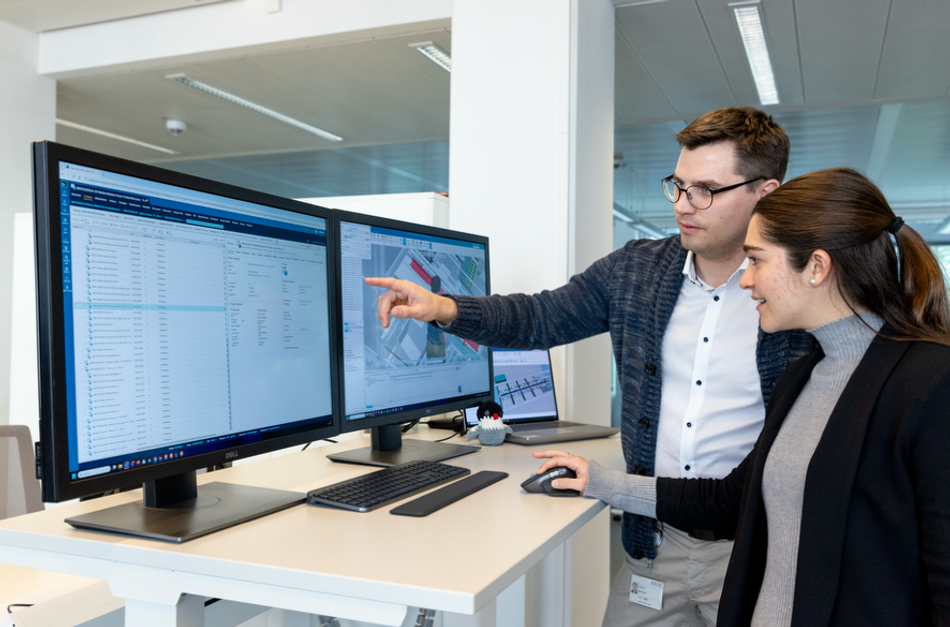
For BSH, maintaining data consistency throughout the entire value chain is of the utmost importance. For this reason, the company uses a comprehensive Digital Twin from product development through production. The Digital Twin contains essential product information, such as components and resources from the mechanical, electrical, software, and automation sectors, as well as all shipping data.
The Digital Twin is stored in Teamcenter. In combination with Siemens simulation software, the Digital Twin enables continuous improvement. Process Simulate, for example, is suitable for 3D manufacturing simulations that can be used to optimize production planning and validation, including human-robot interaction.
AI Transforms Complex Data Into Actionable Insights
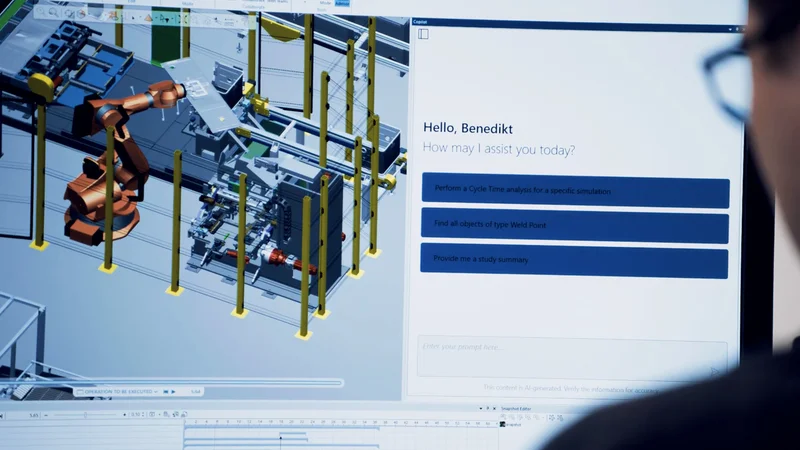
For its initial proof of concept, BSH relied on the generative AI solution integrated into Process Simulate. BSH expects the AI to provide substantial added value. Advanced data analysis and visualization of simulation results are intended to provide deeper insights and support more confident decision-making. The biggest advantage is that the AI in Process Simulate understands natural language. This enables users to work more efficiently within the system and obtain reliable results, even with limited simulation knowledge. BSH aims to use AI to increase efficiency, accelerate the validation process, and create simulations more quickly. This is based on clean, clear processes, as well as reliable, consistent data. BSH will continue to standardize and harmonize company-wide data to lay the groundwork for integrating AI-based solutions. The goal is to automate engineering tasks, set up machine tools, and optimize the production line’s cycle time.
Siemens has been a strategic partner of BSH’s since the company began its digital transformation over a decade ago.
Read the whole story here: https://www.siemens.com/en-us/company/insights/bsh-digital-transformation/
Author: Tsvetelina Nikolova, Digital Enterprise Marketing Manager, Siemens.