Additive Manufacturing in the Automotive Industry: Driving the Future of Mobility
Additive Manufacturing (AM) is transforming the European automotive industry; enhancing supply chain resilience, sustainability, and design freedom while driving innovation toward scalable, data-driven production.

13 Nov, 2025. 4 minutes read
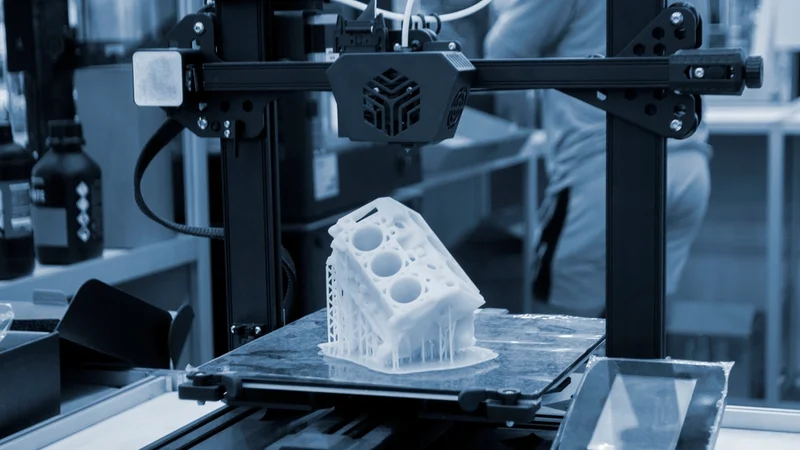
Additive Progressive Modeling Technology (Prototype of Car Engine - 3D Model)
Introduction – Redefining Automotive Manufacturing
Additive manufacturing (AM) has evolved from a specialised prototyping tool into a vital production technology for the automotive sector. In Europe, Original Equipment Manufacturers (OEMs) and Tier-1 suppliers are increasingly integrating AM into tooling, maintenance, and small-series production, where it helps to reduce lead times and improve design flexibility. The focus is now on ensuring AM meets the strict reliability and quality standards required for high-volume manufacturing. Manufacturers are working to optimise production by integrating machines, materials, and data flows to drive efficiency and ensure regulatory compliance. This integration is key to enabling consistent, scalable production while maintaining flexibility and reducing costs [1] [2].
As the industry prepares for Formnext 2025 in Frankfurt, attention will shift towards practical adoption strategies. OEMs will continue to refine their processes, qualify new materials, and enhance the connectivity of AM data within digital-manufacturing and compliance frameworks. This will be crucial for accelerating AM’s role in mainstream automotive production, reducing costs, and meeting the growing demand for sustainable manufacturing solutions.
Why Additive Manufacturing Matters?
External pressures and internal advantages shape the strategic relevance of AM.
Supply-Chain Resilience
On the operational side, distributed AM enables localised manufacturing of spares and replacement parts. Daimler Truck | Daimler Buses, working with 3D Systems, Oqton, and Wibu-Systems, has launched a decentralized spare-parts printing program that allows authorized partners to produce certified components locally, cutting logistics dependencies and reducing lead times by up to 75 percent [3].
Regulatory and Sustainability Momentum
At the policy level, the European Union’s Right-to-Repair Directive and the Ecodesign for Sustainable Products Regulation are advancing requirements for product traceability and compliance with the circular economy [4][5]. Because AM inherently captures design, material, and process data, it aligns naturally with these frameworks—making it both a performance enabler and a compliance-ready manufacturing method.
Industrial and Design Benefits
The internal incentives for adopting AM are equally strong. Additive processes accelerate prototyping and tooling, reducing design-to-production cycles from weeks to days. They enable complex geometries and lattice structures that lower weight while maintaining structural integrity. By eliminating tooling investment, AM enhances cost transparency for low-volume runs and streamlines design revisions. It also extends the service life of products, as legacy or low-demand parts can be produced on demand rather than stored [1][6].
Materials and Manufacturing Processes
Polymers
Selective-laser-sintering (SLS) and Multi Jet Fusion (MJF) remain the most widely used AM methods for robust PA12 and PA12-GF parts. Tier-1 supplier Brose employs SLS for end-use components such as a 20,000-unit Bowden-release assembly, showing that controlled, mid-volume polymer AM can meet cost and reliability targets [7].
Metals
OEMs are consolidating capacity and exploring binder-jet productivity. Volkswagen has added a second Additive Industries MetalFAB system at Wolfsburg and continues its collaboration with HP on Metal Jet to increase throughput for qualified geometries [8].
Large-format & repair.
Wire-Arc Additive Manufacturing (WAAM) and Directed-Energy Deposition (DED) are increasingly applied to heavy-duty tooling and repair [9]. Automated depowdering and finishing, frequently demonstrated at trade fairs, illustrate how AM cells are being industrialised rather than kept as R&D islands [10].
Case Studies
BMW Group
The Additive Manufacturing Campus near Munich has become the model for serial AM integration in Europe, producing more than 300,000 parts annually and serving as the network’s knowledge hub [11].
Daimler Truck | Daimler Buses
By partnering with 3D Systems and Oqton, Daimler is transforming spare-parts logistics into a distributed, certified manufacturing model—embedding AM directly within maintenance workflows [3].
Renault Group
At its Flins Refactory, Renault operates a 500 m² additive centre with around 18 polymer printers for tooling and spare parts. In 2022, the company installed an AM Solutions S1 post-processing unit to automate the depowdering and finishing of MJF PA12 parts, improving repeatability and reducing manual labor within its circular manufacturing “Re-Factory” program [12].
Volkswagen Group
Wolfsburg’s expansion of metal AM, including binder-jet and hybrid AM + CNC routes, targets industrial-scale productivity gains and cost transparency across production programmes [8].
Mercedes-Benz Classic
Operates a certified 3D-printing programme to produce genuine replacement parts to original specifications for heritage vehicles, proving that additive methods can meet OEM quality and documentation standards [13].
Practical Roadmap for Adoption
Start by focusing on parts with high downtime costs and low production volumes, such as jigs, fixtures, or obsolete service spares. Standardise on a small selection of materials (e.g., PA12 for polymers, AlSi10Mg for metals) to ensure consistency and reduce complexity.
Develop internal Design for Additive Manufacturing (DfAM) guidelines to optimise part geometry for AM, ensuring efficient use of materials and build time.
Traceability is crucial: capture all data from build files to inspection results, feeding it into your enterprise systems to meet Digital Product Passport (DPP) requirements. Automate post-processing steps, such as depowdering and finishing, to improve consistency, as seen at Renault’s Flins site. Lastly, pilot secure remote printing using encrypted files and machine authentication, a model already in use by companies like Daimler.
Applications and Future Outlook
AM’s automotive role is widening but remains application-driven. It is mature in prototyping and tooling, expanding in spare-parts production, and selectively applied to low-volume serial components. The convergence of regulatory demands and digital-factory readiness is expected to accelerate the adoption of digital spare-part warehousing and hybrid AM/CNC workflows. Analysts project Europe’s AM market to grow at a rate of roughly 20 percent CAGR through 2030 [14], with the automotive sector as a key driver.
Conclusion – Join the Additive Transformation
As automotive manufacturers plan for the 2026–2028 cycle, AM is transitioning from isolated innovation to a standard manufacturing capability. It supports sustainability, repairability, and supply-chain agility while satisfying Europe’s new data-traceability norms. Formnext 2025 will showcase how automation, certification, and digital integration are redefining production. For engineering and operations teams, it offers a concentrated opportunity to benchmark solutions and align additive strategies with long-term manufacturing goals.
References
Formnext, Additive Manufacturing for the automotive industry: basic principles, recommendations, application examples and forecasts (White Paper)
European Patent Office – Innovation trends in additive manufacturing Patents in 3D printing technologies.
3D Systems & Daimler Truck | Daimler Buses, Press Release (23 Jan 2025).
EUR-Lex, Directive (EU) 2024/1799 on common rules promoting the repair of goods, 2024
European Commission, Ecodesign for Sustainable Products Regulation (ESPR) overview, 2024
Hamza, A., Bousnina, K., Dridi, I., & Ben Yahia, N. (2025). Revolutionizing automotive design: The impact of additive manufacturing. Vehicles,
Formlabs. (2024, November 7). How Brose leverages SLA and SLS technology to bolster automotive production.
Additive Industries. (2023, June 26). Volkswagen Group expands additive manufacturing capabilities with Additive Industries’ MetalFAB system.
RAMLAB. (n.d.). WAAM 101: An introduction to Wire Arc Additive Manufacturing.
VoxelMatters. The increasing automation of metal AM post-processing
BMW Group, 3D printing in BMW production, 2024.
Machine Insider.. Renault Flins invests in an S1 machine from AM-Solutions.
Mercedes-Benz AG. (n.d.). Next generation of genuine Mercedes-Benz replacement parts from the 3D printer
Global B2B Market Research Agency. Europe metal additive manufacturing market analysis