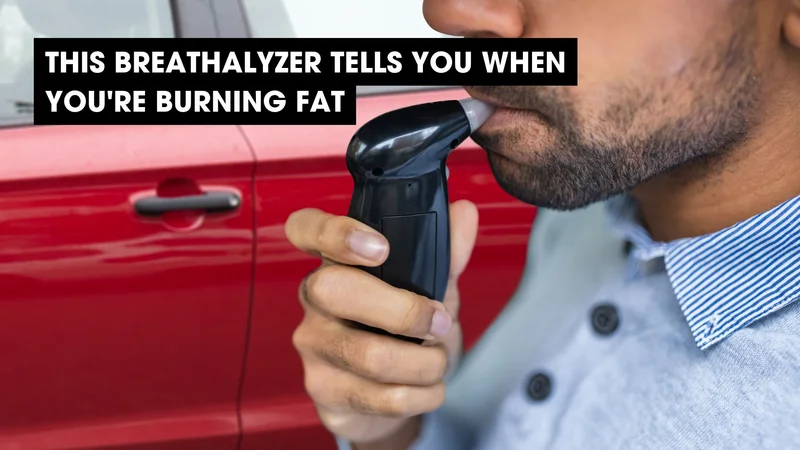
This Breathalyzer Tells You When You're Burning Fat
In this episode, we explore how researchers at ETH Zurich developed a handheld breathalyzer that measures when your body is burning fat instead of carbohydrates, without requiring a blood test.

18 Nov, 2026. 11 minutes read
This article was first published on
the-next-byte-wevolver.simplecast.comIn this episode, we explore how researchers at ETH Zurich developed a handheld breathalyzer that measures when your body is burning fat instead of carbohydrates, without requiring a blood test. By detecting tiny amounts of acetone in exhaled air with near-laboratory accuracy, this smartphone-connected device could transform how we monitor metabolism, personalize diets, and track the effectiveness of weight loss and medical treatments.
Daniel
Hey folks, in today's episode we're talking about an interesting approach to collect information that you're breathing out all the time, every single day, and see if you can understand a little bit more about one of the more mystical parts of diet and exercises. When exactly am I burning fat? This research team from ETH Zurich found a way to tell that just by breathing out.
What's up, everyone? Welcome back to The Next Byte. In today's episode, as we just talked about, we're gonna be speaking generally around the topic of using technology to track your health. And cool I guess like this trying to make this too weird here, but like waste products from the body or exhaust from the body is actually a really decent indicator on what's going on inside the body. Very similar to the way like your your car monitors the health of the engine by looking at the exhaust.
We've got two topics lined up for you today. One of those is around using breath sensing. But the first of those that I want to zoom us in on is from today's sponsor, Mouser Electronics. If you've been listening to the podcast for any length of time longer than a few episodes, you know that we proudly sponsor or proudly partner with Mouser Electronics as our sponsor because they do a great job of their taking the position that they're in in the world, which is one of the world's largest electronic suppliers, distilling that unique expertise that they have into technical resources that folks like you and I can use to try and understand what the heck's going on in the technology world. And if you've listened to the podcast at all, you know that's kind of our mission too is distill what's going on in the interesting, impactful realms of technology and make it easy to understand. So that's why we love partnering with Mouser. We've linked a specific episode of theirs called Stop Flushing Away Health Insights and I think it's particularly relevant to what we're talking about today because it talks about waste sampling. So advanced toilets that can provide regular updates about the health of the user based off of your waste that's going down the toilet. And that the title is pretty indicative there. It's like we've got all these health insights to understand what's going on. Why are we just flushing that away? So we can kind of get some more information around infections, whether you might have certain types of cancer, diabetes, and more. Pretty interesting that you can tell all of that just by looking at your pee and your poop, folks.
Farbod
I love your analogy with the car. And now every time I'm in the toilet I'm gonna think about what kind of car I feel like I am that day. Yeah. Yeah.
Daniel
All right. no, I I I think it's really interesting though. Like we have all these signals of trying to understand what's going on inside the body. Let's let's use actual matter, actual s like molecules that have been inside your body. That's a decent indicator on what's going on on the inside. So appreciate Mouser Electronics for sharing this awesome technical resource, which is linked in the show notes. And I do think it's particularly relevant to the meat and potatoes of today's episode as well, which is a combination team of ETH Zurich, researchers there, University Hospital of Zurich, but then also Olivion. I hope I'm saying that right.
Farbod
Your guess is because my I thought it was Olivion, but Olivia it's European.
Daniel
Olivion? Olivia? I don't know. But they're a this is true. they're a spin-off startup that started at ETH Zurich and is now commercialized and made their own products, doing all sorts of of of handheld sensing, right? I think you understand the history better than I do for Bode. What did I miss there?
Farbod
No, I I you got it. They they were spent off from ETH Zurich. The team had ten years of experience before spinning off in twenty twenty. In 2017 they wrote a paper about using acetones to detect metabolism, which you're gonna talk about later, but yeah, that that's kind of been their mission. It's like this is our expertise, how to do sensing in a compact manner and making it accessible. And then one of the things that you and I always like to harp on is like, it sucks when like amazing things happen and they stay in the research facility. Well, they were like, Our mission is to take it out. We wanna make products out of these and commercialize it. So, yeah.
Daniel
Kudos to the folks that take awesome technologies out of the laboratory and into the real world. We need a little bit of more of that in the world, I think. before we talk specifically about like the sensor that they built or why we think it's interesting, I'd almost rather zoom out to like the body in general or the problem in general, which is that your body, my body, our bodies, both burn carbs and fat. Those are two of the sources that it can use for energy. And that balance shifts back and forth depending on what you eat, how you exercise, etc. When your liver is breaking down fat though, which is like how you get energy from fat, it produces acetone as a byproduct. And that chemical, the acetone actually ends up in your breath. so measuring how much acetone you're breathing out can actually show how effective your body is at burning fat. But the challenge is that those acetone levels are like really, really small, like ten parts per billion. That makes it really challenging to measure without expensive lab equipment. And there's a bunch of like other affordable compact sensors that were used to like try and track these acetone levels in your breath, but they weren't easily specific to acetone. So they could get confused by other chemicals or were highly dependent on like, how you are breathing. And I almost think this is like a better analogy to the exhaust of a car, right? Is like this is your body exhausting, like literally breathing out after doing combustion, which is the same thing your engine does. It's taking stored energy, burning it, and then the exhaust is what you're breathing out. And so we're trying to track the exhaust similar to the exhaust on your car and say, Hey, how much of this fat am I actually burning? but so far to date, at least it's been really challenging to be able to sense that until these folks at Oivion came up with a unique approach.
Farbod
You know, following that trend of talking about the analogy with the car, right? The exhaust is gonna have carbon dioxide in it at much, much higher concentration, but you also have lax of water evaporate. And that's one of the challenges that researchers have run into in the past by trying to understand metabolism by doing acetone monitoring, which is yeah, there's acetone in there, but the concentration is generally low and there's so much other stuff in there. That it's gonna start messing with whatever sensing platform that you have. So kind of like building the stage for what we're gonna talk about, like, yes it existed, yes it's limited, and here's why it has been limited in the past.
Daniel
I mean, just in general. Like trying to sense anything that's at a concentration of ten parts per billion when there's lots of other stuff mixed into that same exhaust flow that are at much higher concentrations than that and can change based off of a lot of stuff. It's a challenging sensing problem.
Farbod
You and I know a thing or two about that, right? Like we're we're novice gas sensing researchers that have I don't know, dabbled in the one part per billion realm, right?
Daniel
For sure. And like what we had to do in that case was literally nanomaterials engineering, designing the material from scratch to be specific to the type of molecule that we were trying to sense. So that's like again, this ten ten parts per billion. That means there's one acetone molecule for every one hundred million of the other air molecules mixed in. This team spent over a decade developing this specific technology. and basically what it does is it first filters out all those unwanted chemicals, all these different hundreds of different chemicals that are inside your breath. They specially engineered this filter to block out the unwanted chemicals so that the sensor, which is acetone-specific, can focus on what are the levels of acetone. And the basically the way it works is you at least as far as I understand it, is the first air you exhale actually mostly comes from your mouth and your airways. As I cough, this device waits until there's air like deeper in your lungs for like a really deep exhale to reach the sensor. That gives a better picture of what's actively happening inside your bloodstream right now, as opposed to like taking the early breath that first comes out. Then you breathe on the sensor, the filter blocks out all the chemicals that are not acetone, and then there's a sensor on the back side of that filter that's basically measuring how much acetone is there. It is electrically wired into a device, the device measures how much air you've breathed out, and then a smartphone app helps guide you as you exhale, and then helps measure how much acetone concentration is in your breath. They correlate this against lab equipment basically to see if it closely matches the lab results. And then voila, you're able to use this handheld device instead of using a super expensive mass spectrometer that is what's typically used in a lab. Did I capture that correctly?
Farbod
You absolutely did it justice. It to me, honestly, if you've ever seen those social media tests where they're like, breathe into this breathalyzer so we can see your blood alcohol concentration level. It's like that, but supercharged and looking for a very specific thing at a much lower concentration than someone who's usually intoxicated will have in their system for like alcohol detection.
Daniel
And breathing in a breathalyzer, I've never done it. But I imagine it's always stressful, never fun. But I feel like this is like, you know, potentially taking a spin on that, right? Like, hey, can I use a breathalyzer to measure more things than just how drunk am I? Can we also see what else is going on inside the blood? and I I think that this is really interesting in terms of weight loss, trying to understand how well your metabolism responds to different types of diet, different types of exercise. for folks that are fasting, they you can use these acetone levels to track your ketone production. which on my own I was like, okay, that's not super interesting. But the medical applications of that are like for people with epilepsy. I didn't know this. They try to make most of them manage ketogenic diets if that can help reduce the amount of seizures that they're having. And then also they were talking about using this as a part of like making more parts of medical research more accessible to people that are in broader trials. As an example like folks that are in current medical trials for metabolic disorders, or people that are using GLP ones as a part of a treatment and as like as a part of a wider study, we haven't been able to like track their fat burning or their fat metabolism as well because it's super expensive to use a mass spectrometer in a lab. Can we equip a lot of those people in those studies with this type of device as well and use it as a way of broadly collecting medical-grade, laboratory-grade feedback, but every single day in people's houses? To better understand what these like what these drugs are doing and how they're working.
Farbod
Well, one one of the interesting things, application-wise, to me is that let's just assume you're someone that has the means to constantly get your blood taken throughout the day or the week, right? It's still so inconvenient to again have someone come and take your blood, send it off to a lab, get it analyzed, take at least one to three days to get the results back, and do something actionable from that result, right? Not only does this kind of make the playing full field equal regardless of the you know capital that you have available to you. But it also is just so much more convenient from a user experience standpoint that you're going to be more inclined to be like, I'm gonna stop for five minutes after this activity or eating that or whatever to just see how my metabolism's doing. So the user becomes more engaged and more willing to like do that data collection. And then I don't know if you were gonna get into it later, but like the, it's so impressive to me that the comparison of the data that they're collecting, as they say, is on par with what the labs are coming out with. So the same kind of accuracy that you're getting out of the spectrometer, you're getting out of this handheld device, reportedly. Disclaimer. But like, you know what I mean?
Daniel
Yeah. No, i it that's definitely impressive and like at risk of like going too far down the parody hole of like this is what Elizabeth Holmes wanted to do with Theranos. Like yeah, exactly. Instead of like, hey, just a drop of blood, we can tell all the stuff that's going on inside your body. Like, I wonder if there are other parallels of like just a deep breath and we can tell you exactly what's going on inside your body. Like, as someone who's been on like a diet, exercise, kick for a little while to try and optimize my health. Like, is this something I see myself using every single day? I'm not sure about that. Like, am I burning fat right now? Am I burning fat right now? Like, I don't know how much that information's helpful to me. But I'm absolutely someone who's like a data nerd and would love to collect that and do like A/B testing type experiments to understand is my regimen working? Like for you know, do this for a week and understand is my regimen working and if so, that's something that I'll keep doing or are there tweaks that I need to make to it.
Farbod
I'm just gonna go out on a limb and say, you know, the guy who has a Oura ring and an Apple Watch and a Garmin and who experiments with different amounts of creatine for optimal performance might be an ideal candidate for something like this.
I'm just saying I'm not saying it's you, I'm just saying, you know, hypothetically. Yeah.
Daniel
Yeah, hypothetically, yes, you're right and I'm wrong. And I'm definitely in the target market for this. I don't know, man. Any anything else we should cover specifically about how this works or why we think it's interesting?
Farbod
No, I mean I think it it might be worth noting that the product is actually live right now. It's called Nutrion. so people can access it and buy it and do the international research study, which is kinda cool. But yeah, that's it.
Daniel
Awesome. So you know how it's really challenging to tell actually what's going on inside your body is is the diet working? Is my exercise working? Am I actually using fat? Well, these researchers at ETH Zurich built a breathalyzer basically that can tell you when exactly your body's burning fat. So when you're using fat for energy, your body produces acetone. Some of that acetone is exhausted out through your breath. their handheld device just uses an extremely sensitive sensor.
With a special filter and it's connected to a smartphone app and it can measure how much acetone is in your breath almost as accurately as expensive laboratory equipment. In testing, they tried more than 300 different types of breath measurements against blood tests and a mass spectrometer and had nearly identical results. What does this mean? Basically, something like this could help personalize your workouts, your diets, ketogenic therapies, and even weight loss treatments without requiring constant blood tests to see are you burning fat, you can just breathe into the breathalyzer instead.