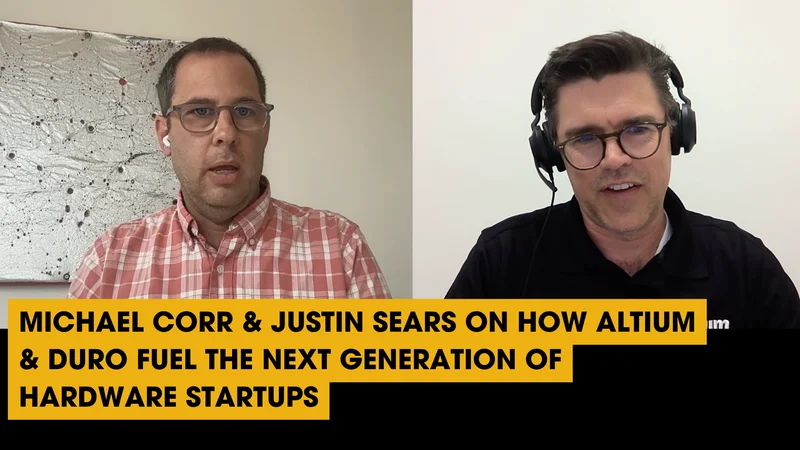
Michael Corr & Justin Sears on How Altium & Duro Fuel the Next Generation of Hardware Startups
In this episode, we speak with Michael Corr, co-founder and CEO of Duro, and Justin Sears, head of product marketing at Altium, about how connected cloud platforms are changing hardware development.

01 Oct, 2026. 44 minutes read
This article was first published on
the-next-byte-wevolver.simplecast.comTf In this episode, we speak with Michael Corr, co-founder and CEO of Duro, and Justin Sears, head of product marketing at Altium, about how connected cloud platforms are changing hardware development. Michael traces Duro’s path from an idea inspired by costly production data mistakes to a mid-market product lifecycle management platform, its response to COVID-era supply chain disruption, and its acquisition by Altium.
Justin explains how Altium Agile Teams connects electrical, mechanical, procurement, and manufacturing teams across the product lifecycle. They also explore the data foundation needed for useful engineering AI, Duro’s API-first rebuild, specialized agents for BOM analysis and part sourcing, and why small hardware teams may regain an edge as powerful development tools become more accessible.
<style>p.p1 {margin: 0.0px 0.0px 0.0px 0.0px; font: 14.0px 'Avenir Next'; color: #000000} p.p2 {margin: 0.0px 0.0px 0.0px 0.0px; font: 14.0px 'Avenir Next'; color: #000000; min-height: 19.0px}</style>
Daniel
Justin and Michael, thank you so much for joining us on the podcast today. Before we jump too much into the technical meat and potatoes of what we want to talk about today, it'd be helpful if the people on the listening side of this conversation get a thirty second to one minute explainer on who each of you are. So Michael, if you could go first and then Justin after would appreciate if you guys can give a quick bio and then we can get talking about all the awesome stuff you guys are working on.
Michael
Awesome. Yeah, thanks for having us. I'm really looking forward to this conversation. So I'm Michael Kore, co-founder and CEO of Duro. Actually started my career as an electrical engineer in the Bay Area. I used to work on lots of cool RF technology. That was my specialty. I used to build radios and telecom equipment. I worked on drones, e-bikes, wearables, you name it.
And you know, throughout my career, I did a lot of various products and production, both in the United States and and overseas in China, and found that, and this is early 2000s, a lot of the data management tools that were available for myself and and my peers in the mechanical and electrical engineering world were really antiquated and out of date for where I felt the industry should be and where it was going. At the time it was still very nascent with respect to hardware culture, but the software industry was just exploding, right? The whole agile movement, what eventually became the cloud. And I saw a lot of overlap and necessities that were the same that could be transferred to the the hardware industry. And it didn't seem like any of the major tool providers were actually paying attention.
And so I saw a big opening in the market where a hardware team's culture was shifting. It was less traditional, less on-prem, and becoming more of a cloud-based, software-centric hardware team. Younger engineers were understanding the principles of cloud, they under knew how to code. And there were no tools that were embracing those workflows for those best practices. And I saw kind of a a merging of these vectors of the technology was now available to even offer something like this where everything's very cloud-based, you know, API centric. And the demand was shifting, where a younger generation of hardware engineers understood those principles. And so that's what the the origin of Duro was.
Farbod
Awesome. Justin, next floor is yours.
Justin Sears
Yeah. well it's so good to be here. I'm Justin Sears. unlike Michael, I'm not an engineer, but I hang out with engineers for my career for the last 26 years. So I grew up in the Silicon Valley, always around software and technology, even as a kid. and I'm a marketer. I'm a product marketer who understands what technology does. Not as well maybe as an engineer like Michael, but I understand it well enough to communicate the benefits and the differences to business leaders so they will adopt this new crazy thing. In my career, I've primarily focused I've been at seven or eight venture-backed startups and also a few big companies. And I've really focused around big data analytics. I was at a company called Hortonworks, which was on the open source big data frontier, and then also workflow automation. I was actually at a SaaS company in 2000, the year 2000, before the term SaaS was even broadly used. We called an application service provider, ASP, and really fell in love with that concept then and it actually took me many more jobs to get back to a cloud-based workflow automation type solution like what Altium offers now. And currently at Altium, I run the go-to-market strategy for Altium Agile Teams, which is our mid market solution and very well aligned with Duro. and so Michael and I we're now part of the same company and we work very closely together to to talk to that same audience.
Michael
And just to add a some context to that, so Dura was acquired by Altium almost a year ago. And so it's been a great working with them, it's a great partnership, very good culture fit. And for me as an electrical engineer it kinda felt like a coming home. You know, I was I used Altium's products when I was, you know, building circuits and so it's it's a a room I'm very comfortable walking into.
Daniel
Fantastic. And Michael, thank you for closing the loop. You took the took the next question out of my mouth, which was, okay, so we've got these two companies. How how are we all in the same room? I think it would be helpful. Michael, you gave a little bit of background. Justin, you gave a little bit of background as well, but Michael, let's let's start kind of toward the beginning of Duro. you talked talked a bit about the inception of it. Would love to understand what the growth trajectory looked like, if any plans changed along the way.
What what does the arc look like from, you know, wow, we've got this awesome idea, let's let's make cloud based PLM type software available to people that are ready to use it. How did that arc end you guys up at Altium?
Michael
I don't know if we have enough time. I think like many founders, you know, where you start is not always where you end up. H hopefully it's in the same general direction, but you're gonna get bumped, you know, left and right definitely along the way. it's a great question. Just to kinda to summarize, you know, we started the the idea started coming together around twenty sixteen, twenty seventeen. And honestly there was a couple things. So first, you know, as I mentioned before, it's through my own using usage of existing products, I felt the pain. Like there's there was a gap. There definitely was something that wasn't working properly. No matter how much I would try and manage the existing tools, pr mistakes would still happen in production and almost always rooted in just user data management errors. The wrong part number was entered, the wrong version of a CAD file was was put into production. We all have those horror stories. And so I just felt that data management could be better.
In conjunction with that, I was noticing certainly around that era, you know, Kickstarter and Indiegogo was really pushing hardware products. And if many may remember, there was some quite a few very successful campaigns, you know, for for two guys in a garage building some cool product, but they would always fall flat when they went to production. Right. Many, many of those campaigns had to, you know, recant or give money back or something or other. And for me it was quite obvious. You know, prototyping and production are two very different things. And a lot of you know, newcomers into the industry, which I was very excited to see, a lot of you know new generation and and new blood coming in to the hardware market with some fantastic ideas. But I felt like that was a primary target market to help. There's lot of people with great ideas, but or the most part, you don't learn manufacturing in school. You only learn it on the job, right? I myself got punched in the face many times putting things into production and and just mistakes happening. I was like, well, here's a perfect opportunity to codify what I believe are industry best practices to help this market, this burgeoning market. And so when we first launched, that was actually what we were focused on was the two guys in the garage, the startup, a very opinionated software where intentionally you had very few configurable features, right? Because that too we felt that many products gave you too much flexibility. And a lot of administrators like, I don't even know how to set this up. You know, PLM, to be honest, I want to bet that the majority of our users don't even know what a PLM stands for, right? It's just this tool that people know they have to use, but they don't really understand it. And so let's simplify the problem. Let's put the bumper lanes on and like let's help startups get to production faster with less risk of mistakes. And so that's where we started. like many founders, you know, we learn your audience, you learn what actually works, what doesn't work. And what we found is two guys in a garage don't have money and they're not always willing to pay for something, right? Or it also became a medicine versus vitamin problem. You know, we're trying to sell them vitamins, say, hey, if you use duro, you're gonna avoid all these pains down the road. But a lot of them didn't believe us. They're like, no, no, no, like, look how successful our prototyping campaign was, we're not gonna have any problems in manufacturing, right? And so it's very hard to sell vitamins, it's very easy to sell medicine. So that too, we kind of had some headwinds in. And so eventually, certainly after we started raising some venture capital. And we had a fantastic board kind of helping you know really kind of steer the ship. Okay, what's the right place to land? It really was more in the mid-market. You know, companies that had been through production had the scars, they had the pain, so we could sell them medicine and not vitamins. They could understand, yeah, had had Duro, we would have avoided this problem, we would have saved all this money, or you know, what have you. And again, you know, being a founder, you have s you know sixty-five percent control of where your company comes from then thirty five percent is you're you're told where your company's gonna go or just outside circumstances. And so one of which was COVID. And so, you know, for those of you who remember, during COVID a lot of startups or early stage companies, you know, were pulling all their funding on what they would maybe consider superfluous software or other surfaces, right? They were preserved cash. And so we were expecting a lot of our customers to call us and cancel their subscriptions because they needed to preserve their cash. But what ended up actually happening was the opposite. So circumstantially, you know, Dura was always very bullish on merging the supply chain market with the design teams, right? There's a big gap for those of you who know.
Engineers will design something more for functionality, but not always for procurement or production. And then you have a separate stage, you know, depending on the size of your team, what's the same people or second people, who review that and say, I can't buy that, or I can't manufacture that to meet our cost or timeline, what have you. So you have to go back to the drawing board, right? And then you're making design changes for production or for manufacturability. And I felt that gap didn't need to be so wide. And so with fantastic software tools with parse distributors and custom manufacturers now having APIs, an engineer could post their designs automatically and get immediate feedback, right? Is this part available? Can we get DFM? What have you? So that was something we just coincidentally built into Duro to begin with. And so when COVID, when the supply chain industry just went haywire, we actually found a lot of customers gravitated to Duro because we had that visibility into what was going on. So our customers, you know when lead times went from a normal eight weeks to 60 weeks
They were able to see that immediately in Duro because of the digital threads we had with these suppliers and immediately adapt. And so that too kind of helped qu shape the course of Duro and we started leaning even more into the supply chain industry and bringing it closer to the design cycle. And then over time, you know, here in El Segundo, that market started to explode, the whole aerospace industry, right? A lot of former SpaceX and Apple employees started their own businesses. And those were definitely more progressive teams. Those engineers inherently understood software and they were looking for a more software stacked approach to building out their tech stack, something that could be plug and play. Digital threads was the theme at the time. And so that was a market we started working closely with. And that also kind of entrenched us in mid-market, but also a little bit towards the bottom end of enterprise. And so that's kind of where we ended up. And then because of the integrations we had with partners like Altium, tt became a no-brainer, right? Altium was trying to expand outside of just the ECAD community. They're trying to get more embedded with the more startup community, the more progressive companies. And so, from my perspective, you know, Justin can can check my math. We were a catalyst to help Altium kind of carry that trajectory, right? Transfer from a product company to a platform company, transfer from a more traditional desktop, you know, electrical engineering culture to a more progressive, cloud based, younger, you know, software driven hardware culture companies. And so Duro is helping Ultium kind of bridge into that market, expanding their total market share.
Farbod
Michael, when you were talking about the you know, being the medicine for these mid market folks that had the scars from production, how much of that production scarring do you think was due to like supply chain issues versus like your mechanical team not talking to your electrical team and the plastics are the wrong?
Michael
I'd say l it's all of the above. I mean I I I think you guys know the hardware market well. And it's the problem hasn't been solved, right? It's getting better and certainly more visibility. You know, one of the the quick a quick anecdote, one one of my favorite stories is when we started in twenty sixteen, twenty seventeen and we started to try and raise you know venture capital, I got so many no's, right? And so many reasons, the market's not big enough. And over a while you kind of build some thick skin, because okay, I get it, but you also start to laugh. Well, the phone you called me with to tell me the market's not big enough was built using software like mine. The clothes you're wearing, the car you drove, you know, the food you eat is all whether it's our PLM or another PLM like product, it was all built using a PLM product. Like so then I started to recognize, okay, I think the investor community just isn't aware enough, educated enough on what the real problems of the hardware industry are. And then COVID happened, right? And that exposed what those of us already knew, the supply chain industry was a house of cards. And now the general population knew that.
Right. And so now the venture capital started to become aware, there actually is a big market here. Right. And so then we started getting more funding and more interest from the the you know, the venture community. And that kind of helped open up the market, you know, for for Duro and for other partners, and I think just started to put The problems and the awareness of not just supply chain but hardware production as a whole, you know, the silo effect, the on you know on the prem, the everyone having disjointed you know data silos and miscommunication between electrical and mechanical engineers. I think the wider market, not just those of us who've been in the industry, started to understand that and appreciate that. And in a very exciting way, there are now dozens, if not scores, of startups you know, every month throwing their Had in the ring. And I can't tell you, you know, well, yes, some of them are starting to compete with Duro. As someone who's been working for 25 plus years, I can't tell you how excited I am of how much innovation is finally happening in the hardware industry, right? When I started and joined the workforce, you know, around the dot-com era, everyone wanted to do software, right? All young engineers wanted to be web developers and eventually mobile developers. Nobody wanted to do hardware. And so there was no reason for the tool providers to innovate. There was no demand for it. And so when I would start a job, it was like pick, you know, you pick one of three tools to use, and that was it. And nothing was changing for a good 20, 30 years. And now the level of innovation is just off the hook, and it's so exciting. And so I can't pinpoint it to a single event, but like that's the history that we saw of how we got to where we are today in exposing these problems you were just talking about, you know, the data silos across teams, miscommunication, the email threads, the wrong, you know, the the typos and the part numbers, the wrong versions. And so now people are starting to address those problems and hardware is definitely getting much easier to to build.
Farbod
Michael, that's such a great representation of what my experience was fresh out of college. I worked at this company. We did hard work completely in-house. You had electrical, mechanical. Electrical was doing stuff mechanical wasn't aware of Rev 2 having you know a different capacitor size than Rev 1, so it wasn't fitting in anymore. And then you have those folks kind of being done with their work, and now it needs to go to test. And by the way, test cannot access the PCB, so they can't see how the refs have changed. So like I felt a lot of that firsthand and it didn't start changing until I was just about to leave. And I I was mentioning this to Justin. We actually had Altium. So I started seeing my team evolve and how they were using Altium and using the cloud platform and the end-to-end and bringing in the mechanical engineers with the SolidWorks integration. So, Justin, bit of a two-part question for you. What led do you think at least to the evolution of Altium from just like the ECAD product to the platform? And then the second part. You know, what what made you guys look at Duro and like what what has Duro added to the equation and the offering?
Justin Sears
Great. So I'll take the first part. I was I've been at Altium now for a couple of years. And as I mentioned, my background was a hundred percent in software, zero percent in hardware. but I'd served a lot of hardware companies over the years, and so a little bit of background at Altium founded in Tasmania, Australia in the late nineteen eighties, and has been in many places since then, but they've been focused on that PCB design challenged for 30 some years. About five or six years ago now they rolled out the cloud collaboration component Altium 365, which is still part of our platform. It's just the name isn't quite as prominent. because like everything silos are dissolving and silos at an organization you just gave a great example for board electrical and mechanical engineers. They park together every day. They work side by side. And yet there's still this wall there of of information. And so with my background, you know, my first software job was at a cloud software company where there's everything was fluid and there weren't those boundaries weren't as strong. And so what what Altium is really doing is I think understanding
The opportunity that lies there. And you know, there's lots of cultural change that happen that needs to happen within our organization. I think that's one reason I was so excited for Duro to join Altium, because as Michael has been explaining, his company has grown up in that place that software and hardware are equal, equal partners. but just the way hardware development and prototyping and then moving to production works is it's much less of a waterfall and much more an agile scrum type process. And hardware should be able to take advantage of some of those disciplines in the same way that software has. Our senior leadership understands that and they've been investing i in this process now for five or six years. What I see now since I've joined is that we're picking up a lot of momentum with mechanical engineers, requirements managers, system architects, procurement people who before, without this platform approach, they might have been aware of Altium Designer, the PCB design tool, the licensed on-prem tool. but they didn't interact with it very much. And now what we have done with our platform approaches open the door to those other people that are interested in the outcome of the hardware development process but aren't blocked out because of the particular tool they use. If they use SOLIDWORKS for mechanical engineering or they use something else for requirements management, we can offer all of those capabilities in one platform. s and that really some of our customers who've been with us for decades on the Altium designer PCB only, they understand that. They get very excited about being able to do more on one platform. Did they answer your question?
Farbod
It did, yes. And to kind of build on it. We love hearing about customer success stories. I know Benchmark was one of the ones that you guys shared with us. I I don't want to spoil too much of it, but the headline that I'm hoping you can fill the rest of the gaps of the story with me is, you know, Benchmark is this company that does product development or product development support for other companies by design. They have a lot of variety that comes in in terms of like product criteria, product maturity. And then if you're working as a third party member. You know, you have to accommodate whatever CAD tools that that company's using or whatever development tools that company's using. And they praised how well Altium, you know, has been able to fill that gap for them. So I I love it if you could take us through through that story a little bit.
Justin Sears
Yeah, and and we like talking about bench benchmark electronics because and there's a great video on our Altium Customer Stories YouTube channel. So maybe we'll include the link there. benchmark telling their own story. but you can just look at the company on the surface and they're ideal for the Agile Teams collaborative platform that we've put together.
Why are they? They have three offices that are all developing products and they're in different time zones. So it's not everybody in the same room where you can lean over and say, Hey, Farbo, where should I put this pin? that happens across three different locations. And you can see this in the video I just referenced, they have every function within the company. So they in that video, you have the part purchaser, you have the manufacturing engineer on the shop floor, you have the mechanical engineer talking about how he never really talked with electrical engineers before this and now he can share files and collaborate. So they're not unique. They're like many other organizations that were now serving with this platform approach. but they got it because it was such a good and they were already using Altium Designer of course, but the kind of extension fit really well with With how their organization runs. And one, you can see it in one of the videos, but one really fun thing is their CEO, they were having a big company event, and their CEO tasked them to create a robot sort of as a challenge, and they used this platform-based approach to create this robot. And then and they had some crazy short amount of time before this high-profile product launch. I mean, maybe it was three weeks, four weeks.
But they came together, they scrummed on this platform, and that video ends with the CEO introducing the robot and it's rolling out on stage in front of the audience. And you can see all the people that were involved in that, like biting their knuckles and exhaling because it actually, they were actually able to launch something in that that short period of time. Now they show that to their customers who are, you know, third party companies that want to take advantage of that expertise, and they've shown that they they can do it.
Farbod
That's awesome. And we're definitely gonna link it in the show notes because it was a blast watching it. Very well produced. Michael, I have a question for you. You know, you you talked about how, you know, there's this difference between a vitamin and a medicine. It's a lot easier to sell medicine. Do you think, you know, this integration with Altium is helping you achieve more of the vitamin vibes and getting in earlier to especially the younger engineer crowd who's definitely willing to have more software in their stack?
Michael
Yeah, I definitely there's there's many things that certainly changed since we first started. I mean, first off it's just better awareness in the market, right? Now these problems that many of us knew before is are now more Issues and startups are aware of them. There's more stories out in the world of these things happening. There's more advisors. Again, there's more precedence. You know, hardware has become more visible in in the limelight and we're all learning from each other. So definitely there are more people who are aware of the potential problems they could be, you know, falling into. So that certainly helps with the the the vitamin problem.
But absolutely. Altium obviously is a household name, a very respected brand. And there's a little bit of of you know, you can just hear the customer just like relax, you know. okay, you guys are owned by Altium. Any any founder, of course, you know, they're gonna have very, you know, astute customers who are going to say, hey, what's your company's stability, what's your longevity? Like, I love your product, I love your vision, but are you funded enough for us to invest in you? We don't wanna put all our, you know, IP and and set up our a whole workforce on your product if you guys are gonna disappear because of you know funding or this or that. Which is a reasonable question and I get it, you know, every once in a while and a customer CEO would ask to speak to me directly and look me in the eye and me tell them that yes, we're well capitalized and we're not going away. which I actually you know respected. You know, like that means they're doing a good job, right? They're taking this seriously. And so obviously with Altium now our our parent, you know, that just goes away, right? So now people can relax and say, okay, let's roll up our sleeves, you know, let's really solve the problem. How can we get DRO into our team? What's the best way? Which package do we need? Obviously, now we can do package deals with other Altium products. You know, our product has had a connector and integration with Altium for a long time, which is kind of what the I think the origination of the eventual acquisition was.
But we're getting more and more entrenched with their A365 platform, you know, the agile teams that Justin leads. and so it'll even be more seamless experience for customers. And so it's makes it easier obviously for us to be able to get, you know, to to sell to our customers.
Daniel
I think Michael, wanna harp a little bit more on the Duro platform and kind of the the technical roadmap you guys have had. You got you posted something just over a month ago, and I thought it was really interesting around how in a world where everyone's talking about using AI as a co-pilot for you in engineering software and engineering tools, having good context and having good connectures, connectors rather, for AI agents to be able to pull the levers with you and for you, that that means a whole lot more than even how capable the AI agent is or how capable your platform is. It's how how connected you can be and being API forward in development. For Bode and I are smiling when we say this because in our day jobs that's something that's like a big principle for the way that we're developing the startup we're working on. But could you share a little bit more about that position and the ch change that you guys underwent and then what that unlocks for the future of using Duro as an engineering software in the world of AI.
Michael
Yeah. Thank you. Yeah, it's actually I'm glad you brought that up. we've always believed in, you know, the term wasn't used at the time we started, but digital thread. you know, kinda as far both mentioned, like you ha like hardware is more unique, not alone, in the fact that it's multiple discipline teams, electrical engineering, mechanical engineering, procurement, what have you, that all have their own jobs to do. they have their own tools, they have their own vernacular. Many cases they're even in other countries, different languages. And so it's always been a struggle to get all their data to come together, right? To build the final product. And so huge, huge markets of custom integrations and plugins and all this kind of stuff to try and get the data into one place. Duro's always believed that's where we should focus is how do we make that digital thread simple? How do we have a plug and play connections to our CAD product P ERP requirements management, what have you. and so that's something we've we started with from the beginning, but and admittedly we did an okay job with in their first platform when we launched until 2018. Our API was available to our customers, but it wasn't as mature as it could be. We weren't admittedly practicing what we preached as religiously as we could.
Michael
And then about two years ago or so, you know, we were at a good inflection point, AI was becoming extremely more commoditized and prevalent and more obvious. You know, there was a period where it wasn't quite sure it was coming, but not sure how it was gonna fit. And that was very obvious. And so this is like 2023, 2024. And on top of that, just general SaaS application development tools and best practices has evolved quite a bit since we started. And so the bones of what Duro had built in the first instantiation were good but not bleeding edge what it could be. And if we're trying to promote like bleeding edge capabilities, we kind of had to look ourselves in in the in the eye and say in the mirror and say, do we want to continue on this legacy platform or not? And so we took a you know pretty hard stance. We said no, let's let's do a major you know step function into modernizing our platform. And let's actually lean into what we really believe in, which is an API-first approach. And so we there is there's literally no feature in the product that isn't available in our publicly facing API. We eat our own dog food. Like you could build your own web client. You can say, I don't like Doros, you know, UX, I'm gonna build my own on top of their API and be able to build exactly what we're building. And so that was just our core principles, because again, it was more around the theme of how do we promote and simplify the digital thread so that you can break down these data silos that are inherent in our industry. It's very serendipitous that AI became so prominent and needs those digital threads, right? AI can only obviously process data it has access to. And so when you have a a siloed, you know, a walled repository of information, you can only do so much with it. And so by promoting these APIs and these connectors that either we build or our customers build, it basically unleashes AI to do more. And one of the things, again, it just compounds, the benefits just continue to compound. One of the things that you know we were willing to spend effort on, but was difficult was again, as I said, each of these different silos, the mechanical engineering, electrical engineering, the different products.
Different data models, different APIs. And so we had to build these bespoke connectors for every single plugin that we wanted to support and transpose the data from the sourcing model, the sources model to Dura's model before we could do any kind of processing of it. With AI, that transposition goes away. Because AI is very good at saying, you don't need to transpose this for me, I'll just I'll just look at its native format. I can do the transposing for you, right? And so we can just again point it to a mechanical engineering repository and point it to Dura's repository and it can do the merging itself, right? And then say start start then start to create content and insight and say and reporting, hey, this is going to interfere or this you should change this or what have you. We didn't have to build the plugin for it to then you know normalize the data for it to to to provide value. And so that's was the you know the backbone of that comment that post I made, I remember making that because I was just seeing a series of posts of people just saying how powerful the AI is. I'm like, but you're forgetting the foundation. Like AI will ultimately reach a limit if it can't access more data. And how do we access more data? Well, we need plugins and in connectors to be built. How do you proliferate those? Well, you need to make sure you have a very simple and rich and mature API across these products, right? And the last comment on top of that is, you know, giving credit to our engineering team.
They not just made the API, you know, mature and easy to use, but they were conscious in how we documented it and made it very agent-friendly. And so agents can read our API documentation and very quickly understand how to use it and build more reliable integrations the first time versus hallucinations or going down the wrong rabbit hole or building something that isn't quite right. And so we've had many of our partners give us quite a few compliments and accolades of of how quickly with their respective AI agent build a connector because of the documentation's maturity.
Daniel
That took, I'm sure, lots of late nights, lots of guts to say, Hey, you know, we feel like we're optimizing inside this local maxima. Let's introduce a ton of chaos. Let's take a huge risk and try and break through to the to the absolute maximum of what the product can be. Michael, I'm sure there were like scary moments along the way. You're like, my gosh, did we make the wrong decision? Was there any like customer impact, customer stories where at the end of this you had a lot of conviction to say like; Holy cow, this is a breakthrough; we did this the right way. Like, what did that translate to in the real world for our listeners who probably don't use Duro, but they might be impacted by Duro's customers? What what did this change on your guys' side impact from a customer story perspective?
Michael
I mean first and foremost, we we can't say enough how grateful we are for the customers who who were patient with us as we did this journey from you know we internally referred to our V one to V two platforms. you know, customers again, you know, we got many accolades for how simple and intuitive our platform was. That was what we're trying to bring to the industry, like trying to remove that complexity. But when they saw the prototypes of the new platform and the extensibility, and it basically gave us an opportunity to build in natively the things that we were trying to bolt on, all the new features that they were asking for, and how much more efficient it was, how much more, you know, or orchestrated it was, and and the holistic simplicity of it, all of them said, We get it, you know, we're in. And so, you know, as we transform to the new platform, obviously we work with them very closely to making sure that there was continuity. many of them immediately recognize, hey, this is a feature I've been asking for for a long time. It's here now natively in the new platform, right? Like Annie, look, that this isn't a new concept. The second time you do something, you're always gonna take absorb the lessons you learned from the first time and do it better the next time, right? We're still making mistakes, but I think we're making different mistakes and fewer mistakes, and we're definitely took the voice of the customer from everything we learned in the first six years or so of our journey into the new platform and wi along with the things that we wanted to do you know better like the API first approach. And so again the what what we get the best feedback on is you know the simplicity, the configurability, and the API.
And especially the administration of the products, right? I won't name the company, but I was giving a demo to a a very large hardware company that's a well-known company, currently on a competitor's product, and when he saw the way that Duro chose to implement the account settings, the library configurations to set up your part numbers, your change orders, your templates, what have you. He basically turned to me, he says, I have thirty IT admin to administer our tech stock here at my company. I can fire twenty five of them tomorrow if we switch to Durham. Right. And that was like one of the best r you know compliments I I had received from a customer because that's exactly what we're trying to do is we're trying to stop the silliness of how complex a lot of these legacy products are. They're unnecessarily complex, right? They have decades of just I call it the Mr. Potato Head. Just you're bolting on feature after feature after feature, and now you've got this really ugly thing. Yes, it has two arms and two legs and a hat and eyes and nose.
But it's not recognizable as a person, you know. And so Duro, we've always strived on UX, UI, making sure it's intuitive. You know, we feel that if a product requires a, you know, a professional services team to configure your product to train you, there's something wrong with your products, right? The product should be intuitive. You should be able to self on board. And so those are the things that we get the most praise from on our new platform.
Daniel
No, I I love it and appreciate that there are customers you can't mention. There are also ones you can. I love looking at the success stories on the website.
Justin Sears
Well, I was gonna I was gonna jump in, Daniel, 'cause there's a there's a fun customer named Proper Voltage and we shot a customer video. We can include the link and and the recap too. the Altium side, we shot a customer video and then it was I think they recorded earlier this year. And then we found out subsequently that they're also duro customers. So that that that points to the but maybe I don't know, Michael, if you have those any story of that customer top of mind because it was fun, you know, we joined together because we know we cover the same space and then this was living proof that there's one customer that chose Altium and then they separately chose Duro and we're now in the same account.
Michael
Yeah. Well it goes for it, like we're we're both you know, really trying to respect and approach this evolving culture of hardware startups. You know. It's as I alluded to earlier, I feel the hardware market was pretty dormant for a long time. Not a lot of certainly young and fast paced innovative companies, you know, some fantastic products on the consumer side, but I think there are a couple of catalysts that really inspired young, technically competent, you know, people who took the instead of historically would take the path of software, took the path of hardware. And I think what's happening is w the attraction is is that now merger of the software and hardware, that wall is now been removed, right? There are hardware engineers who are just as competent software skills and there's software engineers who have great competency and hardware skills. And so there's more sympathy and empathy of how you build a full product these days when you have an understanding of how the different disciplines need to come together. And so I think it's just very exciting to be working with this market.
Right. We get inspired by it. They're always challenging us, asking us for new features. As I said earlier, there's new startups that are offering, you know, tools like Duro joining the market every day. I can't keep up anymore. in in a good way. And so a customer will say, Hey, we just, you know, procured this product, you guys do an integration with them. I was like, that looks cool. Let me look at it, right? Maybe it's a procurement tool or another, you know, operations tool or what have you. and it's just inspiring.
Right, to see the level of innovation that's happening right now. And and again what's what helped r kind of gave us the the confidence that Ultium was, you know, the right suitor to go with, you know, 'cause we had the same vision and the same understanding of where the market can go and and is going.
Daniel
Another quick shout to a sneaky surprise customer of yours that I found out when I looked at the customer stories on the website is fellow El Segundo vase startup in Astraforge.
My friend Matt Gialish is the CEO. I had the awesome opportunity to to visit their factory a couple weeks ago, and it's incredible the progress they've made. And then you look at like for people who don't know. They're basically their their mission is asteroid mining. And that's something that it feels so far out and so far from our current our our current present state, but they're actively pushing to make that a part of our future. And so to have someone that has something that's like that ambitious of a mission and say, you know, Duro's the platform that we choose to help us move as fast as we can and go from nothing to raising what forty million dollars and making our first vehicle in under twelve months, like that's a stronger endorsement than you could ever mention of like how awesome and effective the platform is at helping them move quickly.
Michael
Yeah, though those guys definitely moved fast. I knew Jose, the other co founder, and visited them when they first started on the east side of LA in Pasadena. And then when they opened up that that new space in El Segundo went to visit them there too. yeah, I mean it felt like it was something out of, you know, Hollywood movie, right? Like we have to go mine these things that are flying at however many thousands of miles per hour in space and you know, get their resources up. I when he first told me about that I thought he was kidding. Like, no, this is actually happening, right? And it was like actually, when I understood the problem more, I was like, that's something I never would have conceived of, right? And again, the level of innovation that's happening right now is just very inspiring.
Daniel
Yeah, it's wild. Justin, I'm gonna ping pong to you because the API discussion got me thinking about it and how making platforms more amenable for the AI future and engineering, thinking about the future where and it's and it's hard to ignore when we've got, you know, increasing levels of intelligence, decreasing cost of computation, how does this help us move faster and better? What's the future of Altium, the whole product portfolio side look like when we think about the future of engineering something when you've got AI in your back pocket?
Justin Sears
Well, it starts with the I'm gonna put on my big data hat and it starts with the data and Michael alluded to it with a cloud platform we have a lot of signal on how people are designing things. And so the question becomes number one, how do you use that signal to provide a better service to all of our customers so they don't make the same errors that others might make? How can you enrich their process so they can do better design. but it's also about finishing this build out that we're doing laterally. And so Michael's company was one acquisition, Alt Team has acquired other companies, and we're in a really exciting process internally now of synthesizing the technology that that some of these companies we recently acquired do to provide that end-to-end full cycle platform, really f going from initial concept, the asteroid mining company that has a crazy idea to getting something into production and then sustaining it to the PLM side, like over time. And we have another company they acquired that that specializes on optimizing a production level bomb. So like when you're buying millions of parts for something that's in full production, turns out a one or two percent improvement on on cost there goes a long way. And so because we have this vision of being one platform where multidisciplinary teams can come together and work to work better, faster together to create create hardware, we're looking at where we're still a little weak in that end-to-end lifecycle. And do we build it or do we buy company? like Duro that has already been spending years solving that challenge. And that for me is the kind of I come from a a platform approach where people invest in the company because of the vision and because of what's gonna happen next, just as much as what we can offer right now in August of twenty twenty six.
Farbod
So Justin, speaking of that vision, and Michael just goes to you too, what can you guys tell us about what's coming down the pipeline? You know, you you are now more tightly integrated than ever. What can you share with us about what the next quarter, what the next year can hold?
Michael
Yeah, I know I can take it first. I mean I can tell you some things that we're working on now. You know, first and foremost is, you know, obviously continue to to lean into the API first approach. and, you know, again, that theme of we want the experience to be as out of the box as possible. and so where we can provide plugins, you know, we'll do that just to take the workload off of our customers' hands. But again, if they wanted to build their own, they can use our API to do so.
But now with agents, you know, whether it's Claude or ChatGBT or your your favorite provider. It's becoming more and more simple to build these plugins and to build these integrations. And so we're trying to kind of stoke that marketplace, so to speak, so that people can build these and it's more of just a quick, just a checking the box type of thing. They can move on to go do their work. And then from there, and so we're starting to, you know, again through the API and through our own plugin offerings and the community development, but also providing agents, you know, we're starting to play with agents in the platform. To assist customers because maybe they're not even sure where to start. And so within our own platform, you'd be able to use our interface, our model, and say, hey, I want to, I just purchased this CAD product or this ERP product. I don't see a plugin for it. Can you help me build one for Daryl? Right? And so right there, and then hopefully within a couple of minutes, you've got a basic plugin, you can be off and running.
Furthermore, you know, one of the things that agents, you know, AI is is very good, in my opinion, at doing really two things, you know, creating content or analyzing existing content. And those are kind of, in my opinion, and oversimplifying it, where almost all usage of AI is falling into. And the quality of both, I think, varies across the topic at hand or the market. But I'd say there are some fantastic, you know, innovations in progress in the creation side using I for CAD, you know, for electronic circuits or for mechanical components and what have you. you know, text to CAD is kind of a new theme here. That's getting better, but I still think in my opinion has some ways to go. But what is mature is the analysis of information.
And so how do I analyze analyze what's already been built or or proposed to be built, right? How do I analyze the built materials? How do I compare it, you know, against different resources, not just within itself, you know, which in historically you'd have a whole team of people that'd be doing it. One person would look in a bomb and say, okay, yes, all these parts I can buy, or I can't buy them. Another person would look at it for manufacturability. Like, I don't care if it's cheap, I can't manufacture this. I have to go buy a piece of different equipment or have you. And so I feel that. Those skills historically you had to either hire or outsource and were often difficult to get. Or you know, some we all had this experience where you could get bad advice or good advice, and you're not quite sure how to trust someone's you know opinion on this. And so now we're working with what if you brought that into the platform and you had your own specialized agents, you know, in Duro. And so now a smaller team.
Can augment themselves with skilled agents. So instead of hiring a procurement specialist, we can build a procurement specialized agent that can review their bomb or the proposed changes for them. Right? So these are the things that I think you know are definitely the next wave across Duro and many other products. But I think people have learned that the generalized AI agent or prompts is good but not great and they're gravitating to the the swarm of specialized agents, skilled agents, right? That you can train up on a special specific, you know, topic. that is something that we're exploring and I think is also we're gonna see a proliferation of in the wider market. And I'm really excited to see that.
Justin Sears
And for what I'll I'll piggyback on what Michael has said and I'm very excited about the the supply chain capabilities that we already have, and those are we're continuing to develop those. As we know, with all the global conflict and tariffs and things like that, you can design the best thing in the world, but if you can't get the parts at the cost you need to put it all together, it doesn't mean much. And so that for me and I've in other earlier jobs I've been more directly involved in like a service for supply chain. So I understand the the space pretty well and I've been learning about the electronic particulars around supply chain. but that's where when you think about all the change that's happening and the data platform that Altium has, our ability to provide alternative part suggestions to help companies, whether they're early stage startups or massive global companies, you need to get parts to build the thing you're supposed to build. And and those part decisions are directly related to what a PCB designer does, directly related to what the person who's responsible for man for building the satellite or the car or the drone or whatever the end product is the product manager or the system architect needs that awareness and right now in the way most people do things it's asynchronous so an early design happens you s it gets handed over to the procurement person who identifies the chips or the pieces or that they might need.
And there's a lag there. So then they go back with a costed bomb and the designer says, those choices aren't gonna work, or they test it and parts of the board are too hot. So there's this back and forth that look, I've never been directly involved in it, and mo most of us just benefit from the end result. But providing that visibility into what's happen that team in office in El Segundo, providing that day to day and and minute to minute visibility into how the marketplace is changing changing for the chips they need. I think that's I mean I know that's gonna be transformational. I just don't think people understand how having that data accurate and quickly will give more options. Like you can create better stuff if you if you have more choices that you can make. And if you're not personally responsible for going through all those choices individually and running the calculations, if there's a system that can do some of that thinking for you, I think it's gonna transform how people design things.
Farbod
Couldn't agree more with you, Justin. This just gave me flashbacks to like Michael was saying, during COVID, we got hit pretty hard finding crosses and then waiting like a week to figure out if they're actually good or not. And then rinse and repeat, rinse and repeat while you're like already missing your deadlines.
Justin Sears
And were you on some portal hitting refresh, trying to yeah, like hours a day, I'm guessing? Well I've heard the story so many times, yeah.
Daniel
Yeah, for about I got a I had a story not even that long ago, not even during COVID. Do you remember this? I was telling you I I was buying every single component I could find, even in small roles on Mouser, on Digikey, and picking up orders of like ten to twenty-five of certain components for us to be able to put together our production schedule. I
Justin Sears
You were hoarding, right?
The Next Byte
yeah, we've been down that so I think anyone who's worked in specifically electronics probably has felt this more than anyone else in the world. Anyone who's worked in electronics in the post-COVID supply chain reality understands exactly what you guys are talking.
Michael
Trust me. I I used to 'cause I actually lived in Hong Kong and worked in China for a bit. I'd I'd get tipped off that some guy had a reel in the back of his warehouse, you know, in the in the in the throes of China, up in the hills and I get on like a a bus and go find it, you know. 'Cause I needed that one reel. I I needed like ten pieces. It was that was all I needed or something, but only one guy had a reel in the whole world.
Daniel
Well, crazy stories, crazy things. Speaking of other crazy stuff, and it's a question we ask everyone who comes on the podcast. So I hope you guys have had an opportunity to prepare. we love to talk about your hot takes. So things that you say and you believe, it's your personal opinion, right? It's not that of your employers, but your personal opinion around where you think the ball is headed. In terms of the technology, in terms of the field you work in. It works specifically well and I think it resonates specifically well with people listening to this. If it's something that there's a broad misconception or general misconception around where things are headed, you think the public generally disagrees with you and you're an expert in your field. Michael, Justin would like to hear from both of you on kind of what your hot takes are as it relates to the tech you guys are working on.
Justin Sears
Yeah, for me, I mean, it actually parallel parallels my career. I've worked for Fortune One Hundred companies and I worked for a lot of early stage startups with less than a hundred people. I think the what I'd say the pendulum is shifting again for a lot of the technological reasons that we discussed in this conversation towards the garage startup. So if you if you think about like what jobs and Wozniak did in their garage back in the day, they had to have a lot of luck and endless patience and they just had to hang in there. a lot of the things that they had to wait out now are instantaneous. So I think if you're a larger organization who's been thinking about protecting your existing IP, I think that's a recipe for death because there there are ten to a hundred companies that are learning how to do things faster and and quicker. And so it used to. There used to be a feeling of protection for the very large organizations. I think and software kind of got there first because you could move faster with software, but I think that's gonna be hardware next. Like there the advantage goes to the small, fast moving innovator. And Michael and I were at a a dinner together in San Francisco right after a a big hardware event and a lot of robotics people there talking about it.
And you could go around the room and just the amount of innovation at companies with less than twenty people in that room and the things that they were telling us they were creating that were just pipe dreams five years ago. I don't know if you're a if you're a large industry incumbent how you kind of defend against that, but it's set it's certainly coming. and it's gonna be in it's gonna be for consumers or users of hardware, I think it the events or the the outcomes are gonna be good. but protecting some existing kind of market position, the only way you can do that is to innovate faster, in my opinion. I don't know, what do you think, Michael?
Michael
I do agree. I I like your point. I think, you know, the Davids are getting more competitive with the Goliaths because of the technology and and more formidable, you know, as well and to be taken seriously. A lot of these things that took a lot of resources, you know, financially or just the infrastructure are being commoditized and accessible. the the take I have on what I think is is to answer your question, you know, David, is a new topic that's come up and and we come across this question ourselves is, you know, the make or buy.
And you know, with Claude, it's like, well, you know, why should I buy that software? I can just build my own, right? And so, you know, in the past, you know, we've had objections of you know, why the customers say, Why should I buy your software? I could just continue to use Excel, you know, w and an an alternative, not necessarily a competitive PLM, but like why why can't why isn't the directory structure, the Excel sheet I'm using work, right? It's free, it's flexible, what have you. And we had, you know, counter arguments to that and you know the the trade-offs for that. But the new objection we're starting to to wrangle with is is that customer being like, well, why don't I just use Claude to make my own PLM? And so which to be honest, I was taken back, I was like, they're not wrong. I'm doing the same thing. Why am I buying this other software? I'm just gonna build it myself in Cloud, right? I've you know, I got a couple extra hours in the day. but the more I've been thinking about it, it's it's not that you can't build it. But there's just like anything in AI, you still need the right prompts. You still need to have the background. You still need to have the industry experience. You still need to have the battle scars of how to build that product, right? Yes, absolutely. You can probably vibe code or even, you know, professionally code a PLM system and get something very basic working and solve some of your initial problems. I don't dispute that. Again, we do that all the time ourselves. But you're never gonna build a full board PLM system.
Right. And you're never gonna have the time or resources to maintain it. It takes management, right? As your team needs to evolve things, or as you come to the crossroads of the hard problems with like the the the the the problems that no one wants to solve, like data management, user role management, you know, change order revision policies, like the the underlying boring but important engines, you know. Nobody I presumably at this c the company, the customer was hired to do this, they were hired to build whatever product the company builds. And so I can't imagine that anything they would vibe code or or take or try and build on their own would have any legs to it. And so that I think a lot of people like myself have to again look yourself in the mirror and say, do I really want to take on this task? Do I really have enough industry experience to build my own XYZ product?
Absolutely. It's fun these days to build stuff in Claude, like just to have an idea and then it comes to you know fruition in minutes. That joy is, you know, is is priceless. But once that joy ends and now you have to maintain it or you have to build the dirty stuff or may you know, or you have your teammates who say, Hey, can you add this feature? You're like, Well well damn, I I didn't want this responsibility anymore, right? This is not something I want to do, nor was I hired to do. And so that I think there has been a proliferation of, you know, competitors entering the market, right? The whole thing, you know, where Claude would launch some new model and some other SaaS company's stock would tank, you 60%. But I think now the reality is coming, you know, into fruition where people are like, well, wait a minute, you know, yes, we could build something quickly, but it is pretty fragile. There's really no meat behind it. And so I think the market's gonna push back and you know, people or innovators are gonna say, they're gonna rethink what they're gonna build in claw versus what they're gonna say, no, we should probably just buy this. And I think that point 'cause it's it's really easy to say, like, hey, we've got this tool that makes it pretty much near free for us to develop something new. It's not near free to maintain it. And also if you've got someone else whose entire existence it is, to use these tools to help them develop PLM software that's awesome and amazing, I should be looking at
How your organization is gonna move much faster to deliver a better product for me rather than thinking how fast can I build my own complex product and try and maintain it myself later?
And Daniel, I'll tell you a specific story. So that first SaaS company I worked at between 2000 and 2003, it was a workflow automation platform. And we say we can automate any workflow. And that was the problem. We did not have domain expertise or context to figure out how to make any one of those workflows really right for a particular customer. So we jumped between healthcare claims correction, banking fraud, customer support, tech customer tech support and we were looking, but we never got deep enough in knowing what that audience needed to do. Now I flip that on its head with Altium. We've been serving electronic development people for 40 years and that context is within the organization. So that it's not a general purpose LLM like Claude. We have the context in-house and so we can better serve that audience for the last mile that you know the things that you can't understand generally that you need to understand specifically and through experience. I think we're in a great place. And that's why I'm so excited to see what how what we can help the designers and developers do in hardware. Because and again, trust me, it's not me. I just know who to talk to in our organization that's been doing this for 20 years. That knowledge can be amplified quite a bit by these new capabilities. And it's it's really, I'm not gonna say impossible, but it's hard to imitate. And if someone's imitating us too hard, you you're gonna look at it and say, well why why'd you why are you doing that versus something else that you might be doing with your time? It's kind of that the the most valuable use of that extra hour is probably what determines how deep people go developing these capabilities from general to more specific.
Daniel
Love it. Thanks, guys, for sharing that. Farbod, anything else we need to hit before we start to wrap up?
Farbod
No, I think that's all. the only thing I would ask as we're wrapping up, Michael and Justin, we've already discussed a couple of links that we're gonna include in the show notes for the case studies. But if there's other ways where people can reach you, you know, LinkedIn, Twitter, whatever, please let us know and we'll make sure that's added to the show notes as well.
Michael
Yep. You can always go to our website, getduro.com, or you can hit me up on LinkedIn.
Justin Sears
And and I'll say alt team dot com and a a lot of my stories today were about agile teams, so you can go to the solution page there. And we are moving much more towards a product led growth approach. So rather than saying trust us, design is better when you do it as a team, there's a thirty day free trial. So I would I would and I'll make sure you guys get the link. So try Agile Teams, bring those other people along with you, the procurement people, the mechanical people, get together as a team and so see how easy it is to work together.
Daniel
Awesome. Thank you, guys, for joining us. It's been an awesome conversation, and I look forward to seeing how the audience receives it.
Key takeaways:
- Disconnected files, handoffs, and data silos between engineering and operations create avoidable production errors and delays.
- A digital thread brings design, sourcing, manufacturability, and production data into one connected workflow so teams can respond earlier.
- Duro rebuilt its platform around a public API that exposes every product feature, making custom integrations and agent-driven workflows easier to build.
- Useful engineering AI depends on access to connected data and domain knowledge. Specialized agents may be most valuable for tasks such as BOM analysis, procurement, and part selection.
- Altium and Duro are combining PCB design, multidisciplinary collaboration, PLM, and supply chain visibility across the hardware lifecycle.
- Smaller hardware startups can now move faster with modern tools, but building and maintaining their own production-grade software still requires deep expertise and ongoing resources.
Episode Notes
(00:00) The Evolution of Hardware Development
(00:54) Breaking Down Silos in Hardware Teams
(01:08) Introducing Michael Corr and Justin Sears
(03:31) The Origin and Growth of Duro
(06:11) Duro’s Move into the Mid-Market
(11:06) Supply Chain Challenges During COVID
(12:23) Expansion into Aerospace and the Altium Integration
(17:17) Why Data Silos and the Digital Thread Matter
(24:02) Benchmark Electronics and Multidisciplinary Collaboration
(25:24) How Altium Supports Duro’s Growth
(28:44) The API-First Approach and the Future of Engineering AI
(34:31) Customer Stories and Platform Impact
(41:27) Asteroid Mining and Space Technology
(46:02) The Product Roadmap and Specialized AI Agents
(01:01:35) The Rise of Small, Fast-Moving Hardware Startups
This episode was brought to you by Altium. Altium Agile Teams connects design, procurement, and manufacturing teams in one collaborative platform. Watch the Benchmark Electronics case study mentioned in the episode to see how Benchmark uses the platform to collaborate across disciplines and locations.
Learn more about Duro and its cloud-based product lifecycle management platform.