Virtual Worlds Teach AI To Think Like a Physicist
CMU Researchers Train AI To Learn From Simulations

06 May, 2026. 3 minutes read
This article was first published on
www.ri.cmu.eduResearchers in the Carnegie Mellon University School of Computer Science are rethinking how artificial intelligence learns about the physical world, with implications for everything from robotics to scientific discoveries.
Their new project, Sim2Reason, explores a training approach that immerses AI systems in physics-based environments where they can learn through observation and interaction. Rather than relying solely on human-written explanations and static data, Sim2Reason places large language models inside virtual worlds governed by the laws of physics.
“For a long time, AI has learned science by reading what humans have already written,” said Deepak Pathak, the Raj Reddy assistant professor in CMU’s Robotics Institute. “With Sim2Reason, we’re taking a different approach — letting models learn directly from the laws of nature through simulation. Instead of memorizing solutions, they learn by observing how the world evolves, much like scientists do.”
By grounding AI in physical experience, this approach could help robots improve their ability to understand the physical world. It could also accelerate scientific discovery by enabling AI systems to generate and test hypotheses in simulated settings, uncovering patterns and insights that would be difficult for humans to explore alone. Early results show that models trained this way can solve complex physics problems, including those from the International Physics Olympiad, a rigorous global competition for high school students that features challenging theoretical and experimental physics problems.
Sim2Reason allows AI models to learn through simulated experimentation. Within these environments, objects collide, roll, oscillate and respond to forces to generate continuous streams of data. From these interactions, the system constructs its own reasoning challenges and learns to solve them, gradually building an internal model of how the physical world works. Because real-world physical data can be difficult, expensive or unsafe to collect at scale, this approach offers a way to generate unlimited, high-quality training data directly from simulation.
In doing so, the system moves AI closer to how science itself progresses: not by memorizing answers, but by discovering the laws that generate them.
The CMU team’s approach marks a departure from how many advanced language models are trained. Traditionally, these systems rely on a vault of human-written text, absorbing knowledge that has already been interpreted and distilled. Sim2Reason shifts learning toward direct observation, enabling models to form implicit hypotheses and reason about underlying laws based on what they “see” unfold in the simulations.
At the core of the project is a simple idea: physics simulators already encode the rules of nature, so they can and should serve as powerful teaching tools.
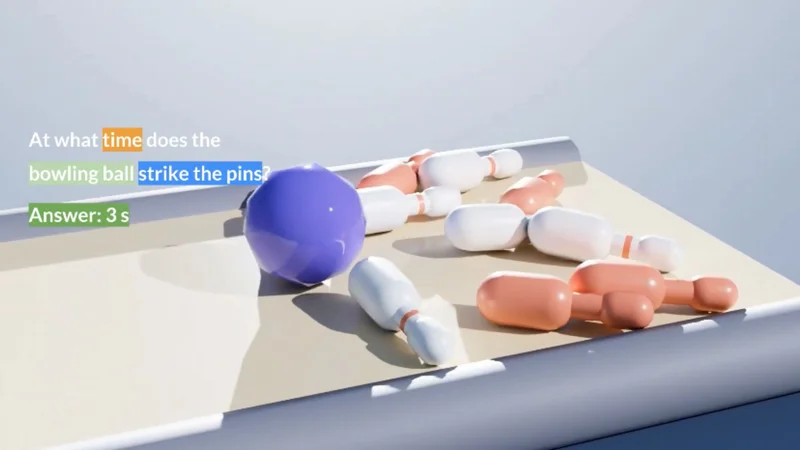
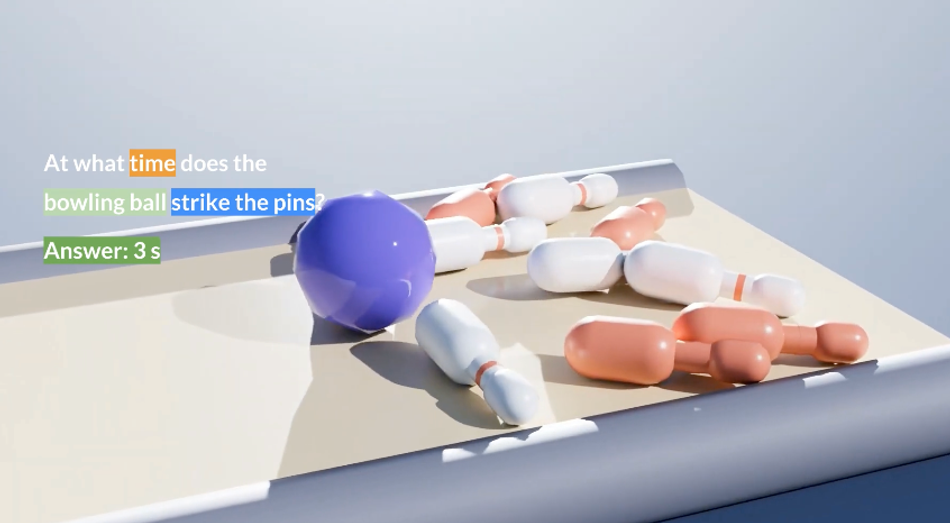
Sim2Reason constructs virtual scenarios such as blocks sliding down inclines, pulleys in motion or objects colliding, then simulates their dynamics over time. As the system records variables like force, velocity and momentum, it also generates questions about these scenes, such as when an object will hit the ground, how momentum evolves after a set period or what mass would produce a given trajectory. Because the simulator governs the environment, it also provides the correct answers, effectively transforming itself into a self-generating teacher capable of producing an unlimited supply of physically grounded problems.
To learn from this data, the researchers trained language models to solve progressively more complex problems. Over time, the models learned to follow chains of physical interactions, estimate properties like mass or force, and then apply what they’d learned to new situations.
The work points toward a broader shift in how AI systems may be trained. Instead of relying solely on human-generated knowledge, future systems may learn by observing, experimenting and reasoning about the world.
Along with Pathak, the Sim2Reason research team included RI Ph.D. student Mihir Prabhudesai; RI master’s student Aryan Satpathy; Yangmin Li, a CMU graduate now at Nvidia; Zheyang Qin, a CMU graduate now at SkildAI; SCS undergraduate Nikash Bhardwaj; Amir Zadeh, a CMU graduate now at Lambda; Chuan Li, chief science officer at Lambda; and Katerina Fragkiadaki, the JPMorgan Chase Associate Professor of Computer Science in CMU’s Machine Learning Department.