The Satellite IoT Sanity Check
NTN modems are "ready for production." But is it, really? And at what cost?

21 May, 2026. 5 minutes read
The Satellite IoT Sanity Check
This article was first published on
iotstars.comIn mid-April 2026, Nordic Semiconductor released the v1.0.0 NTN modem firmware for their latest chipset, the nRF9151. A "1.0" tag is supposed to mean “ready for production”. But is it, really? And at what cost?
Let's put the latest NTN developments to the test and find out if the standard is actually ready for production.
Non-Terrestrial Networks Explained
Non-Terrestrial Networks (NTN) are the 3GPP's response to a continuous demand for connecting the largest part of the planet that no cell tower will ever reach. It opens up a long list of use cases: connecting large farmlands, monitoring energy infrastructure, tracking global logistics, overseeing mining equipment, just to name a few. The standard, defined by the 3GPP in Release 17 (frozen in June 2022), extends existing cellular protocols (LTE-M and NB-IoT) to work over satellites.
The promise is that none of this requires significant changes to the IoT devices. The same modem should support both terrestrial and non-terrestrial networks. The same antenna should work, to some extend. And more and more connectivity providers now let you use the same SIM for both kinds of networks.
In essence, the satellite acts as a cell tower deployed in space. Once a data packet is picked up, it's forwarded to the provider's mobile core, which routes it to the right endpoint on the application side. To the application layer, an NTN link looks like a regular cellular session, supporting both uplink and downlink traffic, just with higher latency and a tighter link budget.
Requirements
To deploy an TN (Terrestrial Networks) + NTN solution, four pieces have to line up:
- A modem that supports both TN+NTN and 3GPP Release 17. Several vendors have shipped NTN-capable chipsets, including the Nordic nRF9151, Murata Type 1SC, Quectel BG770A-SN, Quectel BG95-S5, Telit ME310M1 (Skylo Certification in progress), and Semtech HL7812.
- Access to a satellite network. Nordic currently supports Skylo (Geostationary Earth Orbit, or GEO) and Sateliot (Low Earth Orbit, or LEO). You can work directly with these satellite operators, but several connectivity providers have already integrated Skylo’s satellite networks into their platforms, enabling a single SIM and a single platform to cover both ground and space. Skylo’s GEO-based network means the satellite is always overhead and data can be sent at will.
- An antenna that handles the NTN frequency bands used in Mobile Satellite Services (MSS) spectrum. The antenna must support Band 255 (Global), Band 23 (N. America) and/or Band 256 (Europe).
- A UDP server on the receiving side. NTN today is NB-IoT only, which means UDP traffic only. You need an endpoint that can receive it.
Arguably, the biggest benefit of 3GPP NTN is the minimal rearchitecting required for existing IoT deployments. The same modem, SIM, and application logic can operate across both TN and NTN. Partners like Monogoto make this tangible with a single SIM that seamlessly falls back to satellite connectivity when terrestrial coverage drops, much like an MVNO roaming across multiple MNO networks.
On paper, tons of businesses should be lining up to implement satellite connectivity into their use cases. But do they?
Putting NTN to the Test
Beyond the press releases, we wanted to see what an honest end-to-end NTN deployment looks like in 2026. So we built one ourselves. Every part is off-the-shelf, and the test can be replicated by anyone willing to do the work.
Our setup contains:
Nordic Semiconductor's nRF9151 SiP running the latest v1.0.0 NTN modem firmware.
Actinius Icarus (pre-released) development kit built around the nRF9151 with onboard temperature sensor and accelerometer.
Kyocera AVX NTN antenna, tuned for the satellite’s L-band frequencies
TagoIO IoT platform, with an integrated UDP server to store and process data.
Qoitech Otii power profiler, measuring the device’s energy consumption during the process of connecting to a satellite, sending and receiving data.
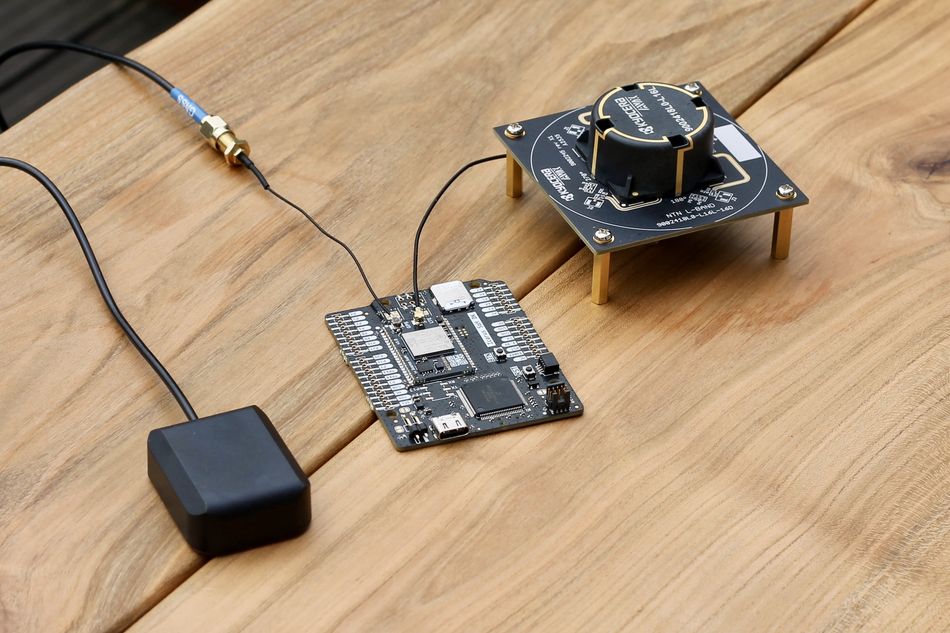
The NTN setup with an active GNSS antenna, Actinius Icarus development kit with the nRF9151, and the Kyocera AVX’s L-band antenna.
The sanity check is built around three questions:
Does it work?
At what price?
At what power budget?
Does it work?
We started from Nordic's open-source Asset Tracker Template, which already ships an NTN use-case branch. The only modifications needed were a light adapter to TagoIO's UDP endpoint and a reformat to match their lightweight telemetry format, TagoTIP.
Connecting to Monogoto required no separate provisioning step apart from enabling the Monogoto overlay at build time. The device booted, registered on Skylo, and started reporting in. From there, the Monogoto hub gave us live feedback on attach status, signal quality, and data flow.
Power it up, and data showed up in the TagoIO dashboard. The verdict: yes, NTN works, with off-the-shelf parts and openly accessible firmware.
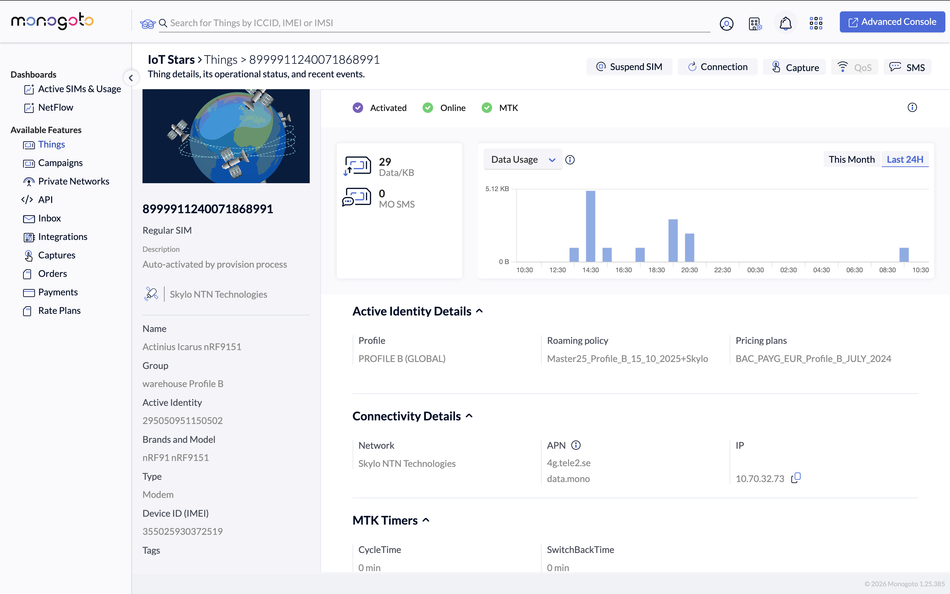
Monogoto hub showing the live NTN connection
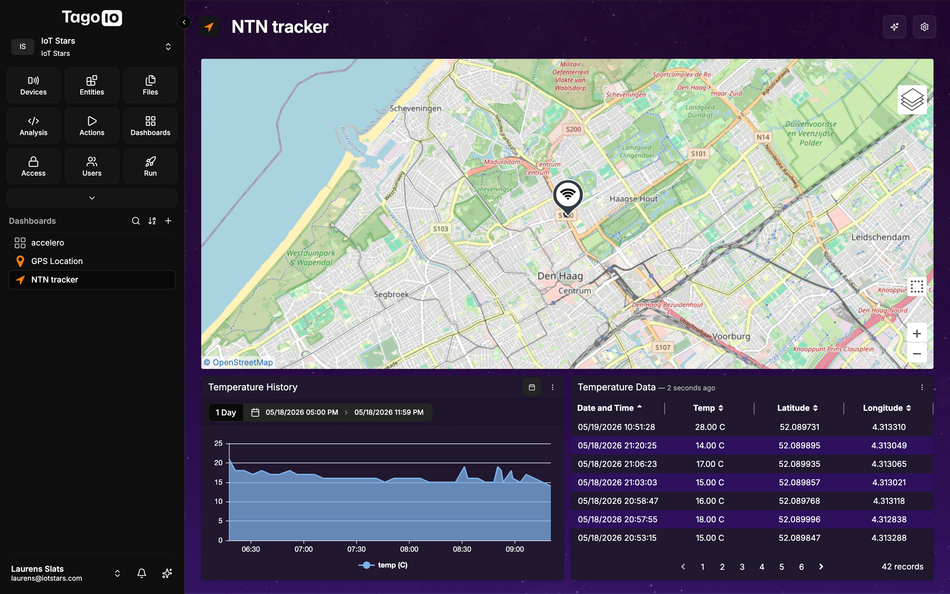
you TagoIO dashboard, visualizing the location and temperature data
At what price?
Monogoto's NTN pricing to access Skylo's network is $0.30 per KB, billed in 50-byte increments (source).
During the test, the following payload was sent, which (including its overhead) contains a total of 152 bytes.
<code>PUSH|<token>|<device_id>|[temp:=14.00#C@=52.089895,4.313049{device=*2519};x:=0.1532#m/s2;y:=0.0383#m/s2;z:=9.4611#m/s2]</code>The sensor payload of 152 bytes rounds up to 200 bytes, which works out to roughly 6 cents per message. Send one every fifteen minutes for a month and you're looking at around $173 per device. Clearly this is not economically feasible and therefore NTN IoT device behavior should be treated differently than TN IoT device behavior.
Compared head-to-head with terrestrial cellular, often under $0.01 per MB, NTN looks expensive, but that's the wrong comparison. NTN exists precisely where terrestrial coverage doesn't. When a device detects it has attached to an NTN network, it should shift behavior: reduce transmission frequency to the minimum operationally acceptable interval and strip payloads down to only the data that matters most. Most modern modem SDKs, including Nordic’s, expose the network access technology in use, so detecting the switch and triggering a different transmission policy can be accomplished.
The real question isn't whether it's cheap in absolute terms, it's whether you can make the economics of your specific IoT business case work.
At what power budget?
One key question remains, does it work out with the available power budget of battery-driven devices? We challenged Qoitech to conduct an in-depth analysis of an IoT device sending data over satellite networks, and the outcomes are more interesting than expected, and we'll walk through it live. This and more will be shared in the upcoming webinar, happening on June 2!
Join the live demo!
Let's move past another article promising "ubiquitous connectivity" and show how the technology works in reality, giving real data about the pricing and power budget.
We’re warmly inviting you to join the live webinar on June 2, 4pm CEST / 7am PST. We'll send a message from a device to a non-terrestrial network, show the power trace as it happens, and put real numbers next to the cost and energy questions every NTN evaluation eventually runs into.
On the agenda:
A live, end-to-end NTN demo
Technical notes from Maor Efrati, CTO at Monogoto
Power analysis findings from Björn Rosqvist CPO at Qoitech
NTN antenna insights from Carmen Redondo, Director Global Marketing at Kyocera AVX
Open Q&A
See it for yourself and decide whether NTN has a place in your next IoT deployment.
by Laurens Slats
laurens@iotstars.com
Further reading:
3GPPs NTN overview
https://www.3gpp.org/technologies/ntn-overviewMonogoto NTN pricing:
https://monogoto.io/monogoto-ntn-pricing-pay-as-you-go-simplified-pricing/Antenna performance:
https://www.everythingrf.com/community/from-earth-to-orbit-the-important-role-of-antennas-in-ntnSkylo’s coverage map:
https://www.skylo.tech/resources/geographical-coverageAsset Tracker Template for NTN use cases:
https://github.com/nrfconnect/Asset-Tracker-Template/tree/ntn_usecase