Synaptics Astra SL1680: A Multi-Modal, AI-Native SoC for the Next-Gen Edge IoT
Synaptics Astra® SL1680 integrates AI, compute, multimedia, security, and I/O to simplify the development of multimodal Edge AI devices.

26 Oct, 2026. 6 minutes read

The Growing Need and Complexity of Intelligent Edge Devices
Embedded systems have traditionally been designed around specific functions such as sensing, control, communications, and signal processing. Their role has expanded significantly with the growth of the Internet of Things (IoT) and, more recently, AI.
Today, embedded IoT devices are expected to interface with rich data streams such as camera feeds, render complex graphics, maintain high-speed connectivity, make complex decisions, and defend themselves against cyberattacks, all while staying within a fixed power, thermal, and cost envelope.
The conventional way to achieve these functionalities was to add a different hardware component for each task. For example, AI accelerators can be added for local inference, a digital signal processor (DSP) can handle signal processing, and a microcontroller can control actuators. Each additional component would add its own bill of materials (BOM) cost, take up more space, and require power rails and a custom firmware stack. As edge products are expected to do more, the cost, performance, and complexity trade-offs of the multi-chip approach become harder to justify.
Rather than stitching together discrete hardware components, the industry is now opting for heterogeneous architectures that consolidate compute, AI acceleration, multimedia, connectivity, security, and a lot more onto a single piece of silicon.
How AI-Native System-on-Chips (SoCs) Are Reshaping Edge Computing
Heterogeneous computing refers to a system that is composed of multiple processing engines, each designed to handle a specific set of workloads more efficiently. In such systems,
CPU handles OS execution and application logic.
GPU enables parallel processing, graphics rendering, image processing, and some AI workloads.
NPU is responsible for neural network operations like AI inference.
DSP carries out repetitive mathematical operations on signals.
Several other components, like audio-video accelerators, security engines, memory subsystems, connectivity, and I/O systems, are also integrated onto the SoC to support various functions without requiring additional components.
Synaptics Astra® SL1680: An Integrated Platform for Edge AI
Synaptics Astra® SL1680 is an embedded IoT processor that brings heterogeneous, multimodal architecture into a highly integrated SoC. The SL1680 is designed for consumer, enterprise, and industrial IoT workloads that require a combination of general-purpose compute, AI acceleration, graphics, vision, audio, security, and multimedia processing.
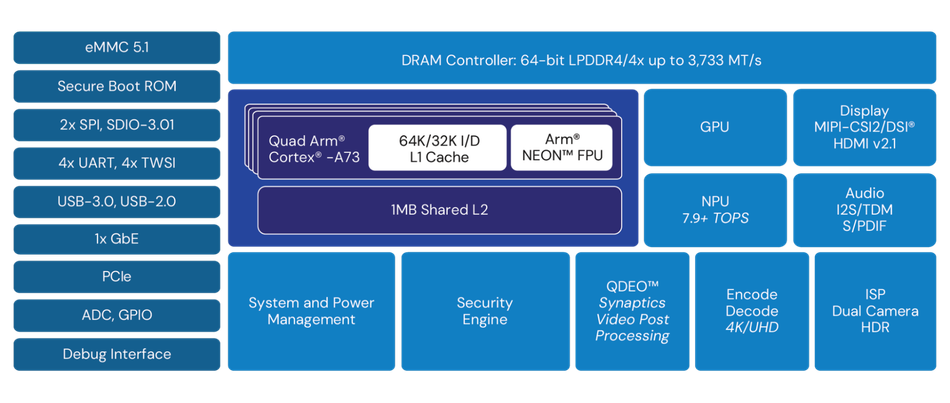
Synaptics Astra SL1680 combines a quad-core Arm® Cortex®-A73 CPU subsystem with an NPU rated at 7.9+ trillion operations per second (TOPS).
Graphics and video are handled by an Imagination Technologies PowerVR Series9XE GE9920 GPU, which supports OpenGL ES, Vulkan, and OpenCL for both rendering and general-purpose compute, alongside a multimedia pipeline capable of simultaneous 2160p60 video decode (AV1, H.265, VP9, H.264, MPEG-2, and VP8) and dual-stream 1080p60 video encode (H.264 and VP8).
Dedicated audio-processing capabilities handle far-field voice capture, keyword detection, and audio post-processing independently of the main CPU, which matters for always-listening voice interfaces that need to stay responsive without keeping the application processor fully awake. These compute resources are complemented by a dedicated image signal processor (ISP), which handles camera pipeline processing without burdening the CPU or GPU.

Security is built into the silicon rather than layered on top: the SL1680 includes a dedicated secure processor, secure boot with RSA verification, memory scrambling and integrity checking, and mitigations against physical attack, all of which matter for any device that will sit on a network for years in the field.
The underlying design philosophy is consolidation: Instead of pairing a general-purpose application processor with a separate AI accelerator, video codec chip, audio processor, and security subsystem, the SL1680 brings all of these onto a single piece of silicon with a single memory subsystem and a unified software stack. The specifications give the SoC enough headroom to run a full Linux or Android stack, rather than a stripped-down real-time OS.
For a deeper look, visit the SL1680's full technical specifications.
Engineering Benefits Beyond Performance
Specifications and performance metrics tell a part of the story. The most meaningful impact of an AI-native SoC like the SL1680 shows up in engineering-level benefits, such as:
Lower BOM cost and simpler board layout: Consolidating multiple processing and acceleration functions into a single SoC can reduce the number of discrete ICs, board-level interconnects, and associated support circuitry for each additional device.
Improved power efficiency: A single integrated SoC with a shared memory subsystem avoids the overhead of moving data between separate chips over external buses.
Simplified hardware and software integration: Engineering teams validate one processor and one Software Development Kit (SDK) rather than reconciling drivers, firmware, and toolchains from multiple silicon vendors, which shortens the path from prototype to certified product.
Faster time-to-market: With much of the integration risk already retired by the chip vendor, validation cycles compress, and products reach market sooner.
Reduced cloud dependence: As inference happens on the device itself, products built on the SL1680 don't need constant connectivity to run AI features.
Improved privacy: When sensitive data, such as video or audio, is processed locally, it can reduce the need to transmit or store raw data in remote cloud systems, depending on the application design. This improves privacy by design.
Lower bandwidth usage: Sending the results of inference or selected metadata may consume significantly less bandwidth than sending raw video, audio, or other high-volume sensor data continuously.
Accessible AI development: The Astra software ecosystem, including open-source frameworks and the SyNAP AI toolkit, lets teams take a model trained in TensorFlow Lite, ONNX, or PyTorch and get it running efficiently on the SL1680's NPU, helping to simplify deployment and optimization.
Edge AI Applications Across Multiple Industries
The ability of the SL1680 Embedded IoT Processor to bring AI inference, vision, audio, graphics, security, and strong general-purpose computing capabilities in a single platform supports a wide range of applications in the consumer, industrial, and commercial spaces.
Smart Home and Consumer Devices
Smart home appliances and home security gateways tend to require more than basic connectivity and remote control. On-device AI supports functions such as local event detection and intelligent automation, while integrated visual and audio capabilities can enable camera- and voice-based interactions. Systems built around SoCs like the SL1680 use always-on processing to support wake-up event detection without requiring the entire system to run continuously at full power.
For devices handling sensitive visual or audio data or deployed in secure environments, local processing ensures raw data is not transmitted to or stored on a remote server, thereby improving privacy.
Industrial Automation and Intelligent Control
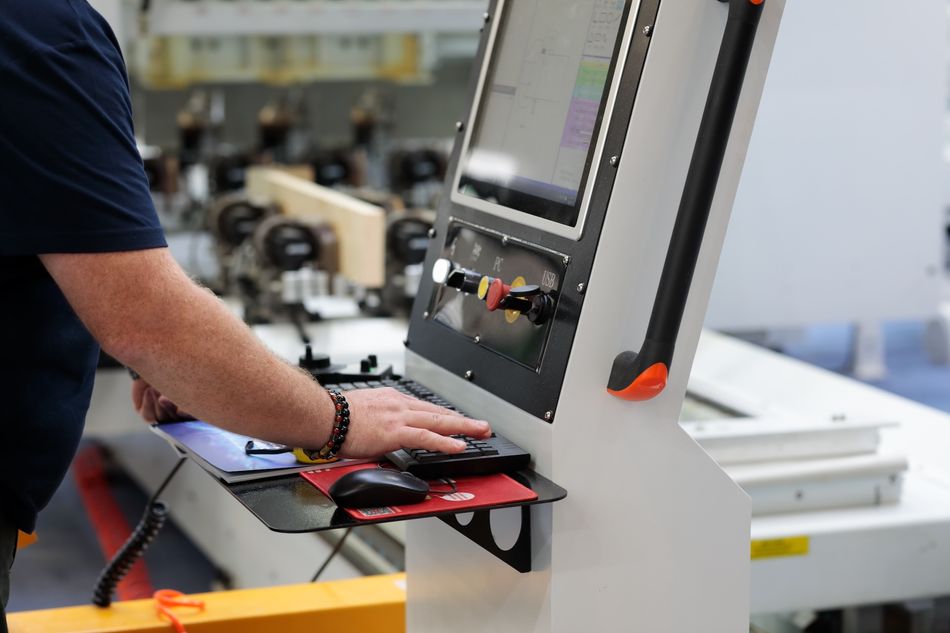
The features that make the SL1680 well-suited for consumer devices are also relevant to industrial applications, but in different ways. Industrial systems make extensive use of machine vision and sensor fusion to support capabilities such as predictive maintenance, automated inspection, and anomaly detection. The broad interface capabilities of the SL1680 ensure that systems can connect to cameras, sensors, networks, and other industrial equipment.
Systems that demand immediate control have historically been difficult to pair with cloud AI because every inference request must travel across the network, get processed on a remote server, and return a response before the system can act. The SL1680's on-device AI processing removes that round-trip: Inference happens locally, so decisions can be made at the low latencies these systems require.
Integrated hardware security capabilities provide mechanisms for protecting software and data, including authenticated boot, hardware cryptographic functions, access controls, and memory-protection features.
Commercial and Retail Systems
In commercial and retail spaces, digital signage, interactive displays, point-of-sale systems, and several other systems are used commonly. Highly integrated platforms like the SL1680 combine AI inference, multimedia, and graphics processing with necessary security features that protect the device software and data. At the same time, the complexity of the underlying hardware and software architecture is reduced.

Accelerating Development with the Astra Ecosystem
In edge AI product development, after selecting the processor, the next step is to evaluate the hardware, integrate peripherals, optimize AI models, build the software stack, and validate the complete system before moving towards production.
Synaptics supports the process with the Astra Machina™ Foundation Series, including the SL1680 Evaluation Kit, which combines an SL1680 core module with the common I/O platform and optional daughter cards for connectivity, debugging, and flexible I/O. This modular approach allows developers to evaluate the SL1680 and build application prototypes without designing a complete hardware platform from scratch.

The broader Synaptics embedded processor portfolio also gives designers multiple options for applications with different requirements. The SL1640 offers a more cost- and power-optimized option within the SL-Series, while the SL1620 targets general embedded processing, graphics, and audio without a dedicated NPU.
The SR-series, including the SR80, SR100, and SRW1500, comprises low-power, AI-native microcontrollers (MCUs) tailored for lightweight embedded systems.
Conclusion
As embedded systems are required to take on increasingly demanding AI, vision, audio, graphics, connectivity, and security workloads, integrated system design is becoming as important as performance. The Synaptics Astra SL1680 brings together these capabilities in a single platform to reduce the need for multiple discrete components.
To find out more about the Synaptics Astra SL1680 Embedded IoT Processor and the available evaluation options, visit the product page on Mouser.