Stretchy plastics conduct electricity via tiny, whisker-like fibers
Advanced imaging reveals a detailed understanding of the mechanisms driving a previously misunderstood material, researchers say

24 Feb, 2026. 4 minutes read
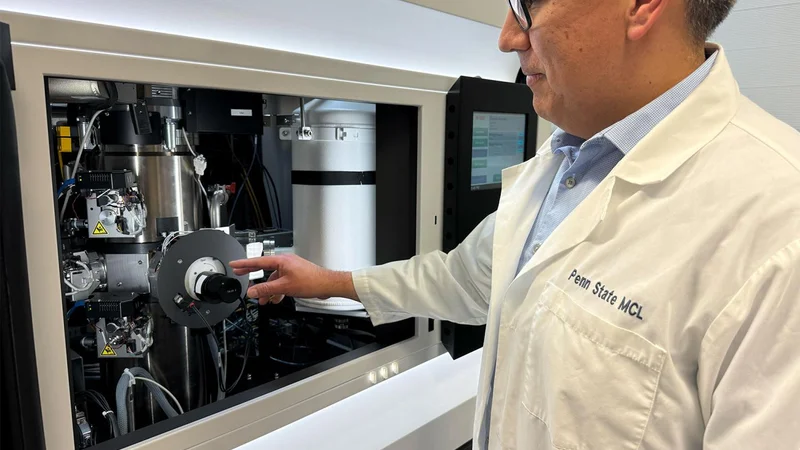
Using an advanced imaging technology, known as cryogenic electron microscopy, a team at Penn State developed a deeper understanding of a material that had previously confused researchers. Credit: Ty Tkacik / Penn State. Creative Commons
This article was first published on
www.psu.eduA stretchy, conductive type of plastic could help power the next generation of implantable biomedical devices, like longer-lasting pacemakers or glucose monitors, according to Enrique Gomez, professor of chemical engineering at Penn State.
Using advanced imaging technology to examine a stretchy material commonly used in soft robotics and touchscreens known as PEDOT:PSS, Gomez and his team found that adding different salt additives and water enabled the material to grow hair-like fibers capable of effectively conducting electricity. According to the researchers, who recently published their findings in Nature Communications, minor changes to the plastic can have a major impact on the material’s physical properties and conductivity.
One of the primary challenges facing the development of bio-friendly devices is balancing the different ways computers and the human body move electrical currents, Gomez explained. Although both the body and computers conduct electricity, they do so differently.
“Our nerves and neurons move electricity around our body using ionic currents, which are essentially circuits built out of mixtures of salt and ions in the body,” said Gomez, who also serves as associate dean for equity and inclusion in the Penn State College of Engineering. “Computers conduct electricity by moving electrons through metal wires and silicon semiconductors. PEDOT:PSS is a remarkable material in that it can conduct electrons, while at the same time remaining sensitive to the existing ion currents in the body.”
Despite its usefulness, researchers don’t fully understand how the material works, according to Gomez. To learn more, his team used a highly advanced microscope technology, known as cryogenic electron microscopy, or cryo-EM, to examine the gel-like plastic. Unlike traditional microscopes, which focus light through lenses to magnify an image, cryo-EM microscopes use the flow of electrons to examine materials at some of the highest resolutions possible.
“These are some of the most advanced microscopes in the world, as they can be used to image things like viruses, proteins and polymers, which we specialize in at Penn State,” Gomez said. “We are experiencing a revolution in microscopy, as these machines allow us to image materials at incredibly high levels of detail.”
The team placed a small droplet of the material encased in a thin, nanoscopic film, only a fraction of the width of a human hair. They repeated this process several times, making minor adjustments to each sample’s chemical makeup by adding different types of salt. They then plunged the samples into liquid ethane kept at -180 degrees Celsius (C) — slightly warmer than the surface of the moon at night. This is to ensure the material samples don’t burn up in the high temperatures produced by the electrons, and allows the team to examine how different salt additives impact ion and electron transfer in the material.
By freezing the samples and examining them at the atomic level, the team identified how the molecular structure of the gel, and more specifically the presence of salt additives, plays a major role in its versatility. Within the material, whisker-like fibers help conduct ions and electrons — samples with added salt displayed a higher number of fibers, which in turn increased the material’s conductivity.
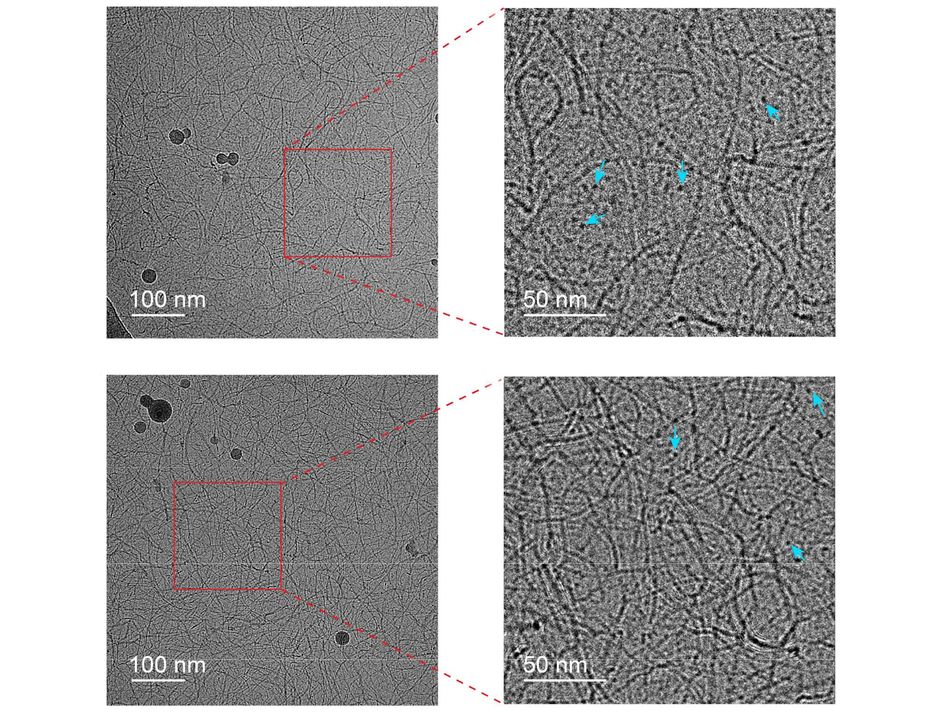
To further understand the material, the team compared samples with and without absorbed water added to the material. When water is present, it softens PEDOT:PSS and makes it more stretchable. The researchers also found that adding lithium salts increases the material’s water uptake, further enhancing its stretchability. When dry, however, PEDOT:PSS becomes brittle regardless of salt content — highlighting the critical role water plays in determining the material’s mechanical properties, as well as how salt additives can enhance these properties. According to Gomez, because electrical conductivity changes very little with water absorption, PEDOT:PSS can achieve the remarkable combination of high stretchability and stable conductivity needed for emerging bioelectronic devices.
This behavior, which indicates that salt additives play a role in templating the structure and stretchability of the plastic, had not previously been observed, Gomez said.
“Even after introducing water to the material, the fibers remain in the structure,” Gomez said. “We believe this is how we can maintain the conductivity that results from the addition of salts, even after using water to swell the material into a stretchy, gel-like texture that can be easily interfaced with biological systems."
Moving forward, the team plans to continue studying and imaging PEDOT:PSS. Gomez said there is still much to learn about how the salt additives impact the formation of the fibers on the material, as well as how the material works and the best possible applications.
“We don’t fully understand how these salts interact with the polymer materials quite yet,” Gomez said. “Making this connection would allow us to further optimize this plastic, and greatly improve pacemakers, epidermal sensors and electromyography, a procedure used to assess nerve and muscle function.”
Other Penn State-affiliated co-authors include Esther Gomez, Waltemeyer Mid-Career Biotechnology Professor and associate department head of chemical engineering; Masoud Ghasemi, Farshad Nazari and Joshua T. Del Mundo, chemical engineering postdoctoral researchers; Yi-Chen Lan and Po-Hao Lai, chemical engineering doctoral candidates; Louis Y. Kirkley, materials engineering doctoral candidate; Mohammed K.R. Aldahdooh, chemistry doctoral candidate; and Sung Hyun “Joseph” Cho, associate professor at the Huck Institutes of the Life Sciences.
Additional co-authors include Baskar Ganapathysubramanian, professor of mechanical engineering at Iowa State University; and Dhruv Gamdha, a mechanical engineering doctoral candidate at Iowa State University. This work was supported by the U.S. National Science Foundation, the Office of Naval Research and the National Institute of Health.
At Penn State, researchers are solving real problems that impact the health, safety and quality of life of people across the commonwealth, the nation and around the world.
For decades, federal support for research has fueled innovation that makes our country safer, our industries more competitive and our economy stronger. Recent federal funding cuts threaten this progress.