Solving Rack Cooling Noise with ebm-papst
Why choose between the ability to cool high-performance AI infrastructure and a reasonable noise environment when you can achieve both?

21 Sep, 2026. 6 minutes read

AI infrastructure is pushing every element of data center design to its limits, especially rack-level cooling. AI inference and training hardware generate far more heat per rack unit than legacy servers, and data centers are growing denser and expanding into edge environments, further complicating thermal management.
Increased power dissipation is driving the need for more advanced cooling strategies, including the use of additional, larger, and more innovative fans. Unfortunately, that often comes at a tradeoff with audible noise. Controlling fan noise through the use of acoustic insulation and intake filters impedes airflow, which in turn forces engineers to compensate by operating fans at higher speeds.
With ebm-papst’s extensive fan portfolio, available through Sager Electronics, data centers no longer need to choose between the cooling performance AI hardware demands and a reasonable noise environment.
Thermal Demands in AI Server Racks
AI servers generate much more heat per rack than legacy servers because of their significantly higher power consumption. New data centers require stronger cooling solutions to be designed in, while retrofitting existing footprints requires a system that can remove more heat within the existing physical envelope.
Fans remain the primary means of heat removal in all data centers due to their ability to provide quick, direct cooling to components at an affordable cost. Computer room air conditioning (CRAC) systems can manage the ambient temperature, but aren’t designed for chassis-level or point source cooling demands.
Traditionally, data centers have used single-stage axial fans to cool their hardware. AI data centers often use counter-rotating, two-stage axial fans for better performance. Counter-rotating fans work by stacking two fan rotors in series, enabling them to generate higher static pressure and move more air through dense rack components. While these fans can cool the hardware effectively, when scaled across hundreds of racks, they create an acoustic cost that operators can no longer tolerate.
The Fan Noise Tradeoff
Counter-rotating fans generate more noise than single-stage axial fans, but their raw decibel levels are only part of the problem. The other part is tonality, which is a measure of how irritating a sound is perceived to be by the human ear, independent of its overall loudness. A fan with lower total dB can be perceived as louder and more bothersome than a higher-dB fan with more desirable tonality.
Counter-rotating fans typically have a high tonality, which makes their sound disruptive, especially for workers in edge facilities and data centers near populated areas. For engineers and technicians who spend hours next to thousands of fans running simultaneously, counter-rotating fan noise is a real occupational health concern. In urban data centers, disruptive fan noise has sparked community opposition.
When looking for solutions to fan noise, data center operators have considered remedies such as acoustic insulation, intake filters, and enclosure-level damping. While these options can reduce noise, they also add airflow resistance, which forces operators to increase fan speeds to maintain the same cooling capacity. Higher fan speed increases both power consumption and noise, compounding the problem the remedy was meant to solve.
No single-fan design had previously delivered the airflow density of a counter-rotating configuration at a meaningfully lower and less irritating sound level...until now.
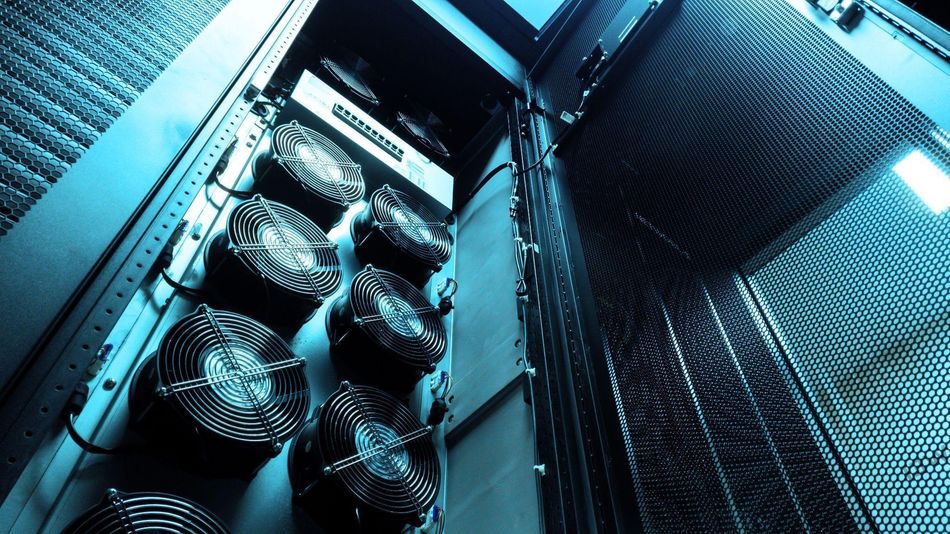 Cooling Fans Inside Data Center Equipment. Source: AdobeStock.
What High-Performance Rack Cooling Fans Need to Deliver
A fan suitable for AI-era data center cooling needs to achieve high airflow, high efficiency, and a low-tonality acoustic profile simultaneously. Operators who prioritize any one of these attributes at the expense of the others will still end up with a suboptimal cooling system.
High Airflow
High airflow at rack scale means building static pressure against the resistance of densely packed server components. Single-stage axial fans move air along a straight path to hit target hardware, but their design limits the static pressure they can develop without increasing fan diameter or speed. Centrifugal fans move air radially, allowing them to build higher static pressure, but their design limits the airflow they can push over the components without increasing their physical size.
Engineers can optimize fan geometry to build static pressure within the same size by directing air along both axial and radial paths, capturing the pressure advantage of a centrifugal design while retaining the compact form factor of an axial fan.
Fan Efficiency
Fan efficiency at rack scale is important because it has a compounding effect on the entire data center.
In a data center running thousands of fans continuously, per-unit energy consumption directly affects total operating costs and the amount of heat added to the system. A fan drawing more power than necessary becomes part of the thermal problem it is meant to solve, generating heat that other fans must then remove.
Overall efficiency needs to be high enough that the fan does not become a significant contributor to the thermal load it manages.
Low Tonality
To create a low-tonality fan, engineers need to address the mechanical source of tonal noise instead of damping it after the fact.
In axial fans, the main source of tonal noise is blade-pass frequency, the pressure pulse generated each time a blade tip passes the gap between the rotor and the stationary housing. Each pulse registers as a discrete tonal peak in the fan’s acoustic profile, so eliminating those peaks requires a design that removes the blade-tip-to-housing gap interaction entirely.
For data centers that can’t modify fan infrastructure, an accessory that reduces tonal content without adding flow resistance is a useful alternative. Such an accessory would make the acoustic environment more tolerable while avoiding the speed increase that any back-pressure-adding approach would require.
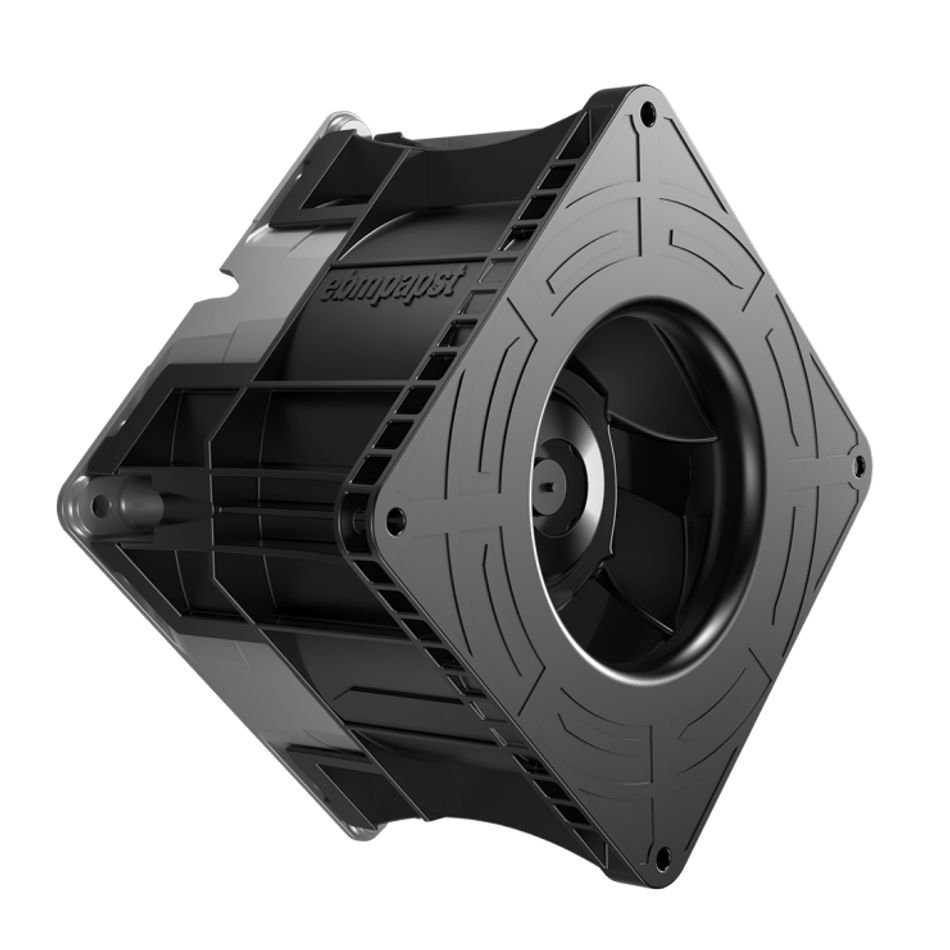
Solving Data Center Cooling with ebm-papst DiaForce
In response to all of these challenges, ebm-papst developed the DiaForce diagonal compact fan.
Designed for AI data centers, DiaForce delivers up to 50% higher air performance thanks to a conical cover plate with a smaller intake opening than the outlet, which directs airflow along both axial and radial paths. The dual-path geometry builds static pressure in a way that a single-stage axial fan can’t, placing DiaForce’s performance envelope between conventional axial and centrifugal designs. This gives data center operators the pressure-building advantage of a centrifugal fan without giving up the rack-compatible form factor that server hardware requires.
ebm-papst also designed DiaForce to achieve 48% overall efficiency, keeping unit power consumption low enough that even large fan arrays do not materially contribute to the thermal load they manage.
Meanwhile, DiaForce’s rotating conical cover plate addresses tonality at its source. Because the cover plate rotates with the blades, the blade tips pass into the cover rather than past a stationary housing gap, eliminating the pressure pulses that generate blade-pass frequency peaks. As a result, DiaForce fans deliver up to 6-12 dB(A) lower sound level than the best equivalent counter-rotating fans on the market.
All of this performance comes in a compliant, drop-in-replacement-ready package. Specifically, ebm-papst designed DiaForce to meet NEBS (Network Equipment-Building System), OSHA, ANSI, and ETSI standards.
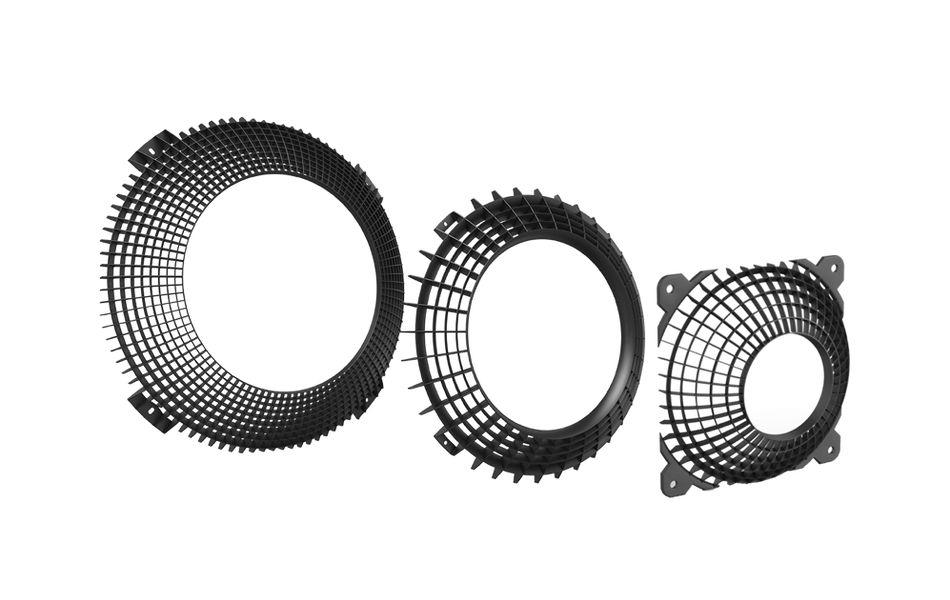 FlowGrid air inlet grille. Source: ebm-papst
FlowGrid
For data centers that can’t easily modify existing fan hardware, ebm-papst offers the FlowGrid air inlet grille. An accessory that mounts onto existing fans, FlowGrid can reduce sound pressure in the entire frequency range, as well as blade-pass frequency peaks and more disturbing lower frequencies.
As a result, FlowGrid can significantly reduce sound pressure levels and noise without restricting airflow or increasing input power.
Complete ebm-papst Cooling Solutions, Available Through Sager Electronics
From product selection to integration, the complete portfolio of ebm-papst cooling solutions is available through Sager to give designers access to the industry's latest fan technologies backed by technical expertise and responsive supply chain support. As a certified ebm-papst Value-Add Reseller (VAR), Sager also provides application engineering, integration capabilities, and technical support to help customers implement optimized cooling solutions with confidence.
In addition to DiaForce and FlowGrid, featured product families include:
AxiForce series: Standard axial fan sizes for moderate airflow requirements, with a lower acoustic footprint than counter-rotating designs.
AxiFlow series: Shares similar frame sizes to AxiForce but targets low-back-pressure environments where maximum airflow takes priority.
AxiEco (200 mm frame): Delivers high airflow, high static pressure, and low noise. An ideal candidate for rear door heat exchanger applications in liquid-cooling systems.
AxiTwin (counter-rotating fan): Designed for installations where maximum airflow in a compact footprint is the main requirement and acoustic performance is secondary.
RadiCal (centrifugal fan): Rounds out the portfolio for space-constrained installations that require high static pressure.

Cooling in the AI Era
The thermal density of AI hardware will continue to climb as inference and training workloads grow more demanding. As data centers evolve, fan technology must too.
ebm-papst has engineered a wide range of solutions to meet the industry’s ever-growing needs. With innovations like DiaForce, FlowGrid, and a full portfolio of axial and centrifugal fans, ebm-papst and Sager customers have access to both advanced thermal technologies and expert guidance to successfully integrate them into next-generation AI infrastructures. With ebm-papst and Sager, designers have the tools they need to cool new and existing architectures with ease.