Rethinking Industrial Sensing for Remote and Distributed Assets
Explore how low-power sensor gateways enable reliable, long-range data collection for remote and distributed industrial IoT assets.

20 Aug, 2026. 6 minutes read

Engineer Specialist Operating Pilot Drone on Wind Turbine Farm
As industrial IoT deployments expand into remote and distributed environments, the challenge is not always how to process more data at the edge, but how to reliably collect it in the first place. Many sensing applications operate under strict constraints, including limited power, intermittent connectivity, and minimal infrastructure. This article explores an alternative approach to industrial sensing, focused on low-power, long-range data acquisition, where simplicity, reliability, and efficiency take priority over local intelligence.
Not Every Sensor Needs to Be Smart
Industrial sensing is often framed around edge computing, real-time analytics, and autonomous decision-making. These capabilities are critical in applications where latency must be minimized, and systems must react instantly to changing conditions.
However, a significant portion of sensing deployments operate under very different requirements. In remote environments such as pipelines, agricultural fields, water systems, and environmental monitoring sites, the primary challenge is not making decisions at the edge. It is ensuring that data can be captured and transmitted reliably from locations where infrastructure is limited or nonexistent.
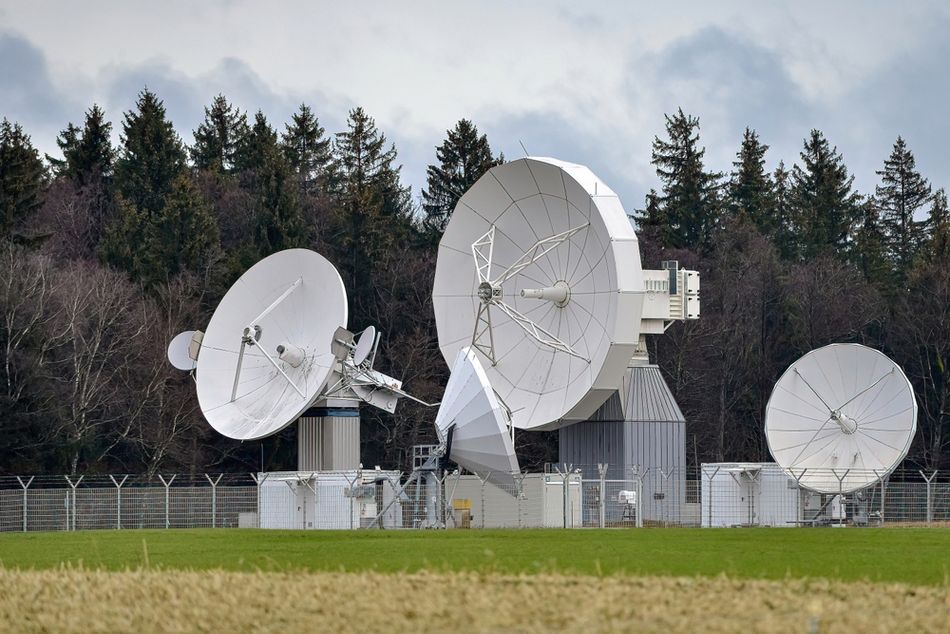
These environments introduce constraints that fundamentally change system design. Power is often limited to batteries that must last for years. Connectivity may be intermittent, low bandwidth, or entirely dependent on long-range wireless technologies. Physical access for maintenance may be difficult or infrequent.
Under these conditions, complexity at the edge can become a liability rather than an advantage. The focus shifts from intelligence to efficiency, from processing to persistence, and from real-time control to reliable data acquisition.
The Constraints of Remote Sensing
Deploying sensors in remote environments requires careful consideration of power, connectivity, and system simplicity.
Power consumption is often the most critical constraint. Battery-powered devices must operate for extended periods without replacement, which requires minimizing energy usage at every stage of operation. This is typically achieved through aggressive power management strategies, where devices remain in low-power sleep states for the majority of their lifecycle and wake only at defined intervals to perform measurements and transmit data.
Connectivity presents a different challenge. Remote locations rarely have access to high-bandwidth networks, and even cellular coverage may be inconsistent. Low-power wide-area network technologies have emerged to address this gap, providing long-range communication with minimal energy consumption. These networks are optimized for small data payloads and infrequent transmissions, which aligns well with many sensing applications but requires a different approach to data handling.
Simplicity is equally important. Devices deployed in the field must be easy to install, configure, and maintain. Complex software, programmable logic, or frequent configuration changes can increase the likelihood of failure and make troubleshooting more difficult. In many cases, the most effective solution is one that performs a single function reliably over a long period of time.
A Different Model for Industrial Sensing
These constraints are driving a complementary model to traditional edge computing. Instead of processing data locally, systems are designed to efficiently collect and transmit data for centralized analysis.
In this model, sensor data is acquired at defined intervals rather than continuously streamed. Devices wake from low-power states, capture readings from connected sensors, and transmit that data using energy-efficient communication methods. Once the transmission is complete, the device returns to a low-power state, conserving energy until the next scheduled cycle.
Data acquisition methods vary depending on the sensor type and protocol. Analog inputs may require scaling and conversion, while digital inputs capture discrete states or pulse counts. Protocols such as Modbus introduce structured data that is typically accessed through periodic polling. Regardless of the source, the goal is to capture accurate data with minimal processing overhead at the device level.
This approach reduces power consumption, minimizes network usage, and simplifies device design. It also shifts data processing and analysis to centralized systems, where computational resources are not constrained.
In remote deployments, store-and-forward mechanisms are often used to ensure data reliability. If connectivity is temporarily unavailable, sensor readings can be buffered locally and transmitted once the connection is restored. This ensures that data continuity is maintained without requiring constant network availability.
The Role of Low-Power Sensor Gateways
Supporting this model requires a different class of device, one that prioritizes efficiency and reliability over local intelligence.
Low-power sensor gateways are designed to act as a bridge between field sensors and centralized systems. They provide the necessary interfaces to connect industrial sensors, while managing data acquisition and transmission in a way that optimizes power usage and communication efficiency.
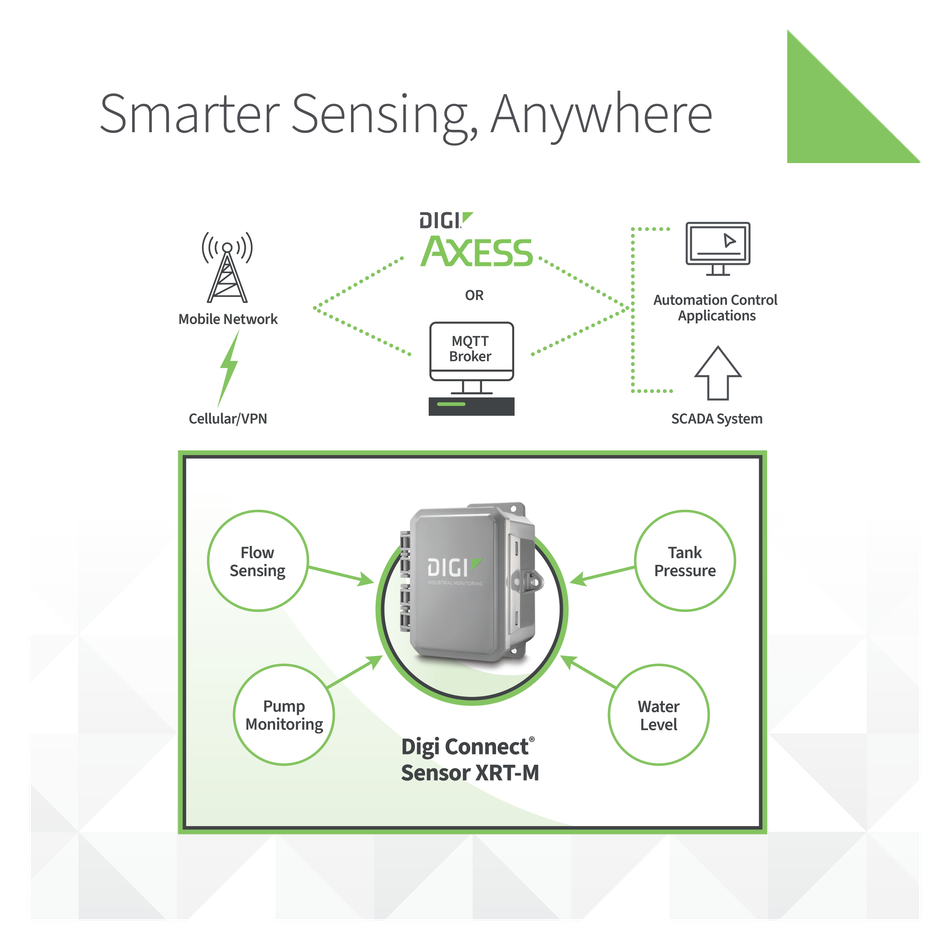
Devices such as the Digi Connect Sensor XRT-M exemplify this approach. Rather than functioning as programmable edge controllers, these devices are optimized for long-term, low-power operation in remote environments. They spend most of their time in sleep mode, waking on a defined schedule to capture sensor readings and transmit them over long-range wireless networks.
By supporting common industrial interfaces and protocols, these platforms enable a wide range of sensors to be connected without requiring additional hardware. At the same time, their streamlined design minimizes energy consumption and reduces system complexity.
This architecture intentionally avoids unnecessary processing at the edge. Instead, it focuses on delivering accurate and timely data to centralized platforms, where it can be aggregated, analyzed, and acted upon.
Real-World Applications of Remote Sensing
This approach to sensing is particularly well suited to applications where data is collected over large geographic areas and does not require immediate local processing.
In energy and utilities, infrastructure such as pipelines, water systems, and substations often extends across remote regions. Sensors deployed in these environments monitor conditions such as pressure, flow, and temperature. Data collected at regular intervals provides visibility into system performance, while centralized analytics can identify trends and anomalies over time.
Agricultural applications also benefit from low-power sensing. Soil moisture, temperature, and environmental conditions can be monitored across large fields using distributed sensors. Long battery life and long-range communication allow these systems to operate throughout growing seasons without intervention.
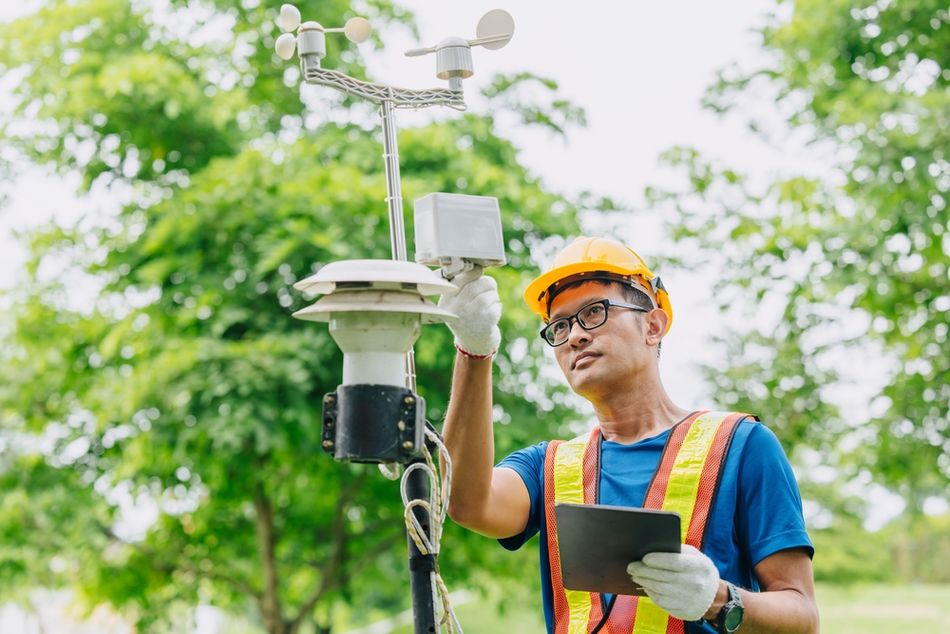
Environmental monitoring systems rely on similar principles. Applications such as air quality measurement, water level tracking, and weather observation require reliable data collection from locations that may be difficult to access. In these cases, efficient data transmission and long-term operation are more important than local processing.
Smart infrastructure deployments, including transportation and urban utilities, often combine both centralized and distributed sensing. Low-power gateways can collect data from widely dispersed assets, feeding centralized systems that provide visibility and long-term analysis.
Balancing Simplicity and Intelligence
The evolution of industrial sensing is not defined by a single architectural approach, but by the ability to match the solution to the application.
In some cases, edge intelligence is essential. Systems that require immediate response or closed-loop control benefit from local processing and decision-making capabilities.
In other cases, simplicity provides greater value. When the primary goal is reliable data collection from remote assets, minimizing power consumption and system complexity becomes more important than adding processing capabilities at the device level.
Many real-world deployments combine these approaches. Intelligent edge systems handle time-critical processes, while low-power sensor gateways extend visibility into remote areas where traditional infrastructure is not practical.
Understanding where each approach fits is key to designing scalable and effective sensing systems.
Conclusion
Industrial sensing is often associated with increasing intelligence at the edge, but this is only part of the story. For many applications, especially those involving remote and distributed assets, the priority is reliable, efficient data collection.
Low-power sensing devices provide a practical solution by focusing on long battery life, efficient communication, and simple operation. By reducing complexity at the device level and leveraging centralized analytics, these systems enable organizations to extend sensing capabilities into environments that would otherwise be difficult to monitor.
Technologies such as the Digi Connect Sensor XRT-M demonstrate how this approach can be applied in real-world deployments, providing a foundation for scalable, resilient sensing across a wide range of industries.
Alistair Craven is Director of Sales Engineering for EMEA at Digi International, leading the technical sales team across Europe, the Middle East, and Africa. With an MSc in Software Development and a BEng (Hons) in Electrical and Electronic Engineering from Huddersfield University, he brings over 20 years of experience in connectivity solutions. Alistair began his career at Sarian Systems, a pioneer in cellular routers, and advanced through technical and leadership roles following Digi's acquisition in 2008. He now plays a key role in supporting customers, enabling sales, and guiding technical strategy across the region.