Radar for Ultra-Low-Power Presence Sensing and Advanced Features for Smart IoT
Learn how XENSIV™ 60 GHz radar by Infineon uses FMCW sensing and on-chip processing to enable precise, low-power presence detection in embedded IoT systems.

13 Apr, 2026. 8 minutes read

Why IoT Devices Need a New Approach to Sensing
In battery-driven IoT devices, improving sensing capability often comes at the cost of increased power consumption. Many smart home and smart building applications rely on continuous environmental awareness, whether to detect human presence, monitor movement, or enable context-aware behavior. However, keeping sensors active at all times will reduce battery life, limit product longevity, and increase maintenance requirements. The challenge is amplified as many IoT devices are required to operate autonomously over extended periods.
Common sensing technologies such as passive infrared (PIR), cameras, and ultrasonic sensors have limitations in smart home and building environments, including higher false alarm rates, limited contextual information, or increased system power consumption. For instance, PIR sensors are widely used due to their low cost and low power consumption, but they typically provide limited information. PIR sensors primarily detect changes in infrared radiation caused by motion, hence they usually miss stationary information and localization (distance, angle) of the persons and show high false alarm rates due to thermal noise like sunlight changes.
Camera-based solutions also introduce a different set of constraints. For example, continuous image capture and processing require substantial power, which makes cameras not ideal for always-on, battery-operated devices. Moreover, cameras raise privacy concerns in residential and workplace environments and require clear optical paths and adequate lighting conditions. Ultrasonic sensors, while useful for proximity detection, can be affected by environmental noise, airflow, and temperature variations, and typically provide limited spatial resolution.
Radar sensing, on the other hand, provides an alternate option for presence, motion, and interaction detection in compact, embedded systems. In this context, Infineon’s XENSIV™ BGT60CUTR13AIP 60 GHz CMOS radar sensor addresses the core constraints of low-power IoT sensing. It combines compact form factors, integrated processing, and energy-efficient operation to support continuous environmental monitoring. The sensor supports Physical AI by allowing devices to perceive and interpret physical activity in their surroundings. This article discusses how low-power XENSIV™ 60 GHz CMOS radar sensing addresses the limitations of conventional IoT sensors and enables reliable presence detection, motion awareness, and always-on operation in battery-driven smart home and building devices.
Why Infineon Developed the XENSIV™ 60 GHz CMOS Radar for IoT
Infineon developed the XENSIV™ 60 GHz CMOS radar platform in response to a gap between the sensing requirements of modern IoT devices and the constraints imposed by battery-powered operation. Many smart home and building devices are expected to remain active for long periods. Traditional sensing approaches usually force designers to trade sensing capability for battery life or rely on multiple sensors to compensate for individual limitations.
One of the goals of the XENSIV™ 60 GHz CMOS radar was to provide ultra-low power operation without compromising sensing reliability. The sensor has an improved Radio Frequency (RF) front end and integrated processing via hardware accelerator, enabling autonomous motion detection and signal processing on-chip.
IoT devices such as smart thermostats, occupancy sensors, and consumer electronics often have strict space limitations. Hence, compactness was another major consideration. The Antenna-in-Package (AIP) approach integrates the RF antenna directly into the sensor package, reducing external components and simplifying PCB design.
The sensor was also designed for versatility across indoor and outdoor environments, with detection ranges of up to 20 meters. With 7 GHz bandwidth at 60 GHz, the sensor provides the spatial resolution needed to distinguish fine movements and subtle presence cues. This capability supports applications for both room-scale presence detection and motion tracking in larger spaces.
The XENSIV™ BGT60CUTR13AIP comes with on-chip processing via an integrated HW accelerator and a dedicated bootloader to enable autonomous operation and reduce system-level complexity. Internal handling of key signal processing tasks allows the radar to perform presence detection without requiring a continuously active host microcontroller. Thus, the Host MUC can be started directly via interruption from the radar sensor upon presence detection and allow for advanced processing/ features to be performed directly on Host MCU. An Infineon-provided FCC-certified reference design accelerates product development, helping reduce RF design complexity, compliance effort, and time to market. In this context, the XENSIV™ 60 GHz CMOS radar platform builds on established radar sensing techniques, adapted and optimized for the practical requirements of battery-driven IoT.
Inside the XENSIV™ 60 GHz CMOS Radar Sensor
The XENSIV™ 60 GHz CMOS radar sensor is designed for FMCW radar sensing. FMCW radar operates by transmitting a continuous signal whose frequency is swept over time. When this signal reflects off an object and returns to the receiver, the frequency difference between the transmitted and received signals can be used to calculate distance. The system can also estimate velocity by analyzing phase differences of a single channel, and angular information by phase differences across different receive channels.
This principle allows the radar to detect both moving and stationary objects due to the capability to detect very small movements via FMCW. As the sensor actively emits and receives RF signals, it does not depend on ambient light or thermal contrast, making it robust across a wide range of environmental conditions.
Key Architectural Elements and Features
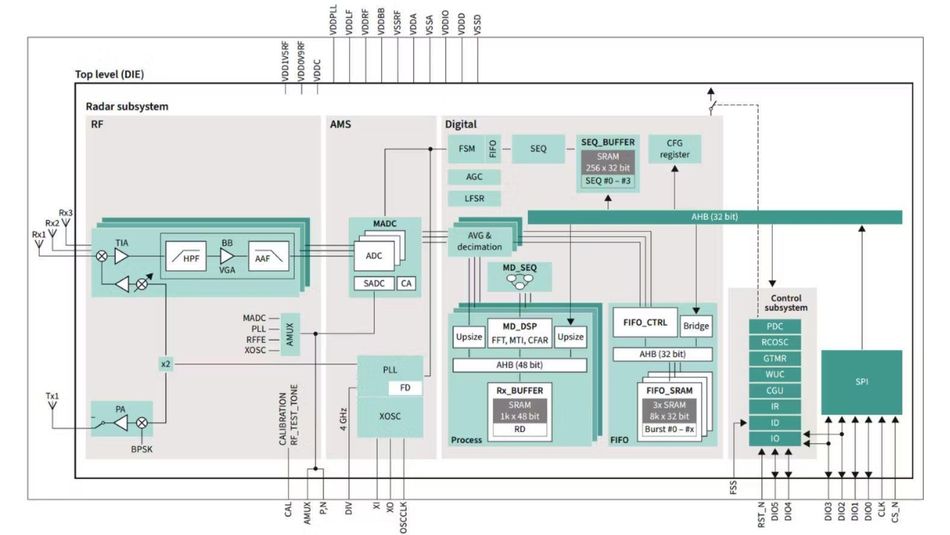
On-chip signal processing support is an important feature. The sensor includes an integrated hardware accelerator (HWA) capable of performing computationally intensive tasks such as a 2D fast Fourier transforms, filtering, constant false alarm rate (CFAR) processing, and angle of arrival estimation. Its integrated MTI also allows to send an interrupt waking up the host MUC once motion is detected. The radar sensor has supporting blocks already integrated, such as internal low-dropout regulators (LDOs), an oscillator, and control logic, reducing overall BOM cost and the need for external circuitry.
The sensor also incorporates a power management system with autonomous wake-up capability. This allows it to continuously monitor the environment in low-power modes and only activate the host system when meaningful activity is detected, supporting always-on operation without excessive energy use. In low-power sensing modes, the radar consumes less than 1 mW, while deep-sleep states can reduce consumption to around 0.1 mW. These characteristics support continuous environmental monitoring in battery-operated systems.
The AIP configuration includes one transmit channel (Tx) and three receive channels (Rx) arranged in an L-shaped layout featuring both azimuth and elevation at the most compact design. This arrangement supports a wide field of view of up to 150 degrees in both azimuth and elevation. This makes it ideal for indoor presence and motion sensing, where coverage of an entire room is required. The sensor also supports reliable detection of both moving and static objects at ranges of up to approximately 20 meters and operates across an industrial temperature range from -20 °C to +85 °C, with a backside temperature rating of up to 105 °C.
Integrating the antenna within the package also improves repeatability and simplifies RF design. Moreover, the small footprint measuring approximately 6.05 × 4.3 × 0.9 mm³ allows integration into space-constrained devices without requiring external RF components.
All these architectural elements and features make the sensor ideal for embedded IoT designs where space, power, and design simplicity are critical.
Radar Enables Applications for Smart Home and Smart Building Devices
Low-power radar sensing enables several capabilities that extend beyond simple motion detection. One of the most important is reliable presence detection for both moving and stationary individuals. For instance, the radar can detect subtle motions such as breathing, allowing systems to keep track of the occupants even when they stop moving.
Radar also supports motion tracking and activity awareness, enabling devices to respond differently based on how people move within a space. In more advanced implementations, radar can be used for vital signs sensing or basic gesture detection, expanding the range of interactions available without requiring direct contact or visual monitoring.
These capabilities translate into applications across smart home and smart building environments. For instance, instead of the camera sensor running constantly to detect motion, which drains battery and generates heat, the radar can act as the primary trigger. It can sense motion at a distance, determine if it is in a region of interest, and wake the camera only when a person enters a specific zone. In smart TVs and displays, radar can detect when a user enters a room and automatically wake the display, or dim the screen when the user leaves, significantly saving energy.
Similarly, by detecting even static presence, radar can ensure that lights and climate control are on as long as a person is in the room, even if they are reading or sleeping, and shuts them off precisely when the room is empty. Moreover, as radar does not rely on optics, it functions perfectly in total darkness, bright sunlight, or even through smoke and steam, while also protecting user privacy.
Implementation Considerations for IoT Product Development
The XENSIV™ 60 GHz CMOS radar sensor is designed to reduce the effort typically associated with adding RF-based sensing to battery-driven IoT products. Infineon provides FCC-certified reference designs that can be reused as a starting point for product development, allowing developers to transfer validated RF designs and reduce the time, cost, and uncertainty associated with regulatory approval. This helps teams focus on application development rather than RF compliance and antenna tuning, which are often major barriers for radar adoption in compact IoT devices.
The single-package radar implementation simplifies hardware integration. The sensor combines the radar MMIC, antennas, and supporting circuitry into an AIP module, minimizing external RF components and reducing PCB complexity. This compact, self-contained design is beneficial for space-constrained products, where routing high-frequency signals and maintaining RF performance can otherwise be challenging. Compared to multi-chip or discrete radar solutions, this integration supports more predictable performance and a smaller overall footprint.
At the system level, radar-based presence sensing can also reduce complexity compared to multi-sensor approaches that combine PIR, ultrasonic, and optical sensors to achieve similar functionality. Using a single radar sensor to cover presence, motion, and activity detection can simplify sensor fusion logic and lower overall power and integration overhead. This consolidation is very relevant for battery-powered devices where components count, stand by current, and firmware complexity directly affect product lifetime.
Firmware and processing requirements are also addressed at the sensor level. The on-chip signal processing capabilities and autonomous detection features allow the radar to operate independently in low-power modes, waking the host MCU only when relevant events are detected. This reduces the need for continuous high-level processing on the host and enables simpler firmware architectures focused on application logic rather than raw signal analysis. Developers can choose how much processing is handled on the sensor versus the host, depending on system constraints and performance requirements.
Infineon supports development and integration by providing a broader ecosystem that includes software tools, reference designs, evaluation kits, and documentation tailored for IoT use cases. These resources are intended to shorten development cycles and lower the barrier to adopting radar sensing in embedded designs. Moreover, because radar sensing does not rely on optics, the sensor can be placed behind non-transparent enclosures without requiring lenses or optical windows. This allows flexibility in industrial design, improves environmental robustness, and simplifies mechanical integration compared to vision-based sensing solutions.
Radar as a Building Block for Next-Generation IoT Devices
Context-aware and autonomous IoT applications require sensing technologies that deliver richer information within tight power budgets. Low-power radars offer a way to detect presence, motion, and activity continuously and reliably.
The XENSIV™ 60 GHz CMOS radar is positioned specifically for battery-driven devices, combining compact integration, efficient operation, and on-chip intelligence. The sensor enables devices to sense and interpret their physical environment locally, supporting smarter behavior and maintaining long battery life.
With the XENSIV™ KIT_CSK_BGT60CUTR13 connected sensor kit, developers can seamlessly harness the power of the XENSIV™ 60 GHz CMOS radar to prototype and evaluate next-generation IoT applications. This versatile platform simplifies the development process, enabling rapid iteration and real-time testing of context-aware solutions. Its compact, battery-powered design and advanced features, such as on-chip intelligence and seamless integration with ModusToolbox™, make it an ideal choice for creating smarter, more efficient devices. Start prototyping today and bring your IoT innovations to life with the XENSIV™ KIT_CSK_BGT60CUTR13.
References
BGT60CUTR13AIP. [Online] Infineon. Available at: https://www.infineon.com/part/BGT60CUTR13AIP (Accessed on: January 13, 2025)
Infineon launches next-generation highly integrated XENSIV™ 60 GHz CMOS radar for low-power IoT solutions [Online] Infineon. Available at: https://www.infineon.com/market-news/2025/INFPSS202510-005 (Accessed on: January 13, 2025)
Next-generation, ultra-low-power XENSIV™ 60 GHz radar with CMOS technology | Infineon [Online] YouTube. Available at: https://www.youtube.com/watch?v=1Y0xSXnGP_g (Accessed on: January 13, 2025)
XENSIV™ BGT60CUTR13AIP Product Brief [Online] Infineon. Available at: https://www.infineon.com/document-promo/infineon-bgt60cutr13aip-productbrief-en (Accessed on: January 13, 2025)
BGT60CUTR13AIP Preliminary Target Datasheet [Online] Infineon. Available at: https://www.infineon.com/document-promo/infineon-bgt60cutr13aip-datasheet-en (Accessed on: January 13, 2025)