Powering the Next Generation of xEV Platforms with Murata
Enabling High-Efficiency, Safe, and Reliable Power Electronics with Advanced Passive Solutions

23 Oct, 2026. 4 minutes read
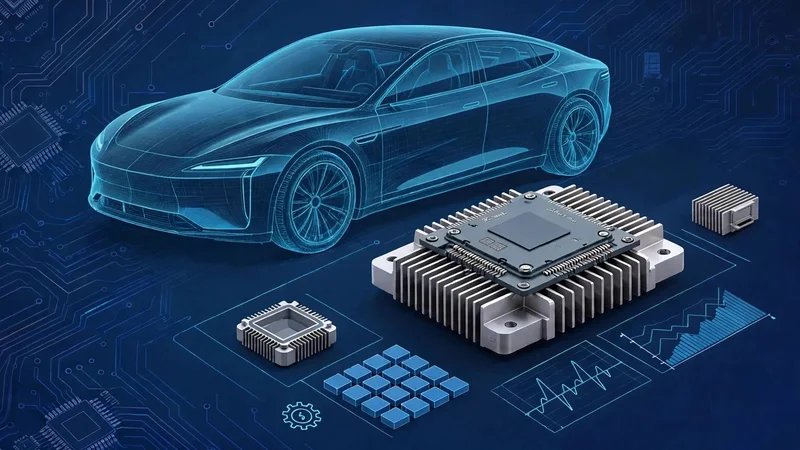
As vehicle power electronics move to higher voltage, faster switching, bidirectional energy flow, and deeper integration, passive components become system-level enablers of efficiency, EMC, safety, and long-term reliability.
Four technology shifts are shaping the next generation xEV:
Coexistence of 400V, 800 V-class, and emerging 900V-plus power architectures.
Wider use of SiC in traction inverters and SiC/GaN in OBC and high-voltage DC/DC conversion.
Integration of the motor, inverter, transmission, OBC, DC/DC converter, and power distribution into e-axle, charger-converter, and X-in-1 systems.
Bidirectional charging, V2L, V2X, and V2G operation supported by increasingly software-defined controls.
Each shift can improve vehicle efficiency, charging performance, packaging, or functionality, while also increasing the electrical, thermal, mechanical, and EMI demands placed on components. Murata solves those challenges with an industry-leading portfolio of passive components designed with Automotive standards in mind.
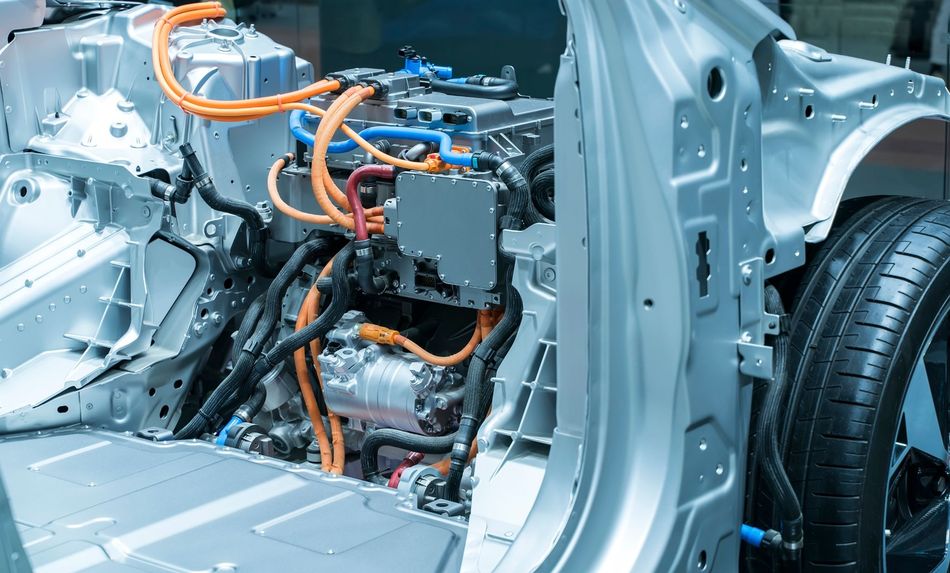 Battery and wire installed on the electric system of an EV. Source: AdobeStock.
Market and Design Challenges
Compared with traditional vehicles or similar industrial applications, electric vehicles introduce a number of unique challenges for power designers.
1. Higher power density brings thermal challenges:
Thermal management—component placement, cooling paths, temperature sensing, and material compatibility—ultimately become part of the electrical design.
2. Faster switching moves EMI into a more difficult frequency range:
SiC and GaN devices can reduce switching losses and enable higher switching frequency, but they also increase dv/dt and di/dt. Parasitic inductance Ldi/dt produces overshoot and ringing, while parasitic capacitance creates common-mode current paths through the enclosure, coolant system, motor, cable shields, and chassis. These issues can be solved by low-inductance current loops, local high-frequency bypassing, well-tuned snubbers, controlled gate resistance, stable isolated gate-driver supplies, and common-mode filtering based on measured or accurately modeled impedances.
3. Gate-driver power integrity becomes more critical:
Fast-switching power stages degrade the gate-driver CMTI, negative gate bias, Miller-clamp behavior, isolated supply regulation, and local decoupling. The impedance and placement of the gate-driver capacitor bank, ferrite bead, transformer, and isolated supply filter help keep the driver stable during a high-dv/dt event.
4. High-voltage design requires coordinated transient and insulation margins:
Regeneration, cable inductance, switching overshoot, load dump within lower-voltage domains, and fault conditions can create higher transient stress. Creepage, clearance, dielectric strength, partial-discharge margin, and capacitor safety classification must be considered as a coordinated insulation system compliance under ISO 26262 up to ASIL D. Following AEC-Q200 is also a component stress-test qualification.
5. Mechanical stress remains an electrical reliability issue:
Vibration, board flex, solder fatigue, coefficient-of-thermal-expansion mismatch, and repeated thermal cycling can crack a ceramic body or termination, which can be solved by Murata Flex, metal, and a conductive resin layer MLCC.
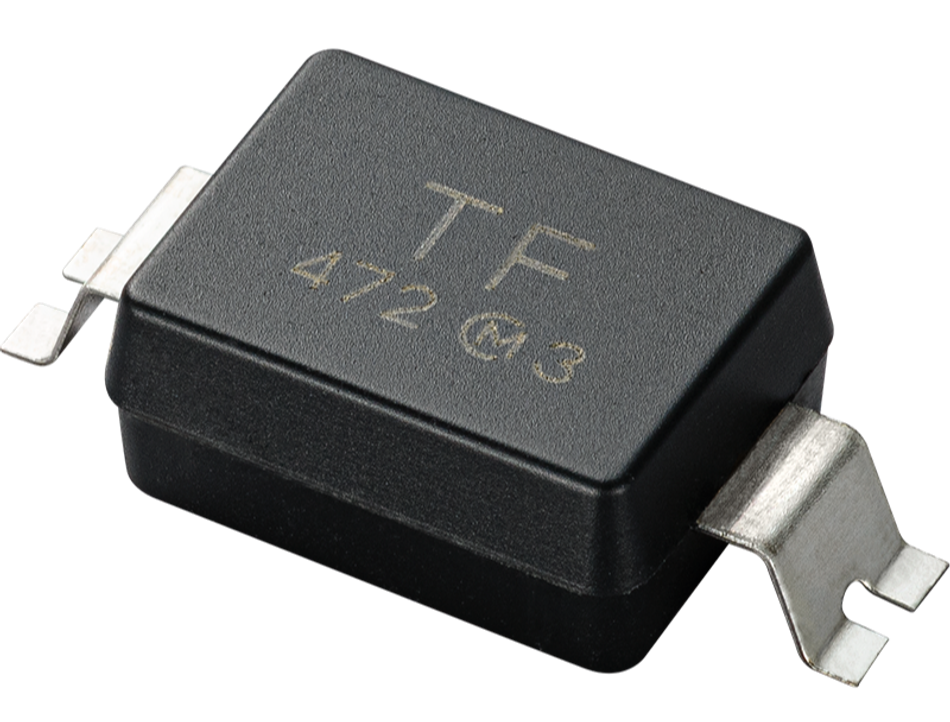 Safety Standard Certified Resin Molding SMD Type Multilayer Ceramic Capacitors for Automotive (Powertrain/Safety) - EVA86Q7UTF101KA01#. Source: Murata
Murata Technologies for Next Generation xEV Power Conversion
A deep understanding of the industry’s challenges supports an automotive-grade portfolio of passive components for high-voltage and high-frequency power conversion. Six technology areas map directly to the design challenges discussed previously.
1. High-voltage C0G MLCCs for resonant and snubber circuits:
Murata has introduced a 15nF, 1.25kV C0G MLCC in a compact 1210-inch (3.2mm x 2.5mm) package, with a 4.7nF to 15nF range. The low-loss, temperature-stable C0G dielectric is well suited to high-frequency resonant and snubber functions where capacitance drift can shift switching behavior, increase loss, or reduce damping effectiveness.
The component voltage rating should still be verified against the actual repetitive and transient waveform, including ringing, temperature, mounting conditions, and lifetime derating.
2. High-frequency DC-link assistance and local decoupling:
In traction inverters, bulk film capacitors remain important for energy storage and low-frequency ripple. Low-ESL MLCCs can complement them by supplying high-frequency current locally, reducing the commutation-loop area, and helping limit voltage overshoot near the power module, isolated gate-driver supply, and control-board rails. Small MLCC banks placed at the load provide a lower high-frequency impedance than a remote bulk capacitor.
3. Safety-certified capacitors for common-mode noise and insulation:
Murata's EVA series combines IEC 60384-14 certification, long creepage and clearance distances, and a metal-terminal structure intended to reduce solder and board-flex stress. Murata offers 500Vac and 1,500Vdc ratings, more than 10mm of creepage and clearance in the outside-bending configuration, and X1/Y2 certification options.
4. EMI suppression supported by component models:
Murata’s EMI suppression portfolio includes EMI filters, common-mode chokes, ferrite beads, and capacitors for power and signal paths. The SimSurfing design tool provides measured-equivalent impedance plots, S parameters, SPICE netlists, and operating-condition data that can be used to narrow component choices and improve pre-layout simulation.
5. Mechanical robustness and high-temperature sensing:
Murata offers both soft-termination MLCCs, which use a conductive resin layer to absorb board-flex stress, and metal-terminal structures that mechanically decouple the ceramic body from the PCB. It reduces the risk of flex cracking and solder fatigue when used with an appropriate land pattern, mounting process, and mechanical design. Murata's resin-molded FTI series NTC thermistor supports wire-bonding and operation up to 175°C.
6. Support for the control and communication domain:
As deeper integration brings power and control and communication, the same enclosure creates noise, thermal EMI, and reliability issues. Murata decoupling MLCCs, power inductors, common-mode chokes for CAN/CAN FD or Ethernet, crystal resonators, and thermal sensors therefore influence the stability of the complete X-in-1 controller.
Building Better xEV Systems with Murata
The next generation of xEV platforms are defined by how effectively the entire system balances efficiency, charging performance, cost, thermal margin, electromagnetic compatibility, functional safety, and long-term reliability.
Murata helps bridge the gap between the capability of modern SiC and GaN devices and the realities of the automotive environment. High-voltage C0G MLCCs, high-frequency DC-link assistance, safety-certified capacitors, EMI suppression components, mechanically robust terminations, power inductors, timing devices, and high-temperature sensing provide the building blocks needed to create denser and more capable xEV power electronics.
The objective is to place the right impedance, insulation, thermal feedback, and mechanical robustness at the right location—and to validate those choices under the vehicle's real electrical and environmental conditions. That system-level approach is how Murata can help customers power the next generation of electrified mobility.