Powering Micromobility: How Connectivity Platforms Drive Smarter Fleets
Smart micromobility operators pair fleet management platforms with connectivity infrastructure to gain better insights into vehicle performance and more effectively manage their fleets as a whole.

22 Jul, 2025. 4 minutes read

Powering Micromobility: How Connectivity Platforms Drive Smarter Fleets
This article was first published on
monogoto.ioConnectivity is the lifeline of connected devices. It’s not a way to differentiate a product; it’s the foundation on which real value is created.
In a recent webinar hosted by Micromobility Industries, leaders from Joyride, ATOM Mobility and Monogoto explored how connectivity platforms help fleet managers remove friction, improve uptime, and scale more efficiently.
Connectivity isn’t binary, nor guaranteed
Connectivity isn’t as simple as being “on or off.” Connectivity providers vary significantly in their support for mobile networks, pricing models, quality of service, and security levels.
Smart micromobility operators pair fleet management platforms with connectivity infrastructure to gain better insights into vehicle performance and manage their fleets more effectively.
Consider expanding into a new geography, say winning a contract in Canada, while your fleet is based in the United States. A US operator may not support all networks in Canada. With a flexible roaming SIM, connectivity platforms can ensure vehicles can be deployed across cities, countries, or continents without the need to swap SIMs or make any changes to the vehicles’ configuration.
“ Roaming SIM cards are great because you don't always know where the vehicle is going to be. Perhaps the vehicle has been taken out of its location. Maybe you are moving the vehicles to a new market because you won a new contract.”
— Vince Cifani, CEO Joyride
Still, even with a great connectivity provider, don’t assume your vehicles will be online 100% of the time. Tunnels, parking garages, crowded city streets, or large delivery trucks can all block signals.
“Connectivity isn’t guaranteed. What matters is how quickly you can respond when it drops.”
— Itamar Kunik, CEO Monogoto
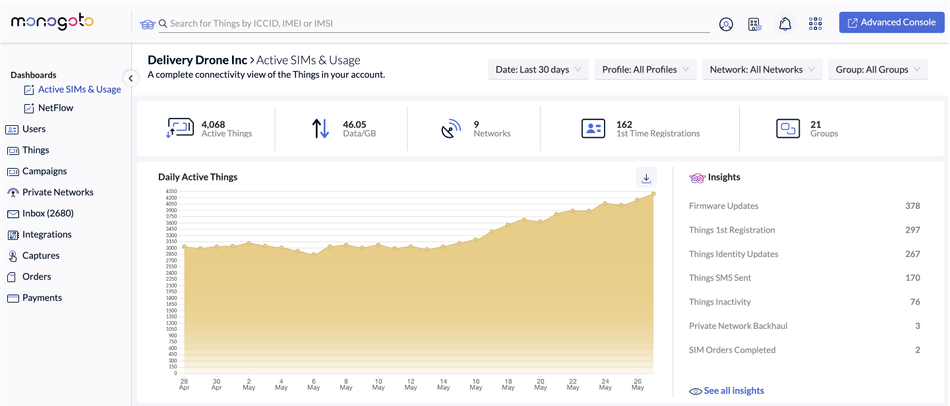
What to do when something goes wrong?
When a vehicle goes offline, how can you determine if it’s due to the SIM? The firmware? The network? The hardware?
Without visibility into the connectivity layer, fleet operators are left guessing. Connectivity platforms in conjunction with smart tooling from JoyRide offer ways to quickly isolate the issue:
- Is the issue related to one vehicle, part of your fleet or your entire fleet?
- Did all devices go offline at the same time?
- What firmware are the vehicles running that went offline?
- What hardware version are the vehicles using, which went offline?
- Is the SIM still registered to a network? Does it respond to pings?
As Vince (Joyride) pointed out: “If a vehicle goes offline, you need to know if it’s the modem, the firmware or the network, without opening it up.”
Connectivity platforms help reduce downtime by providing diagnostics, including the last seen timestamp, network registration status, active/inactive SIM state, ping responsiveness, data round-trip time and real-time device-level logs.
These insights feed directly into the fleet management workflow, enabling teams to act faster and more effectively.
Automate Operations & Reduce OPEX
Manual maintenance and rebalancing don’t scale. Automation does.
ATOM Mobility shared how their platform enables rule-based maintenance tasks, triggered by real-world metrics such as: X rides completed, Y kilometers driven or Z hours of idle time.
Additionally, data on customer ratings can trigger maintenance tasks if recent customer feedback falls below a specified threshold.
But it doesn’t stop there. By integrating connectivity intelligence, new layers of automation can be unlocked. Alerts can be triggered when a device connects/disconnects too frequently, which can initiate redistribution actions and flag a specific area as having poor coverage. If an asset isn’t connecting well in areas while other assets are working fine, a maintenance task can be initiated.
“ Where are the refunds happening? When we know it’s related to connectivity problems, we can make the judgment to rebalance part of a fleet.”
— Karlis Peterhofs, ATOM Mobility
The result: reduced operational overhead, better uptime, and a smoother rider experience.
Anomaly Detection & Alerts
Once your fleet scales, you can no longer monitor vehicle-by-vehicle. Anomalies can be detected by combining data from hardware sources including GPS, accelerometers and ignition events, as well as connectivity data such as network status and user behavior (e.g., ride ratings, duration, distance, speed).
Over time, this data reveals patterns and deviations from those patterns. These deviations are early signs of failure or poor user experience.
Proactive alerts and anomaly detection allow teams to preemptively service vehicles, prevent bad customer ratings and reduce support costs.
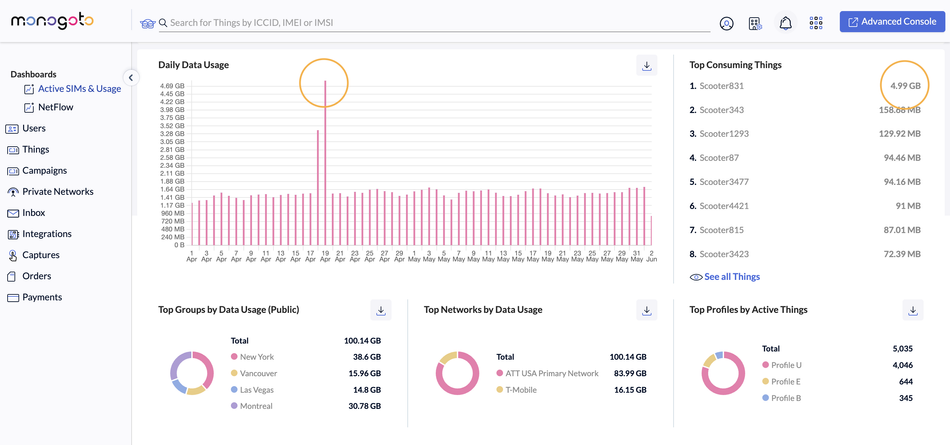
“You can’t look at 50,000 vehicles one by one. AI and historical data help detect what’s ‘not normal’ before customers notice.”
— Itamar Kunik, Monogoto
Conclusion: Start Small, Think Long-Term
“You have this really simplified, unified process where the hardware, the software, the vehicles, the connectivity, all work together.” — Vince Cifani, Joyride
Scaling a micromobility business isn’t just about more vehicles; it’s about smarter operations. And smarter operations depend on smart processes, triggered by actual data. For this to work smoothly, all components must work together seamlessly: the hardware, the software, the connectivity, the vehicles, and the operations team.
“We’ve seen operators grow from 300 to over 3,000 vehicles in a saturated market, not only by choosing the right market and vehicle type, but also by leveraging the right platform features.”
— Karlis Peterhofs, ATOM Mobility
Choose partners who understand your business goals. Integrate automation into your operations from the start. And get the full picture so you can act fast.
Want to learn more? Watch the recording or reach out to us directly.