Powering AI Data Center Cooling with MEAN WELL and Sager Electronics
Ensuring Power Continuity and Thermal Stability in Next-Generation AI Facilities

26 Oct, 2026. 7 minutes read
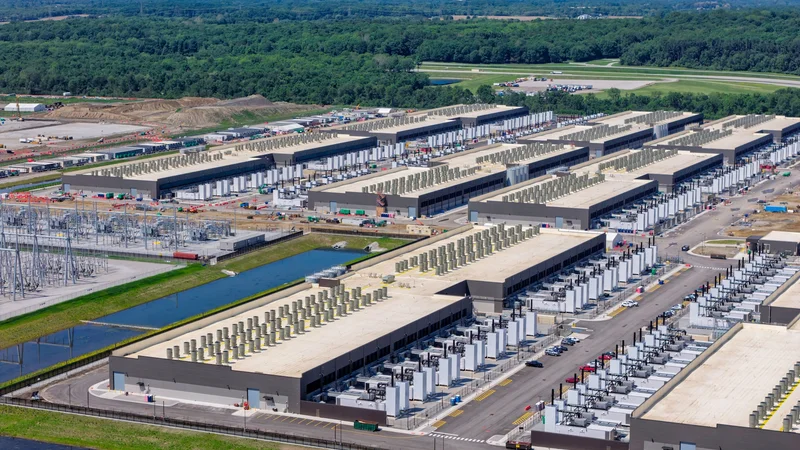
AI training and inference are pushing data centers to their power limits. Today’s racks have climbed from 10kW to roughly 130kW, with 1MW and greater on the horizon. At those densities, air cooling is no longer sufficient, so liquid cooling and its supporting infrastructure have become the de facto solution.
But while liquid cooling improves heat transfer, it also introduces a complex network of pumps, coolant distribution units (CDUs), fans, and controls. And, like any other mission-critical system, it can only perform well when supplied with clean, reliable DC power.
Fortunately, MEAN WELL offers a robust, comprehensive portfolio of AC/DC and DC/DC power products optimized for cooling infrastructure. With high-performance power solutions, operators can more easily scale AI infrastructure for today’s demands, while preparing for whatever the future holds.
The Thermal Wall in AI Data Center Racks
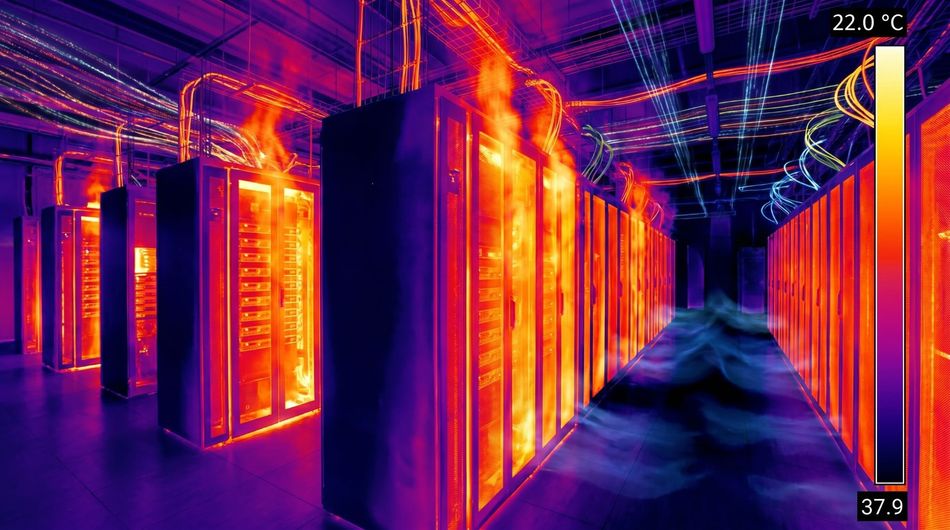
AI rack density has risen much faster than in earlier server generations. Whereas traditional racks commonly operated around 10 to 15kW, AI training racks now span roughly 40kW to beyond 130kW. For example, state-of-the-art NVIDIA GB200 NVL72 racks draw about 132kW, and projected Rubin- and Kyber-era designs range from 250kW to more than 1MW per rack.
Above roughly 70kW per rack, air cooling alone becomes insufficient to remove the heat produced at these densities. As of 2025, high-density deployments commonly used a mix of about 70% liquid cooling and 30% air cooling. Direct-to-chip cold plates and rear-door heat exchangers are now common ways to move more heat out of dense racks without relying only on higher airflow.
Liquid cooling, however, is an active system. Pumps and motors circulate coolant through rack loops and CDUs, meaning coolant flow depends on electrical power. For instance, standard high-density designs use roughly 1.2 liters per minute per kilowatt, which, at 100kW, equates to about 120 liters per minute. And, in parallel to liquid efforts, heat exchangers, power electronics, memory, networking hardware, and other components may still need airflow-based cooling.
The result is a cooling system built around several moving and controlled loads, all of which need reliable power to properly remove heat.
Where Data Center Power Architecture Is Heading
Most data centers distribute power at 480VAC today, and that installed base is unlikely to change quickly. Reworking live distribution equipment can be costly and disruptive, especially when the gain is incremental. Cooling infrastructure is easier to add around the existing plant, which makes it a practical near-term entry point for facilities adopting higher-density AI racks.
New builds face a different problem. As rack power moves into the hundreds of kilowatts and eventually the megawatt range, low-voltage distribution drives current higher and increases conductor size, copper use, and the space needed for power delivery. Industry leaders like NVIDIA are addressing that constraint by adopting an 800VDC architecture, which brings its own set of power challenges.
The higher distribution voltage allows operators to move more power through a given conductor size. NVIDIA estimates that a 1 MW rack can require about 200 kg of copper busbar under legacy approaches. [1] Moving to 800VDC can cut copper requirements by roughly 45% compared with 415VAC and 480V approaches, while improving end-to-end efficiency by up to about 5%.
A higher-voltage DC path can also reduce the number of conversion stages. Instead of repeatedly converting power as it moves toward the rack, the architecture can use a more direct DC path and perform DC/DC conversion closer to the load. In turn, this architecture reduces conversion losses and can simplify the power chain.
The expected timing centers on 2027, in line with NVIDIA’s Kyber roadmap and the broader 2027 to 2028 transition window. For cooling-system designers, that means two environments will coexist: a large installed base built around 480VAC and new high-density facilities beginning to use 800VDC.
Cooling is a Power-Continuity Problem
At AI rack densities, a cooling interruption can create thermal risk almost immediately. For example, if coolant flow or fan cooling drops, processors can throttle or shut down within seconds to protect the silicon. A rack can therefore remain electrically energized while still losing useful compute capacity because the cooling system is no longer removing heat fast enough.
The same issue appears during a utility outage. Data centers use backup systems to ride through dips and outages, but backup generators do not take the load instantly. Diesel generators can accept full load in about 10 seconds, while a UPS carries critical loads through the seconds-to-minutes interval before generator power is fully available.
Cooling has to survive that transfer too. Pumps, fans, and controls may be connected to backup energy upstream, yet a local converter can still reset or enter protection during a disturbance. If that happens, the cooling load drops even though the UPS or battery still has energy.
For that reason, designers should consider the cooling power path from the backup source all the way to the connected load. Beyond the generator and UPS, continuity depends on the converters and local distribution that keep coolant and air moving.
The Power Layer Behind Cooling
Pumps and motors that circulate coolant need power sized for long, high-duty operation. The supply has to match the selected motor and drive, including startup demand, continuous load, and protection behavior. It also needs enough input tolerance to ride through electrical noise, surges, and other disturbances that can appear in a motor-heavy environment. When any interruption to pump power stops coolant flow, reliability outweighs peak ratings.
Fan banks create a different scaling issue. A CDU, heat exchanger, or UPS can contain many fans that run continuously. Efficient DC conversion therefore matters both at the individual converter and across the fleet. Losses accumulate across racks, and any wasted power becomes additional heat that the cooling system must remove.
Regardless of load, designers need well-protected AC/DC or DC/DC conversion that can support years of stable operation without drift or failure.
Requirements for Ride-Through Cooling Power
Ride-through starts with the operating sequence. Cooling power has to stay available as the facility moves from utility power to the UPS and then to generator power, keeping the required fans, pumps, and controls energized through that window.
The converter also has to tolerate events during the transfer. Inverter startup can introduce transients, while motors and groups of fans may draw more current at startup than they do once running. If several loads restart together, short-term demand can differ greatly from steady-state load. A supply that trips or resets at that point defeats the purpose of the backup layer upstream. Engineers therefore need to evaluate normal startup, transfer to backup, operation from the backup source, and recovery when primary power returns. Any controller or monitoring equipment on the backed-up rail also has to tolerate the specified transfer interval.
For cooling power, continuity and transient tolerance come first. Efficiency and power density still matter, but only after the required loads can guarantee availability even through disturbances.
How MEAN WELL Powers Cooling Loads
For operators embracing modern cooling infrastructure, MEAN WELL offers AC/DC rack power and DC/DC converters for the job. Specifically, MEAN WELL offers a series of products suited to continuous motor and pump duty, prioritizing continuous-duty reliability and wide input tolerances over other specifications.
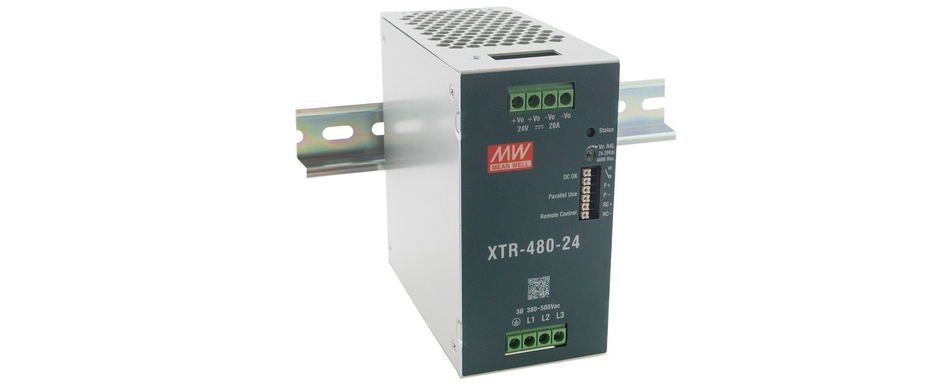
On the fan side, one example is the XTR-480-24: a 480W DIN-rail AC/DC supply that supports multiple 24V, 50W DC fans inside high-power online UPS equipment. With a 24V, 20A output, it accepts three-phase 320 to 600VAC input and can also operate from 450 to 800VDC. By offering both pump-side and fan-side power in one portfolio, MEAN WELL lets designers qualify fewer vendors and simplify BOM management.
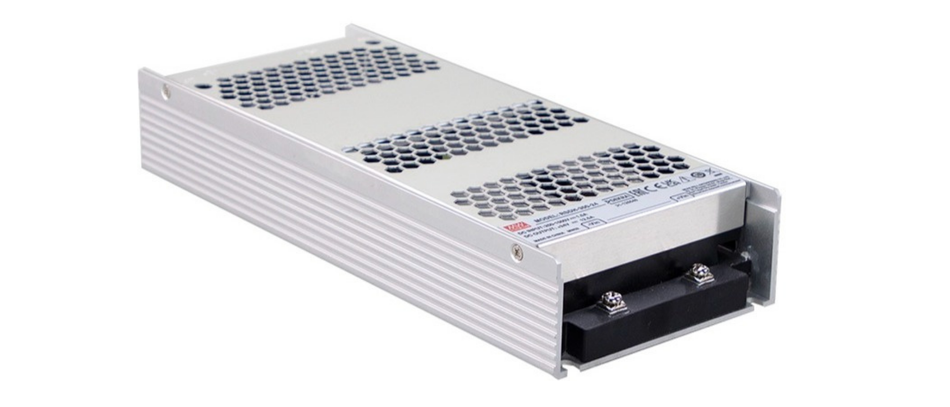
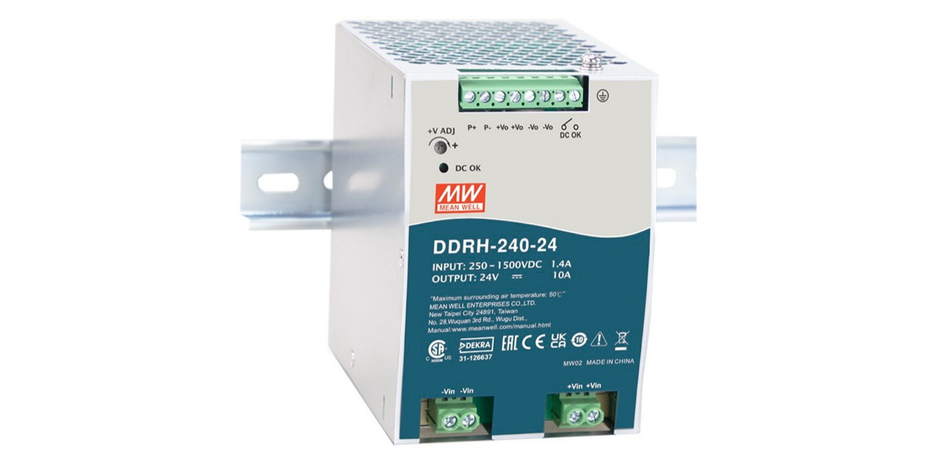
MEAN WELL also covers the high-voltage DC side of the architecture. For example, its RSDH-150/300 and DDRH-120/240 DC/DC families accept 250 to 1500VDC, which encompasses the 800VDC distribution bus. They provide 12, 24, 32, and 48VDC output options, with the RSDH models covering 150 and 300W classes, while the DDRH models provide 120 and 240W versions.
Sager Electronics is an authorized stocking distributor of the broader MEAN WELL portfolio, giving integrators a common, reliable, and knowledgeable sourcing path for AC/DC and DC/DC requirements as cooling systems move from design into deployment.
How MEAN WELL Powers Cooling Solutions
MEAN WELL’s AC/DC power solutions also include UPS architectures that keep cooling loads energized through the transfer window from utility to generator power.
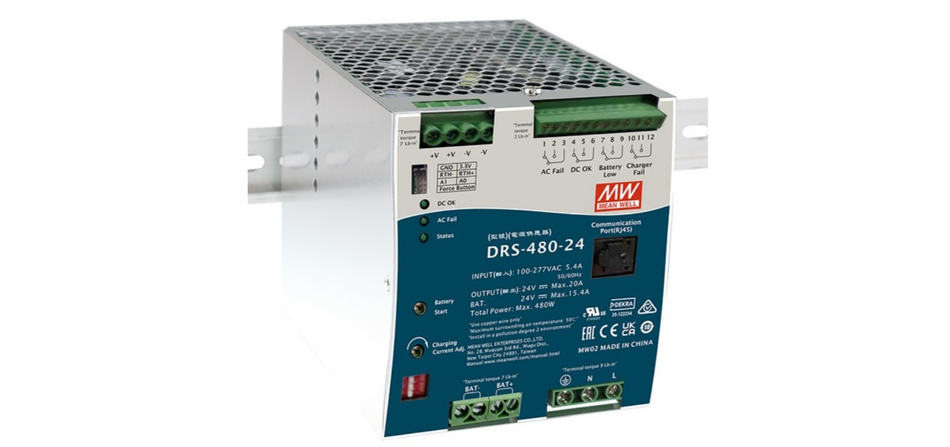
For instance, the DRS-240 and DRS-480 combine an AC/DC supply, battery charger, DC-UPS function and status monitoring in a DIN-rail package. The DRS-240 provides up to 240W and the DRS-480 up to 480W. Both accept 90 to 305VAC input and are available with output variants from 12 to 48V, depending on the model. In either product, when the AC input falls below the specified threshold, the DC-UPS function transfers the load to a connected battery with an AC-to-battery transfer period of less than 10ms.
The DRS units also report conditions such as AC failure, low battery voltage, charging failure, and DC output status through built-in Modbus and optional CAN bus. Designers must include their charging and load-sharing limits in the design, particularly after an outage when the supply may be carrying the load while recharging the battery.
Powering What Comes Next
As AI rack densities continue to rise, reliable cooling infrastructure will become even more critical to data center performance. Pumps, fans, coolant distribution units, controls, and backup systems all depend on power solutions capable of supporting demanding loads while delivering the efficiency and reliability these environments require.
MEAN WELL offers a broad portfolio of AC/DC and DC/DC power solutions designed to support cooling infrastructure in today’s 480VAC facilities, while its high-voltage-input capabilities help address the industry's transition toward emerging 800VDC architectures.
Through Sager Electronics, data center designers and integrators gain more than access to MEAN WELL’s extensive power portfolio. Sager combines MEAN WELL solutions with technical power expertise, application support, and a broad range of value-add capabilities to help customers identify and implement the right solution for their cooling requirements. Together, MEAN WELL and Sager provide the products and expertise needed to support AI data center cooling today while preparing for the power architectures of tomorrow.
Explore MEAN WELL power solutions, or contact the technical team at Sager via this short-form for application-specific support.
References
https://developer.nvidia.com/blog/nvidia-800-v-hvdc-architecture-will-power-the-next-generation-of-ai-factories/