MIT's Injectable Mini Liver Could Save Thousands of Lives
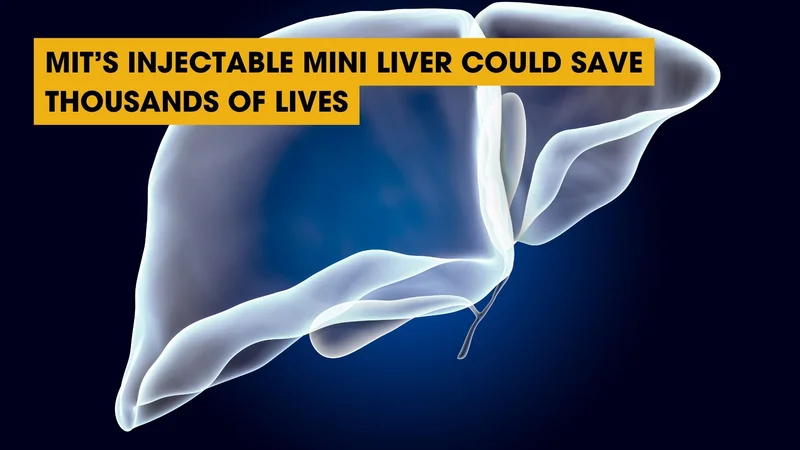
In this episode, we explore MIT's groundbreaking approach to treating liver failure by injecting tiny "satellite livers" instead of replacing the entire organ.

03 Sep, 2026. 15 minutes read
This article was first published on
the-next-byte-wevolver.simplecast.comIn this episode, we explore MIT's groundbreaking approach to treating liver failure by injecting tiny "satellite livers" instead of replacing the entire organ. By combining liver cells with a self-assembling hydrogel scaffold, researchers have created miniature liver tissue that can survive, receive blood flow, and support the body, offering a potential bridge for patients waiting for transplants and a future alternative to major surgery.
Farbod: Livers. Who knew they were so important? Am I right? Well, what if I told you that instead of waiting for a liver transplant, your doctor could just inject a tiny backup liver somewhere else in your body? MIT researchers are working on exactly that, and the weirdest part is it doesn't even go to where your liver is. Let's digest it together.
Alright friends, welcome back to the Next Byte Podcast. As you heard, we're talking about an area that Daniel and I are typically not experts in, which is biology. But those are the most fun episodes because we get to learn together.
Daniel: It's exactly what we're here for. We're here to learn. That's the reason why we did the podcast to begin with. So you're gonna see us we're
Farbod: And it it's gonna be a good one. But before we jump in, let's talk about today's sponsor, Mouser Electronics. Now, if you've been walking or walking, if you've been listening to us, watching us for a while now, you'll know that we love working with Mouser because they're one of the world's biggest electronics distributors. And by being one of the biggest, they get to work with really cool folks in industry and academia, and occasionally they share what they're seeing.
Just to show you like the breadth of work that they have coming across our desk, the resource that we're linking in the show notes is about like bioprinting, right? And specifically bioprinting for corneas, which, you know, if you're thinking about electronic suppliers, you might be thinking, why? Why are they even talking about the medical realm? Well, this field is so advanced, and technology is penetrating into every single subfield that you could think of. They're a resource that they have decided to discuss is about this company called Pendorum Technologies. They've taken on this massive challenge of cornea transplants and they've shared some really interesting statistics like how one in eighty people in India, where it's like the most detrimental, don't have access to cornea transplants at all. Like, even if they find a donor, the procedure to have the transplant done is so expensive, it's so prohibitive that's not done whatsoever.
And India is one area of focus, but they've decided to take this challenge on worldwide. This company has taken this novel approach of saying, you know, if you can't find the transplant, can you make your own? And they've decided to use additive manufacturing or 3D printing to challenge this, which is where Mouser's technology, you know, expertise starts to chime in. These folks are talking about how they came up with this bio ink, which is a hydrogel, based on stem cells approved by the FDA, to create the cornea that would be transplanted off-site and then having the surgery done, which removed a very restrictive portion of the entire process. But you still had to do the surgery. There was the post op, all that stuff. Which again, there's cost, there's time. It's limiting for folks that might not have access to a surgical center. So they were like, hmm, could we just like eliminate that part? And once the surgery has started and the cavity's there, could we just in situ do the 3D printing process? So they're talking about this they dubbed it 4D printing, which I don't know how I feel about the name. It feels like, you know, we could have put a little bit more thought in there as as the founders of this incredibly novel process.
Daniel: It also still feels like there are only three dimensions.
Farbod: That's what I'm saying. Like, really? It's like that movie theater that's 4D, but it's just 3D. It's just whenever the donkey sneezes, they're just spraying water at you. I digress. They're talking about depositing this bio ink into the cavity and then doing the photo cross-linking process that turns the ink into the hydrogel that acts as the scaffold, which is the cornea donor tissue. So really interesting topic. we're, like I said earlier.
Linking it in the show notes. If you're at all interested in understanding what like the nature of the world looks like when it comes to doing transplants and how difficult it is and what the leading edge of solutions looks like for it, you should definitely check it out.
Daniel: and how to specifically engineer the materials which are used in a bio ink style printing with very, very similar parallels to what we're talking about as the meat and potatoes of today's episode.
Farbod (04:44)
I I was telling Daniel before we started, I think this is one of the best transitions we've done because of how well the Mouser resource links pun not intended to the actual cross links. to to the actual article we're talking about. Which, you know, speaking of, we're going back to MIT. Haven't been there in a minute. It's it's been a couple episodes, a couple dozen maybe at this point, that we've talked about research coming out of MIT, but, we're going to the Bhatia lab, Professor Sangeita Bhatia, and then postdoc researcher Vardman Kumar. We're talking about livers and liver transplants. Now I'm gonna confess on how little I know about livers basically up until this point. I knew the liver is important because every time I take an Advil, it says, you know, don't take too much. And then I know that liver disease is bad because you hear about it in TV shows and stuff. It's like, this person needs a transplant; it's really tough to get.
What I didn't know is that your liver does a lot. It's basically the toxic chemical processing plant of your body, kinda like how wastewater management gives us clean water when it takes wastewater in. It does that and then like five hundred other things.
Daniel: Yeah. Controls your metabolism, makes proteins that live in your blood, helps you fight off infection. The the short, yeah, heals itself. The short answer is that you can't live without your liver. That you know, what does the organ do? Helps you live. It's the liver.
Farbod: But the liver is an incredible thing, and if it did any of those single functions, it would already be like, wow, that's crazy. It's so necessary. But it does a lot. And what's surprising is that by mass, eighty percent of the liver is actually this cell called a hepatocyte. Hepatocyte. Am I saying that right? Alright, I took ESL, so we have Daniel here to just like sanity check. But the hepatocytes are the real like warriors here. They're the ones who have the heavy lifted. And when we're talking about, you know, liver disease, which pulled some stats. We have about ten thousand Americans every year who are on the waiting list for liver that have chronic liver disease. their livers have reached the point where it can no longer self-heal. They have to get a transplant. There's no other way. And unfortunately, Dr. Sangita in the video by the way, which we're also gonna link in the show notes, sent something crazy, which was eighty-five percent of people who need the transplant can't actually get it. And that breaks down into like different categories. One is like organ not being available, which makes sense. But the other side, which is, you know, more heartbreaking, is that even if it was, they can't survive the surgery. I tried to dig a little bit deeper. Another statistic that came out from the Mayo Clinic was that twelve to seventeen percent of people on the transplant list die every year because even though they're willing and able to have the surgery, there's just no liver that's available for them. So
Daniel: We don't you you need your liver to live. It's not like a kidney where you can be like, I'll I'll be a kind person and donate one of my two kidneys and we'll both be able to live. Like it's kind of gruesome, but the way that you get a liver is by someone passing away and them being an organ donor and them being healthy enough for to be able to harvest the liver and the doctor, the medical system, being able to harvest that liver fast enough after you pass before it degrades on its own. So I mean there's a lot of qualifiers there. And then to make matters worse, if someone's so sick that they need a liver transplant, likelihood is that they're probably too sick to be able to survive the surgery. crap, what do we do?
Farbod: So it's natural that some of the brightest in the world are trying to tackle this problem, right? K what what do we do here? And one of the more interesting approaches has been can we create these cells that are really doing the heavy lifting, the hepatocytes, and just inject them into the bad liver, right? Like, fellow engineer here, that makes sense, right? Like you got the bad thing, you put the good stuff in and it works, right? No, it doesn't. These hepatocytes, after being injected into your liver, die pretty quickly, actually. They need to connect with each other and form structures where blood and oxygen can flow to sustain them. And simply shooting them into a failing liver does not allow for that to happen. So, you know, folks have thought about this. You know, how do how do we make this work? But generally it's been a failure. You know, spoiler warning, this lab had the same idea. It was like, can we can we see if we can replicate that same idea, but make them actually live? Now, the way they went about it is pretty interesting. You know, with the Mouser article, we were talking about 3D printing and having a scaffold, and that scaffold has the stem cells, which allows, you know, the growth of whatever tissue that you like. The folks at MIT took a similar approach where they were like, we have these hepatocytes, which are the foundational stem cells, let's just call them, even though that's not what they are technically, for the liver. We need them to bond and stay bonded together after they've been injected or inserted into a patient. And then we need to make sure that blood can flow so they can live long term. Instead of creating this bio ink, they combined these spherical gels. They literally call it balls. They're like you have these balls of hepatocytes, these balls of gels, you bring them together and they start linking into a gel-like material. They shove that in a syringe, and this gel material, what's interesting about it is even after going into the syringe and being pushed out, it keeps the same mechanical structure. So it's not dissolving, the pressure isn't like breaking it apart. You still get this binding of the gels and the hepatocytes going into the body. Then what is ends up happening in the body is that when the structure is in the general shape that you want it to be, they're using ultrasound to engineer it even more and move it to the right place inside the body for it to do its thing. And by the way, that right place isn't the liver. They're not putting this thing inside of your failing liver. They're calling them satellite livers, which can be placed anywhere, theoretically.
Daniel: Yeah, which is crazy, right? Like imagine and this like hits close to home. My mother in law passed she had bile duct cancer that spread to her liver and she was in a very similar situation where it's like they weren't able to operate, but if they were able to give her a satellite liver as an example that was further away from the cancer, there's a chance that this would have contributed to her having an improved quality of life and living much longer than she did.
What's awesome though, is that they basically are like looking at all of the ready mix ingredients required to make a satellite liver. So you mentioned like the vast majority of the mass of the liver are these hepatocyte cells. But there's also blood vessels involved and there's also proteins involved that are holding it all together. So they're like, sweet, let's mix all those ingredients together and put them inside a syringe and let's inject that anywhere in the body. So they've got these hepatocyte cells, they've got these new blood vessel cells that help stimulate blood vessel growth to bring oxygen and nutrients to these cells, and they also have the hydrogel structure that helps carry these liver-made proteins back into the bloodstream and have the satellite liver contributing to the health of the body. It's like let's just look at the main ingredients of what is in the liver, let's mix those up in a syringe and let's find a good spot in the body to inject it to it. It feels so simple but technically complex to execute for sure.
Farbod: And and the promise of it is interesting, right? 'Cause you're not replacing the liver, you're not healing the failing liver, you're just adding essentially little micro livers to help out the body while you figure out what to do next, right? And I think that's what's so promising about it, going back to the statistics that we were talking about. Think of the people that can have the surgery, their body is not weak enough yet, but just ran out of time waiting for a donor liver. In the trials that they were running, you know, they were doing it with mice, these structures survived for up to eight weeks. And even after they were doing their study, they were still secreting the necessary molecules that you would expect from a liver, right? Those eight weeks could mean life or death for the 12 to 15% of people that lose their lives every year waiting for a liver. And if you take a step back from that, imagine, you know, we keep talking about quality of life being weak because your liver's failing. Imagine if those satellites or a combination of them could help people like cross the line and become healthier and be able to have surgery because they were able to bridge that gap due to these microsatellites in their bodies.
Daniel: One thing that I think is interesting too is like in theory, doing this hepatocyte cell therapy rather than doing a liver transplant is a way of making a donor liver go a lot further and help treat a lot more patients. But the catch is that in the current scenario, when you do a liver transplant or a liver cell transplant or liver cell therapy into someone's body, around 70 to 80% of those cells end up dying because they aren't attached into the ecosystem, they don't get enough blood supply, there's not enough structure around them, scaffolding around them, for them to be able to attach into the body, graft into the body, and grow into being functional tissue. So you're wasting a lot of these donated cells. And it actually turns out to be like it doesn't actually help much more than one person. One person's liver can't help treat much more than one person, but if you get to the point where that fraction of cells that survive is vastly higher. You can get to a scenario I'm just doing napkin math here, but you could get to a scenario where that if that effectiveness is more like 80 to 90% instead of 30%, you could use the number of healthy cells from a donated liver to help treat four or five people, as opposed to just one. And that helps the liver supply issue as a part of the there not being enough donor livers to be able to support people to help them stay alive. It helps that supply issue as well. If you can take one liver and use it to create tissue grafts in five people, you can't just chop up a liver five ways and then go implant those with surgery and expect it to survive. So this is another unique way of making what's the constraint here? There's a couple constraints, right? The patient's health and their ability to be able to survive a surgery. Just doing an injection, injecting a graft is way less invasive than cutting someone open and replacing their liver. Separately, there's a supply constraint, and this also helps the amount of constrained supply go further and help treat more patients, which I think is very interesting. And the key unlock here is actually the bead, hydrogel bead scaffold that they're mixing into the syringe. There have been people trying to do these injectable cell therapies for a long time, but the scaffold that they mix into the material is the thing that's unlocking improved survival rates of these cells.
Farbod: You're absolutely right. And to kind of build on what you're saying, Dr. Bhatia mentions it in the video, but again, assuming all conditions are met, that there is a donor liver and that you are able to have that transplant surgery done, you still need to be close to a surgical center that can accommodate that kind of a procedure, right? And that's not necessarily the case for everyone that needs a transplant. But the idea of an injectable satellite liver, that's not something that needs to be done at a surgical center. It can be in a clinic, literally. Right? So it becomes a much more accessible treatment when you think about again, everyone that needs it. We're so lucky to live in an environment where every healthcare that you need is easily accessible, but that's not the case for the wider audience across the world.
Daniel: One thing that I think is cool too, we keep referring to the video. Like, I feel like if you don't want to read the full article, you already listened to the podcast. But if you don't want to listen to the full podcast or you want the three-minute download, you should watch that video because it really is a good job of explaining succinctly what this team is working on. But they also mentioned that there's the potential to use this exact same recipe as a platform for other cell therapies too. So hepatocyte cell therapy is not the only cell therapy that is life-saving treatment for people, where the survival rate of the cells that are being injected ma matters massively toward the overall effectiveness of the end result of how that cell therapy works. You know, they've basically said we, you know, we tested this for liver cells, but there's a pretty darn good chance that you can use the same hydrogel beads and the same cells that they're using to promote blood vessel growth and go rinse and repeat with a different type of human cell that you're injecting as a part of cell therapy and use that to increase the effectiveness of that treatment as well.
Daniel: I was just gonna say measure your optimism. They've only tested it in mice so far, right? Like they've only ever done animal testing. There's a long road for experimental therapies like this to, like make it into where you can do human trials and then it becomes you know, a widespread treatment. But I will say it's promising from an equipment perspective, like you're saying, is that there's not really like a super novel technology required for the actual administering of the treatment where the novel technology where the innovation happened is in the material. So in theory, provide these syringes of you know, the correct mix of material to lots of people, and if they have a long hypodermic needle and an ultrasound machine, like you're saying, you could go get your liver graft at a at any random clinic, which is pretty crazy.
farbod: And like I I'm trying to put myself in the shoes of someone that might have chronic liver disease. If this was offered to me as like an experimental procedure, I would interpret it as like, okay, like what is the downside? It's not touching my liver, right? And I know it's not like a long term fix. It's just
Daniel: Yeah, the only downside I'm aware of is like they make you take immunosuppressive drugs so that your immune system doesn't kill the...
Farbod: Which, if I'm not mistaken, is the same thing they would do when you get a liver transplant as well. Right?
Daniel: For sure. Yeah, yeah, yeah. I'm just saying it would suck to suppress your immune system in general. But yeah. It's not a new risk if you've already
Farbod: No, for sure. Agreed there. Yeah, yeah. I just meant, like what I'm saying is like if you're already in the in a state where you're waiting on that and you don't know like necessarily there's just no certainty about the procedure itself or the donor, it seems like all in it's it's like a net positive. It's like worst case scenario just doesn't work, but if it does work, then it's just positives all around. but the silly thing I was gonna say earlier is like we love acronyms. We didn't actually touch on it here. Dave named this thing injected self-assembled image guided tissue ensembles or insight. Which like insight but insight? Like, come on, that's pretty good. It's like a solid eight out of ten for me.
Farbod: Alright. Folks, more than ten thousand Americans are currently waiting for a liver transplant. But MIT researchers are exploring a radically different idea. Instead of replacing your liver, what if they could just inject you with a tiny backup one? They're mixing functioning liver cells with microscopic hydrogel spheres and they inject them into your body where they assemble into a small soft tissue. Blood vessels can then, like, grow into it to keep the liver cells alive. And in mice, the little livers they've been putting in there, have actually been working for an entire eight-week study. It's still like super early research, but eventually this could provide temporary support while someone waits for a transplant or potentially even offers an alternative to a transplant altogether.
Good. Alright, folks. That's the pod.
Episode Notes
This episode was brought to you by Mouser, our go-to source for electronics parts for any hobby or prototype. Click HERE to discover how additive manufacturing is revolutionizing cornea transplants.
Become a founding reader of our newsletter: http://read.thenextbyte.com/
As always, you can find these and other interesting & impactful engineering articles on Wevolver.com.