How JOT Microfactories Are Ushering in the Age of Automation
Kimmo Kilpeläinen, JOT Automation Global Key Account Manager, discusses the impact of automated microfactories on productivity, labor, and costs.

23 Sep, 2026. 6 minutes read
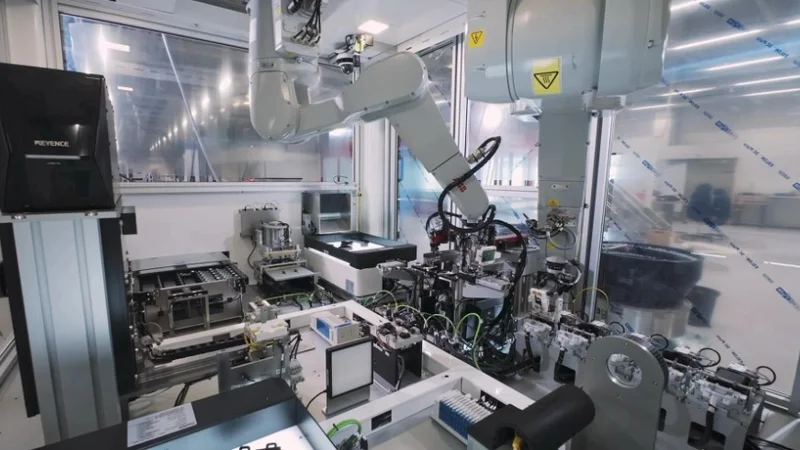
If there is one trend whose impact on global manufacturing markets can’t be overstated it is that of automation. Driven by robotics, digitalization, and smart technologies, industrial automation is enabling manufacturers from virtually all sectors to streamline their processes and augment productivity and consistency, all while mitigating costs and labor requirements.
Perhaps no one understands this paradigm shift better than JOT Automation, a Finnish company with nearly four decades of experience in automation that specializes in delivering modular microfactories to a variety of industries, including automotive, telecommunications, consumer electronics, and power electronics. We recently had the opportunity to speak with JOT Automation’s Global Key Account Manager, Kimmo Kilpeläinen, about the company’s ANT Plant Microfactory and the benefits it is bringing to end users. He also speaks more broadly on the state of automation today and how JOT Automation is facilitating the transition to efficient production and reshoring.
Manufacturing Welcomes Microfactories
When one thinks of a factory, one typically pictures a massive building fitted with large-scale machines, conveyor belts, and workers working tirelessly to achieve a target output. But this is not the only representation of a factory that exists. Increasingly, manufacturers are turning to microfactories, which are compact, highly automated production facilities designed to fulfill complex manufacturing tasks.
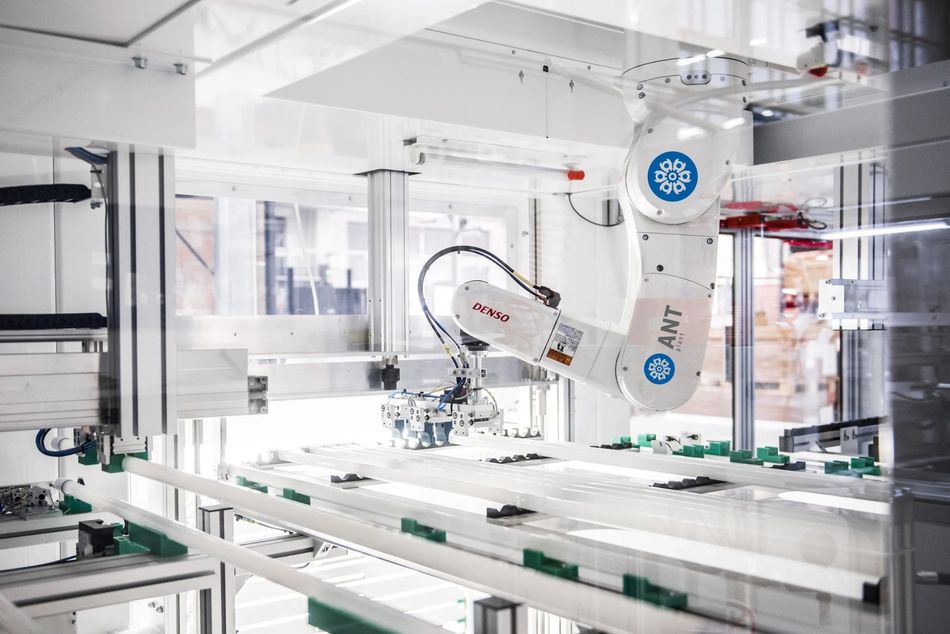
Notably, microfactories are not just an alternative to old-school manufacturing floors; they also offer an economical alternative to customized automation systems, which can take years to implement and come with a massive upfront investment. That’s because microfactories like JOT Automation’s ANT Plant Microfactory are based on a modular, pre-designed structure that can be easily tailored to the manufacturer’s production requirements, whether it's assembly, testing, laser marking, packaging, or all of the above.
In the case of the ANT Plant Microfactory, the system is based on modules, which integrate ceiling-mounted robots to maximize the workspace in the production cell. Each module is designed for one application, and multiple modules can be integrated into a workflow or to scale production as needed. If product design changes, end users can also adapt their ANT Plant Microfactory cells by installing new tooling. This capability is key for manufacturers that must maintain production flexibility or who have high-mix production requirements.
As Kilpeläinen explains: “We can offer flexibility and modularity because when you need to update your products, you just need to change some tooling in the cell module. In that way, the modular configuration is very efficient to use.”
Collaboration at the Core
From the customer’s perspective, adopting JOT Automation’s microfactory solution starts with collaboration. As Kilpeläinen tells us, in most cases a customer will come to them with an idea and a Request for Information (RFI). “They introduce their case to us, and then we evaluate the customer process and how suitable it is for automation. If there is room for improvement, then we tailor our microfactory to get the best results. We also offer a proposal of how the product itself could be modified to fit better with our processes.”
This collaborative approach also takes into account customer limitations, including physical space, budget, and timeline. Beyond these, Kilpeläinen suggests that the ANT Plant can accommodate a wide variety of applications, including assembly and testing of consumer electronics, EV batteries, power electronics, and more. In cases where the production requirement is too complex or too big for a microfactory — ANT Plant robots specialize in handling parts under 10kg—the company also develops custom automation solutions from scratch.
When it comes to installation, the Microfactory has nothing but benefits. Compared to a traditional automation system built from the ground up, the ANT Plant Microfactory can be delivered 30% faster and be installed on site in as little as eight hours (90% faster than a custom automation infrastructure).
“It's a ready platform,” Kilpeläinen says of the ANT Plant. “When we are dealing with the customer, we need only design customer-based applications. That means that on day one, when we get the purchase order from the customer, we can already order parts from the supplier because we don't need to design anything from scratch—70% of it is ready. And while those parts are coming, we can design for the applications.” This concurrent approach shortens the delivery time dramatically.
Bringing Microfactories to the World
JOT’s innovative automation solutions have not gone unnoticed and many end users have welcomed the adoption of its ANT Plant Microfactory. In fact, within one year of launching the modular microfactory, JOT Automation had made €20 million in sales from Europe and the United States.
At the time of this milestone, in late 2025, Kilpeläinen stated: “There is clearly traction in the market for this type of solution. Customers appreciate the possibility to start manufacturing quickly with minimal risks and scale manufacturing as needed.”
To date, the greatest interest in JOT’s microfactory solutions has come from manufacturers in the automotive and battery industries as well as power electronics and consumer electronics.
For instance, a leading manufacturer of electronics in the United States installed a fully integrated ANT Plant microfactory for its battery electric vehicle electronic control unit (BEV ECU) assembly and testing line. This installation, which spans only 4.1 square meters (44.1 square feet), is designed to handle 14 high-precision tasks, including component feeding and assembly, ROM writing, laser marking, and electrical testing. Not only that, but the modular nature of the microfactory enables the customer to easily scale up or update the tooling for future product variations.
Despite these tangible benefits and enthusiastic adoption by certain sectors, there are still hurdles to the broad rollout of automated microfactories. Among these challenges is awareness: many manufacturers simply don’t realize that economical, modular microfactory solutions are already on the market. “There hasn’t been a customer who has said that the system isn’t working,” Kilpeläinen explains. “We’ve proved that it really is working and that it is cost competitive. But I think awareness is a key thing. We have to push our stories and tell everybody what we can do and that the technology is here. That’s how customers will find out.”
Besides a lack of awareness, he also cites organizational inertia as a key hurdle, particularly long decision timelines that can impact a manufacturer’s ability to stay competitive. Fortunately, the rapid assembly and installation of the ANT Plant Microfactory can address this particular challenge. “When we start talking with a customer, it takes time on their end to make decisions about the investment and ROIs, etc. Often, by the time a decision is made, a significant part of the lead time has elapsed. That means we have to deliver the microfactory quickly, which we can do with the ANT Plant.”
Production Comes Home
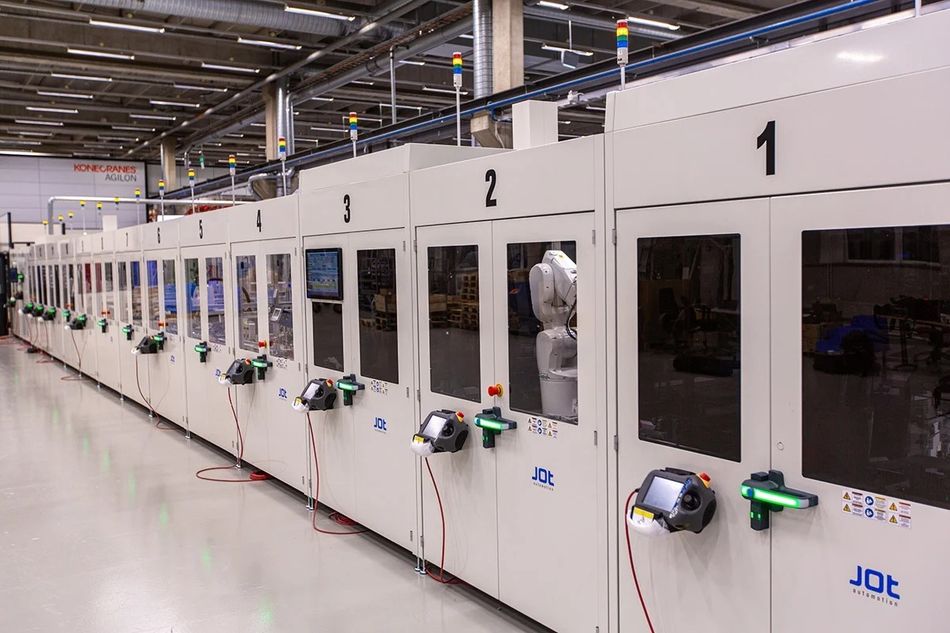
Another key benefit of JOT’s microfactories is that they enable manufacturers to reshore production. With much of the company’s business coming from Europe and the United States, it’s clear that establishing manufacturing at home is a key priority for many customers, as they aim to simplify and strengthen supply chains, protect themselves against tariffs, and overcome labor shortages.
Microfactories like ANT Plant are facilitating reshoring by offering a pathway to rapid, modular, and low-cost automation. In one case, for example, Kilpeläinen explains how a customer was able to transition from using 50 employees at a factory in China to needing two people to run the microfactory in Europe. “Cheap labor is not a winning case anymore,” he says, “And on top of that, there is no human error in the processes because everything is automated.”
The minimal labor required to keep the microfactories up and running is skilled labor, and JOT Automation provides training to operators from the beginning of the collaboration and beyond the installation process. “When we are doing the installation, we are teaching key topics to customer engineers and maintenance people,” he elaborates, “After installation, we also have a support period where we are available in case something happens.”
Fortunately, the learning curve is not steep and the ANT Plant system integrates a number of safety features that, on top of not requiring much intervention, keep operators completely safe. Among these features is an enclosed cell and electrical locks that prohibit entry into the unit when production is ongoing.
JOT Automation, Up for a Challenge
With the manufacturing landscape undergoing a dramatic shift impacted by new technologies, supply chain challenges, and labor shortages, automation is central to remaining competitive. And while some may think the path to automated production is difficult and costly, innovative players like JOT Automation are showing that this doesn’t have to be the case.
With its modular ANT Plant Microfactory, the company is enabling manufacturers in diverse sectors to implement automation rapidly, flexibly, and cost-efficiently. Presently, the company is largely serving electronics and battery markets, which benefit from the compact, highly precise capabilities of the robotic automation platform, but Kilpeläinen wants to make clear that its solutions are broadly viable and can transform virtually any production application. “What I always tell the customer is to challenge us,” he says. With that said, if you have a manufacturing application or a reshoring need that is being held back by lead times and costs, JOT Automation’s microfactories might just be the answer.