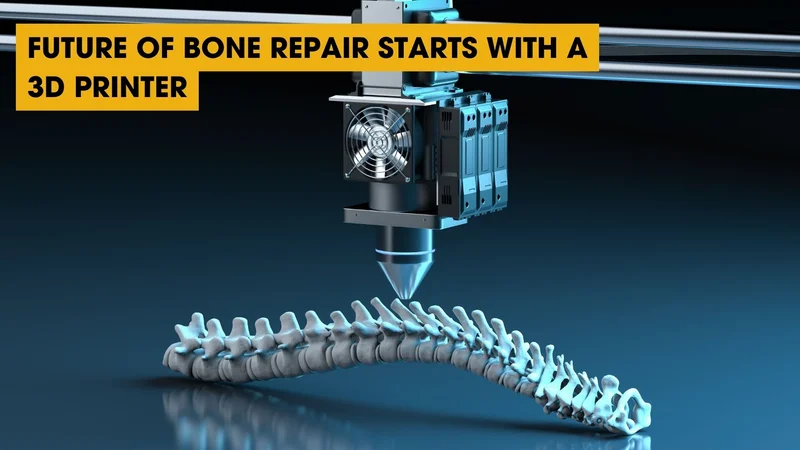
Future of Bone Repair Starts with a 3D Printer
In this episode, we explore a new 3D printable material that can quickly transform into a strong, bone-like scaffold capable of supporting new bone growth. Learn how this breakthrough could lead to faster recovery times and improve treatments for patients with serious bone injuries.

22 Jul, 2026. 9 minutes read
This article was first published on
the-next-byte-wevolver.simplecast.comDaniel: Hey friends, if you've ever had a bone fracture or bone surgery or dental repair, this this might hit home for you is the fact that bone is one of the hardest things in the human body to grow. And it's really, really challenging for doctors to find a way to 3D print any grass for bones too. In today's episode, we're talking about scientists that figured out a new way to 3D print bone that hardens itself, helps real bone grow back. And the best part is it does it all at room temperature instead of at insanely high temperatures like other premium solutions.
Howdy folks, welcome back to the Next Byte podcast. As you might've heard during the intro, today we're talking about 3D printing bone that hardens itself, which is pretty exciting. Before we jump too quick into this topic, let's talk generally about the aspect of 3D printing as it relates to medical implants and customization. It's really interesting. Additive manufacturing is great for implantable medical devices.
And the reason being is like every single person's body is different and every single injury is different. And so you've got complex geometry. You've got constraints on what materials can go inside the body. All of this lends itself really, really well to 3D printing, which lets us use complex geometry, lets us use complex materials and solves a lot of problems for the medical realm, which helps make like state-of-the-art care, which typically was reserved for like spending a lot of money machining or forming some specific type of implant, making that customizable and accessible at a lower cost. If you're interested in this topic at all, I would recommend you check out a resource from today's sponsor, Mouser Electronics. They do a fantastic job of making complex technical topics easy to understand, which is basically the primary goal of the podcast for us here. So that's why we love partnering with them.
It's a great technical primer on 3D metal printing for medical implants. And it's highly relevant to today's main topic, which is about 3D printable scaffolds for bone growth. I would say a lot of the 3D metal printing that's discussed in that episode, the principles apply here in bone growth. And they're even talking about in that original article from Azure Electronics, they even talk about some of the complex geometry constraints and material selection constraints that this team from ETH Zurich, EMPA and University of Freiburg are trying to solve with their 3D printable bones today. So definitely worth checking it out. We're going to link it in the show notes. Give that a click if you're interested in 3D printing for medical implants.
Farbod: I'm excited about this, man. We've touched on additive for implantables, just like the ad mentioned, but growing bone or helping regrow bone is a topic that hits home for me. Because I've only broken or fractured one bone before and I hated the recovery process. So if anything can help that, I support it.
Daniel: Well, that's what I going to say. Bone in general, doing some research for this, it kind of reminded me, because I never have broken a bone, or at least I never been diagnosed with a broken bone. I'm pretty sure I broke my collarbone, but never like got it checked out. But bone is one of the hardest things in the human body to grow. And it's definitely one of the hardest things in the human body to 3D print, because bone needs to be insanely strong requires mineral deposits, which take a long time for the body to grow, like to put calcium into your bone. It takes a long time for that to grow. But the problem is you can't just like make a block of solid calcium and then put it in the body and expect it to attach and work well because you also, bone is living, breathing thing. It needs a bunch of tiny holes so that cells can pass in and out of it. So blood vessels can grow through it. So you need like highly porous bones and you also need them to be able to like be built. of the minerals that are required in bones, ⁓ the best things that we have available today basically forces you to have a trade off of one or the other. can either use the, you can either use like the production intent material. You can use minerals that are just like your bone at room temperature, but they won't be that strong. Or you can create a really, really strong thing using a giant industrial oven that's at high heat, but then the problem is you can't use the materials like calcium that harden quickly. You can't do that in a giant industrial oven without burning it to a crisp. So big giant bone injuries like major fractures, bone loss from cancer and infection, jaw repair, spinal fusion, any large bone grafts that typically would need a graft or a metal implant. These engineers struggle with this trade-off, which is like, we can either make it strong and it has poor porosity in the bad material. So it doesn't often take well to the body or you can make one that's porous, but it's weak and it won't be strong for a long time until the body like grows the actual minerals around it.
The research team says, can we basically create a scaffold that gives us the Hannah Montana best of both worlds? So we can 3D print this easily. It hardens fast, but also make sure that it's strong enough to support weight. And also porous enough that it actually helps to support for real bone to grow back really quickly. And I think about like you, when you broke your bone, you probably had to wear a cast for several weeks and like it took a long time for the body to heal and grow that back. Imagine if you had a surgery or something like that, where they had to cut out several inches of your bone, you'd have been bedridden for months.
Farbod: Yep. And I still, I gotta recognize, again, when I see it, the Hannah Montana quote, very nice. But yeah, man, like I had a fracture, so it wasn't even a full break, and it took like two months. I was 12 years old, so that's like peak bone activity, I guess, know, beginning of puberty, but it still took forever. And the only thing I had on my mind is like, this is unfortunate, but if it was a full break, I would just be out of commission.
Daniel: And imagine a situation where like, I don't know, you had bone cancer or something like that and they had to take giant chunks of your bone out, especially in a large bone like your femur, your pelvis or something like that. I could see it taking years or maybe never healing. But the awesome thing we can talk about here is this team succeeded in making 3D printable bone scaffold ink that hardens at room temperature. So you can use the intended materials without having to burn them in a know, several hundred degree oven. The scaffold cures and becomes strong enough to carry weight in about one week after implementation. And stem cell tests showed signs of new bone growth, including collagen and osteocalcin, which is the version of calcium mineral that happens, like that's formed around your bones. This test with stem cells showed that when they put these stem cells on the scaffolds, it promoted new bone growth really, really quickly, which is like the intended solution here. And the idea is that they've used enzyme driven mineral growth instead of high heat to harden the minerals. So this is an ink that contains gelatin particles, calcium, and then this enzyme, which is forcing the minerals to grow called alkaline phosphatase. Basically this enzyme helps form crystals inside the printed shape, which makes the scaffold harden up its own and that the gelatin pieces that they put in there are interesting. They're basically doping this ink with weak things that they know will be weak and later melt away. But the idea is that they provide temporary support for the ink, but later they melt away inside the body, leaving pores for cells, nutrients and blood vessels. And after everything hardens over the course of about a week, the scaffold stays strong enough, even with all the pores to be able to support the weight and pressure of putting this inside the human body.
Farbod: And I think it's notable to say that this idea isn't novel. Folks have attempted it and have been successful. It's just always required that high heat environment. And this process allows us to do all of it at room temperature, which is what makes it so much more accessible.
Daniel: Yeah. And I would say in practice, right. They haven't yet implanted this into human bodies or into living things to watch the scaffold work in practice. But like you're saying, the big jump that they've made here is not having to compromise between using the right materials, having the right porosity to promote actual bone growth. And then the manufacturing method being precise enough and accessible enough that you're not having to cook something in an oven several hundred degrees. The idea here is that, you know, they start testing this outside of just the benchtop scenario. They start testing this in living beings and they start testing it in humans. It has not yet been proven in human patients to be clear. But so far they have proven that the scaffold can be fully 3D printed. It can harden on its own at room temperature. It does support bone like loads. So as interesting as they created a small section of this bone that I think was only about like two centimeters by two centimeters. And that little two centimeter by two centimeter section of synthetic bone was able to support the weight of an average human being without breaking. So it's like, OK, cool. You can go put this bone graft inside someone else's bone and it's able to support their weight. All of this is great. It has not yet been proven in human patients. So I look forward to them getting the opportunity to test this. And I like the idea of this approach, which is like challenging the assumptions, challenging the constraints and saying, you know, why do we have to choose between poor airflow and space for cells versus being strong enough to support human weight? Can we just come up with a new material that helps us achieve both? Which oftentimes some of the largest breakthroughs in manufacturing and in design are found by people who do that, just that. They say, you know, why do we have to choose between this and that? Why can't I have both? The people who figure it out are usually the ones that make a giant breakthrough. So really encouraged by this team. Anything else you want to add here?
Farbod: What I was gonna say real quick, one of the things that excited me about this room temperature manufacturing process is for others that have taken a stab at it with the high temperature flow, it's possible that the benefits of the scaffold structure on its own might be like a 10% or 20% or 30% improvement in terms of recovery time. But now that you're are not dependent on high heat, which by the way, organic material tends to not like, you might be even able to dope these pores with things that help accelerate the bone growth more than just a scaffold. So that seems like a really interesting avenue to me. Like you said, they haven't tested in a human body yet, but when they do, I wonder if this new approach is gonna unlock even more potential than we had previously thought possible with this kind of technology, so. That's got me pretty excited too.
Daniel: I like that idea, right? So like if the gelatin that's being implanted in there specifically to create the pores, if that gelatin was also doped with like precursor materials that help the stem cells form bone even faster, that'd be pretty sweet. Like then the cells can come in, infiltrate ⁓ the gelatin pockets, but then also have all the building blocks they need there to promote faster bone growth. Yeah, that'd be pretty sick.
I don't know why I just like went to a Minecraft analogy, I'm like, imagine if like the first cave you walked into in the Minecraft had a chest full of everything you need. You're like, oh, this is great. Yeah, that'd be pretty sweet if they could do that. All right, I'll wrap us up pretty quick if that's cool with you.
Daniel: Alrighty, scientists just figured out how to 3D print bone that hardens itself and helps a real bone grow back even faster. The context here is that bone is one of the hardest things in the human body to grow back. And it's also one of the hardest things to 3D print because it has to be insanely strong while also having a bunch of tiny holes inside of it for blood to come in, for blood vessels to grow through. So these researchers built a 3D printable bone material that solves both of these problems at once and gets rid of the industrial ovens that are usually required for bone grafts. Instead, it uses an enzyme that basically forces the scaffold to grow bone life minerals itself at room temperature. And then it creates this bone graft scaffold that hardens quickly while staying porous enough for real bone to grow through it. And in their initial tests on a small two centimeter by two centimeter cube was strong enough to support the entire weight of a human body. So it's proven that real stem cells can grow real bone on it. And it's proven that it's strong enough to support human body weight and they're able to do all of this at room temperature thanks to their brand new material for 3D printing.
This episode was brought to you by Mouser, our go-to source for electronics parts for any hobby or prototype. Click HERE to see how 3D metal printing is making custom medical implants stronger, better fitting, and tailored to every patient.
Become a founding reader of our newsletter: http://read.thenextbyte.com/
As always, you can find these and other interesting & impactful engineering articles on Wevolver.com.