Engineering the Future of Smart Agriculture
How Aratas Is Enabling Climate Smart Data Driven Farming

18 Aug, 2026. 7 minutes read
The next agricultural revolution is here. Climate volatility, shrinking labor availability, and the digitization of farms are reshaping how growers operate, but they’re also redefining the technologies that are needed to sustain global food production. What was once a largely mechanical industry is now a distributed network of sensors, edge devices, wireless communication systems, and automated decision‑making tools.
For Aratas, this shift is more than a market trend. It’s an engineering opportunity that aligns directly with the company’s core strengths in sensing, connectivity, and ruggedized component design. Drawing on decades of experience across industrial automation, the Internet of Things (IoT), and environmental monitoring, Aratas is building the foundational technologies that will enable growers to operate with greater precision, resilience, and autonomy.
This article explores the major technology shifts shaping smart agriculture, the impact of climate change and workforce constraints, the evolution of communication and data management architectures, and the growing role of long range (LoRa), low‑power sensing. It also highlights how Aratas is applying its cross‑industry expertise to deliver reliable, field‑ready solutions for the next generation of climate‑smart agriculture.
Smart Agriculture: Sensors are the New Infrastructure
Agricultural advances need to maximize yield and efficiency while minimizing resource use and operational risk. From planting to harvesting to machine monitoring, growers want solutions that will help them optimize workflows. That means automation is no longer optional. Instead, it’s the backbone of modern farm management. Sensors make intelligent, flexible automation possible by measuring physical quantities and turning them into digital signals.
Smart agriculture uses different types of sensors, but there’s a common thread. They’re all related to environmental monitoring. Growers who leverage data about soil temperature, rainfall, wind, humidity, and soil radiation can make better decisions about irrigation, fertilization, pest management, and equipment scheduling. This environmental data provides the contextual intelligence that’s needed to interpret soil conditions, crop stress, and machine health.
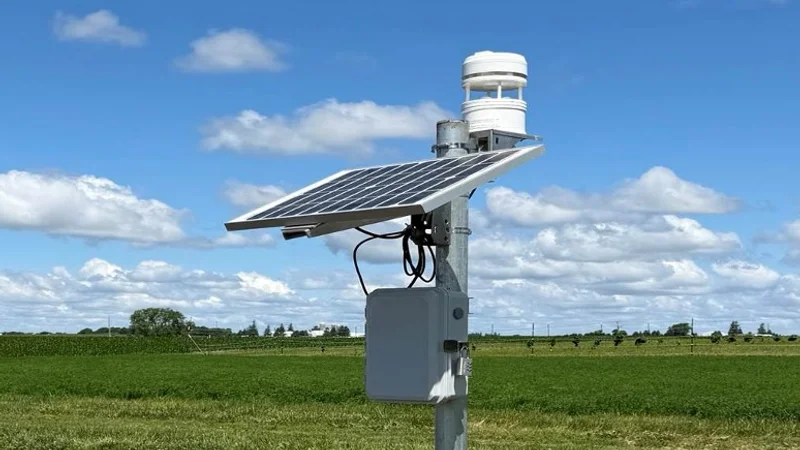
Aratas’s Weather Sensor platform isn’t designed to be a standalone device. Instead, it’s a core building block for distributed agriculture sensing networks. This all-in-one environmental sensing unit provides real-time measurements of key environmental variables. Moreover, it’s designed for remote, harsh, and low-maintenance deployments such as rural locations and large agricultural fields.
Climate Volatility Is Redefining Agricultural Requirements
Climate change isn’t a future threat. Growers are already facing climate volatility that’s disrupting regular operations. Extreme heat, unpredictable rainfall, and severe year-to-year variability are forcing farms to abandon long-standing assumptions about seasonal patterns. Some are still using climate models that are decades old, but they need devices that use live weather data to predict weather conditions with greater accuracy.
This is a profound change. Historically, agricultural planning depended on historical averages. Climate instability has rendered those models insufficient, however, and growers now require:
Real‑time, hyperlocal environmental data
Continuous monitoring rather than periodic sampling
Automated alerts and decision support
Predictive analytics based on live sensor inputs
These requirements place new demands on sensor accuracy, durability, and communication reliability. Devices must withstand extreme weather, operate autonomously for long periods, and deliver actionable data without requiring constant maintenance. The Aratas Weather Sensor was engineered for this new reality and provides real-time measurements of temperature, humidity, barometric pressure, wind speed, wind direction, and rainfall.
Ruggedization, Low Power, and Zero‑Maintenance Design
Agricultural sensors must withstand conditions that would degrade conventional instrumentation. Dust, mud, sunlight, temperature swings, and mechanical vibrations are everyday realities in the field. There are other challenges as well. Remote locations often lack grid power, and cable installation is time-consuming. That’s why the Aratas Weather Sensor doesn’t require nearby grid connections or cables. It can also transmit data over long distances and consumes just 1.5W.
Developing this sensing technology meant tackling multiple challenges head-on. To enable deployment in remote locations without access to grid power, the Weather Sensor is optimized to run on small, inexpensive solar panels. This wireless device is also built for rapid deployment, minimizing installation time and the need for specialized technicians. In addition, it overcomes challenges associated with traditional anemometers and tip buckets that are used to measure weather conditions.
Anemometers measure wind speed or velocity. Tip buckets are a type of rain gauge that measure the amount of precipitation. Both are subject to degradation from dirt buildup and mechanical fatigue. In designing a non-contact weather sensor, Aratas’s engineers chose ultrasonic sensing for wind speed and wind direction. They also implemented optical rainfall detection with a proprietary calculation algorithm. This reduces maintenance requirements and saves precious labor.
Labor Shortages are Driving Automation and Remote Monitoring
Agriculture is facing a labor shortage. An aging workforce, rising labor costs, and the physical demands of farm work are pushing growers toward automation. Farmers who understand what’s happening in their fields have a business advantage, but making the rounds is time-consuming and labor-intensive.
Remote monitoring reduces the need for manual field checks and enables:
Fewer site visits
Faster response to environmental changes
Automated irrigation and fertigation
Better allocation of limited labor resources
Despite its advantages, remote monitoring only works if the underlying sensors are reliable, autonomous, and capable of long-range communication. This highlights one of the most important technology shifts in modern agriculture: the evolution of communication protocols. As farms become digitized, the challenge is not just about collecting data. It’s about transmitting, aggregating, and managing this data across large, distributed environments.
From Short-Range Serial to Long‑Range Wireless Communications
RS‑232 and RS‑485 are serial communications standards that are used commonly in agricultural environments. RS-232 is limited to about 15 meters. RS-485 can cover up to 1200 meters but still requires cables. Because many farms are in rural areas, there are limited opportunities for network connections. Plus, Narrowband Internet of Things (NB-IoT) and other cellular technologies are expensive. They also require high-voltage power.
These realities create a set of related constraints. There are long distances between sensors and gateways, limited power availability, and sparse or unreliable cellular coverage. To address these challenges, the Aratas Weather Sensor supports a range of communication options – including LoRa. This long-range, low-power wireless standard is increasingly used on large-acreage farms because of its ability to transmit data over kilometers with only milliwatts of power.
Originally, Aratas’s engineering team explored Bluetooth, Long Term Evolution (LTE), and Category M1 (Cat M1, LTE-M) cellular connectivity. The Weather Sensor supports all these technologies, but it’s not limited to a single standard. This flexibility ensures that Aratas sensors can operate in agricultural environments ranging from small research plots to large commercial farms that span thousands of acres.
Why LoRa Is Foundational for Smart Agriculture
LoRa’s growing popularity isn’t accidental. It’s the result of strong alignment between the protocol’s strengths and agriculture’s needs. Among its advantages, LoRa supports:
Long‑range communication of up to 10–15 km in rural environments
Ultra‑low power consumption that’s suitable for solar‑powered sensors
High penetration, even with vegetation and rough terrain
Low infrastructure cost compared to cellular or satellite networks
Scalability for hundreds or thousands of nodes
As a result, LoRa is used in agricultural applications ranging from weather stations to soil moisture networks. LoRa-enabled sensors are also used in livestock trading, irrigation automation, pest monitoring systems, and distributed machine-health monitoring. To expand the capabilities of its weather sensor platform, Aratas partnered with KS Technologies, an engineering firm that specializes in IoT hardware and firmware.
The partnership with KS Technologies enabled Aratas to deliver pre-validated LoRa connectivity, seamless integration with Long Range Wide Area Network (LoRaWAN) gateways, optimized power management, and robust long-range performance. However, LoRa isn’t just a communications option. It’s a strategic enabler for Aratas’s broader automation roadmap in agriculture, and the innovations keep coming.
Edge Computing: The Next Frontier for Smart Agriculture
As sensor networks grow, the amount of raw data becomes too great to transmit continuously. By processing data locally at the sensor or the gateway, edge computing reduces bandwidth requirements and enables real-time decision-making. Today, edge computing technologies that work with climate data are essential for optimizing operations.
The benefits of edge computing for agriculture include:
Real‑time alerts for frost, heat stress, or irrigation needs
Local decision loops for automated irrigation or ventilation
Reduced data transmission costs
Improved reliability in low‑bandwidth environments
When combined with LoRa, edge computing enables a hybrid architecture where sensors collect and pre-process data, gateways aggregate and analyze trends, and cloud platforms handle long-term analytics and machine learning. For scalable, resilient agricultural automation, this layered approach is essential. So is Aratas’s ability to transfer its engineering insights across industries.
Cross‑Industry Innovation: How a Broad Portfolio Informs Agricultural Solutions
The weather sensor platform isn’t an isolated development. Instead, it’s the result of years of innovation in IoT, industrial sensing, and environmental monitoring. The basis for this device was an IoT evaluation board that Aratas had developed. This board was powered by universal serial bus (USB) technology and used similar functionality and algorithms.
Aratas’s cross-industry approach accelerates development and ensures that its agricultural solutions benefit from proven sensing algorithms, mature component libraries, and deep expertise in low-power design. The company also uses well-established reliability testing frameworks and leverages its experience in relays, switches, connectors, and industrial sensors. This informs its approach to ruggedization, sealing, and long‑term reliability—critical attributes for agricultural environments.
The Future of Smart Agriculture: Autonomous, Connected, and Climate‑Adaptive
The agricultural sector is moving toward a future where sensors operate autonomously for years, wireless networks cover entire farms, and edge devices make real-time decisions. Cloud platforms will optimize long-term strategy, automation will compensate for labor shortages, and climate-adaptive systems will respond dynamically to environmental change.
Aratas is positioning itself at the center of this transformation by delivering foundational technologies that make climate‑smart agriculture possible. Sensing, connectivity, power management, and ruggedized components are all critical. The company’s engineering‑driven approach, combined with its cross‑industry expertise, ensures that its solutions are not just technologically advanced but practical, reliable, and ready for deployment.
Smart agriculture is no longer a niche. It’s the operating system of modern farming. As climate pressures intensify and labor shortages deepen, the need for robust, autonomous sensing and communication systems will only grow. Aratas’s low‑power architectures, long‑range communication, zero‑maintenance sensing, and flexible interoperability are helping growers build more resilient, efficient, and sustainable operations.
The future of agriculture will be defined by data, automation, and connectivity. Aratas is engineering the components that make that future possible.