Edge AI Is Moving Into the Physical World. The Missing Layer Is Connectivity.
This is the real evolution of Edge AI: machines that perceive, reason, and act in the physical world.

09 Apr, 2026.
This article was first published on
monogoto.ioAt NVIDIA's GTC 2026, the conversation around AI fundamentally shifted.
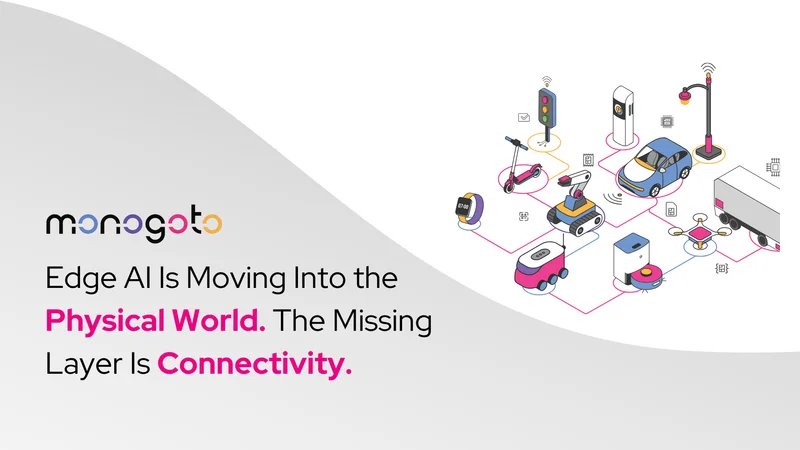
This is no longer just about copilots, chatbots, or even humanoid robotics. It is about something much bigger: AI moving into the physical world at scale. From excavators and surgical systems to robotaxis, autonomous forklifts, rail inspection systems, and precision agriculture equipment, intelligence is now being embedded directly into the machines that move industries forward.
This is the real evolution of Edge AI: machines that perceive, reason, and act in the physical world.
That shift is forcing organizations to rethink infrastructure.
For years, the focus has been on the compute layer: more powerful edge processors, better vision models, improved sensor fusion, motion planning, and real-time decisions. And rightly so. The machine’s intelligence now lives directly on-device, enabling real-time autonomy where the work actually happens.
But production systems introduce a second reality. No machine operates alone.
Every autonomous system still depends on persistent connectivity for fleet coordination, telemetry, safety heartbeats, teleoperation, and over-the-air model updates. The challenge is no longer simply moving data. It is maintaining operational continuity as machines move across environments, transition between access zones, and extend beyond facility walls.
This is where many deployments often encounter new challenges.
Wi-Fi is an excellent place to begin. It helps teams validate early use cases in controlled environments such as labs, warehouse zones, and single-site pilots. It is familiar, cost-effective and often the fastest way to prove ROI.
However, physical AI does not stay in a controlled environment.
Machines move from factory floors to loading docks, from yards to roads, across rail systems, farmland, and remote construction sites. The moment mobility, scale, and outdoor continuity enter the equation, connectivity requirements change drastically.
Wi-Fi covers a building. Physical AI covers the world.
That’s why the next era of autonomous systems will depend on hybrid connectivity architecture that combines Wi-Fi, cellular, and satellite - designed around how machines actually move.
Our new whitepaper, Edge AI by Monogoto: Connectivity for the Physical AI Era, explores the connectivity blueprint required to move physical AI from pilot to production.
Learn why the future of autonomous machines depends on connectivity that moves with the machine.