Edge AI for HVAC monitoring: how Sensor Reply built a smart diagnostic system without cloud dependency
A compact, modular architecture combining industrial hardware, on-device anomaly detection, and a multi-agent AI layer for real-time HVAC diagnostics in laboratory environments.

26 May, 2026. 2 minutes read
Industrial HVAC systems in high-performance facilities operate under constant pressure: maintain efficiency, catch anomalies early, and keep downtime to a minimum. For companies managing critical infrastructure, identifying equipment degradation before it affects operations isn’t a nice-to-have – it’s essential.
Sensor Reply, a company within the Reply Group specializing in edge and embedded AI for industrial applications, took on this challenge with a clear set of requirements: build a smart monitoring assistant for HVAC fan coil units that runs diagnostic and anomaly detection logic entirely at the edge, on industrial hardware, with no dependency on continuous cloud connectivity for core functions.
The architecture
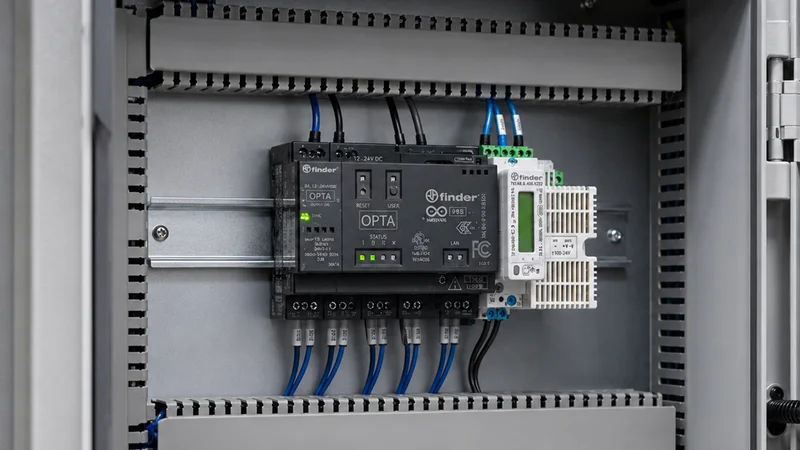
The system is built around a layered edge-to-cloud continuum. At the field level, an Arduino® Opta™ microPLC handles real-time data acquisition from HVAC sensors, executes on-device anomaly detection to identify functional drifts and equipment degradation, and synchronizes preprocessed data and KPIs with an edge gateway.
That gateway hosts a multi-agent AI system capable of natural-language data analytics, automated chart generation, and maintenance planning – all running locally. When a fan coil unit fails or enters an overload condition, the system autonomously identifies optimal workload distribution across the remaining units. Users can request custom reports and visualizations through natural language queries, without touching a dashboard manually.
The choice of the Opta as the edge control layer came down to a specific need: industrial-grade reliability combined with enough development flexibility to iterate quickly on custom logic. As Ilario Gerlero, Associate Partner at Sensor Reply, explains: “It helped us create a compact, modular, and edge-intelligent solution that bridges field data acquisition, local anomaly detection, and cloud integration. For us, it was a good balance between industrial robustness and development agility.”

Why edge-first matters here
Running anomaly detection and AI-driven diagnostics locally rather than in the cloud has concrete implications for this use case. Latency is reduced and core monitoring functions remain available regardless of connectivity. The multi-agent AI layer adds operational intelligence – compensation strategies, maintenance planning, workload rebalancing – without requiring a persistent uplink to execute them.
The system also needed to integrate multiple sensor technologies and communication protocols within a single coherent architecture. The modular design of the hardware layer made this tractable without locking the team into a rigid integration path.
Deployment and market response
The solution is now a permanent fixture at Reply Area42, Sensor Reply’s innovation lab, which welcomes over 250 customers annually. Its reception at trade fairs has generated concrete follow-up opportunities from companies interested in applying similar monitoring architectures to their own industrial environments.
Looking ahead, Sensor Reply is exploring more advanced edge AI use cases – including on-device computer vision and LLM-based processing deployed directly at the field level – as a natural extension of the architecture validated in this project.
Arduino and Opta are trademarks or registered trademarks of Arduino S.r.l.