Building Reliable High-Bandwidth Automotive Telemetry Systems
The connectivity foundation for advanced driver assistance systems, software-defined vehicles, zonal architectures and electrified powertrains.

21 Jul, 2026. 12 minutes read
Executive Summary
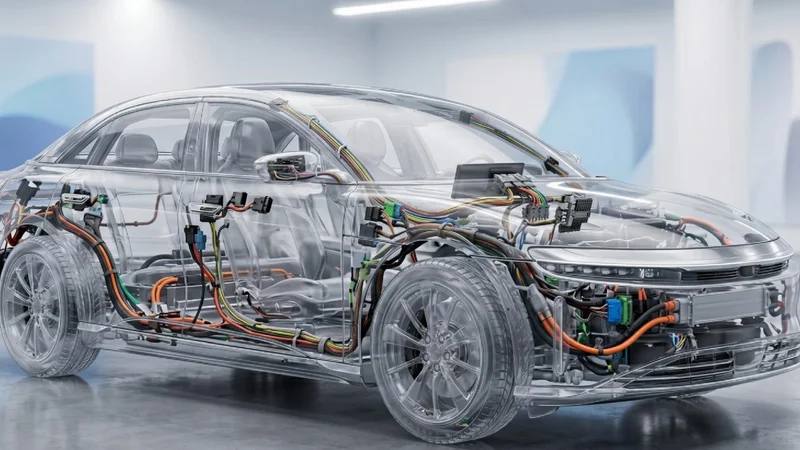
As the demand for advanced automotive technology grows, modern vehicles are generating unprecedented amounts of data. Automotive electrical systems–including advanced driver assistance systems (ADAS), surround-view cameras, in-cabin monitoring, digital cockpits and electrified powertrains–require a continuous exchange of high-bandwidth information between sensors, compute platforms, and output devices. Described as “data centers on wheels," today's vehicles enable high
performance capabilities for an enhanced driver experience.
This growth in data volume calls for a change in the underlying connectivity architecture. Developed for lower-bandwidth function-specific communication, traditional designs based on numerous distributed electronic control units (ECUs) and extensive point-to-point wiring become more difficult to scale and maintain as data rates continue to increase.
To address this challenge, automakers are turning to zonal architectures. This approach consolidates different vehicle functions and reduces wiring complexity. However, it also increases dependence on high-speed interconnects that must deliver reliable performance under adverse conditions like vibration, thermal cycling, and moisture, in tight packaging constraints.
As a result, purpose-built connectivity systems are gaining popularity in modern automotive design. Connectors and cables are expected to support multi-gigabit data transmission, robust mechanical retention, and efficient assembly in high-volume production environments.
This white paper examines the architectural requirements driving demand for reliable and high-bandwidth automotive telemetry, while also highlighting solutions from Molex that help address these challenges. Insights about TTI supporting deployment through global inventory and supply continuity are also available.
Introduction
Vehicles are undergoing a fundamental shift in how they generate, process, and make use of data. Functions that once operated in isolation now require exchanging large volumes of data across cameras, radar modules, displays, power electronics, and centralized compute platforms. Vehicles that were once a collection of discrete electronic subsystems are now converting to integrated, data-driven platforms.
This white paper examines the architectural and connectivity implications of the shift to zonal architectures. It explores why legacy electronic architectures struggle to keep pace, how zonal architectures are changing vehicle design, and what performance characteristics are required from modern interconnect systems. This document also highlights how Molex and TTI help engineering and sourcing teams implement reliable, scalable automotive telemetry systems.
The Explosion of In-Vehicle Data
The volume of data moving through modern vehicles has increased dramatically in recent years. To improve user experiences, automakers have steadily introduced new features and made quality-of-life enhancements. Most of these improvements required isolated electronic systems until recently, as these systems have evolved into an interconnected network of sensors, displays, compute platforms, and cloud-connected services.
From Isolated Sensors to Continuous Data Systems
Early automotive electronics relied on individual sensors designed to support specific functions such as engine control, anti-lock braking, or airbag deployment. In the past, data volumes were very modest in scale as communication occurred only when a threshold was reached or an event was triggered.
Modern vehicles operate very differently, with cameras, radar modules, ultrasonic sensors, and, in some platforms, LiDAR continuously generating data that must be transmitted, synchronized, and processed in real time. Instead of carrying occasional signals, vehicle networks now have to support persistent data flows at high bandwidths.
Camera and Video Data as Primary Growth Drivers
Camera systems are among the largest contributors to growing bandwidth requirements within vehicles. Rear-view cameras, which were once optional, are now offered as standard in even the base models of automobiles for many markets. As customers opt for higher variants, they expect features like a 360- degree camera, driver monitoring cameras, and occupant monitoring systems.
Some production vehicles already incorporate more than a dozen cameras. Feature-loaded vehicles commonly use extra cameras to support driver assistance, perception functions, and ultimately offer improved on-road and off-road visibility.
Each camera adds a continuous video stream that must be transmitted with low latency and minimal signal degradation. Regulatory requirements and operational demands are accelerating adoption across passenger vehicles, delivery vans, and work trucks.

Digital Instrument Cluster and Display-Rich Entertainment Systems
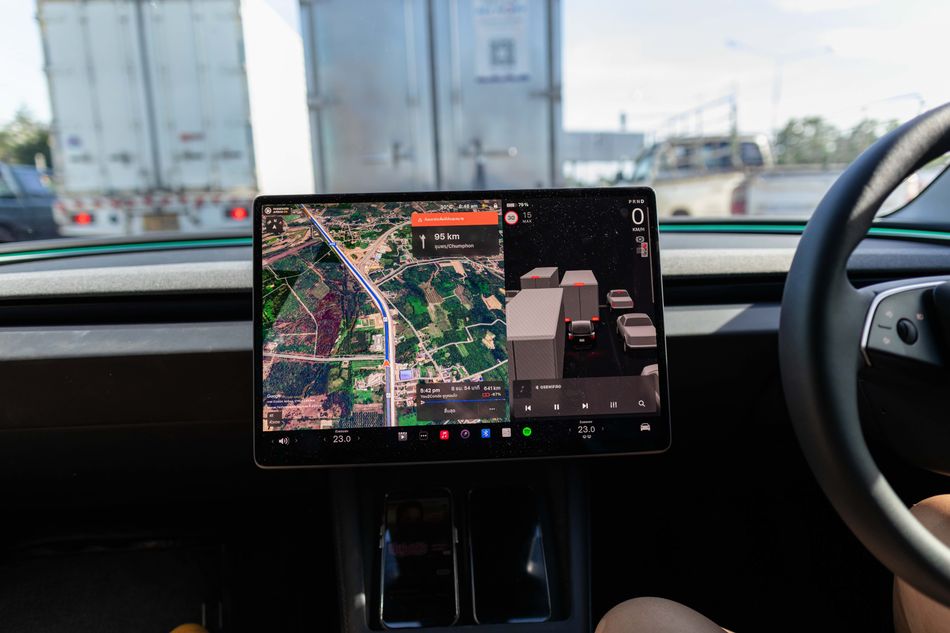
Modern car cockpits are equipped with digital instrument clusters and large infotainment displays. Premium brands were the first to introduce passenger screens and rear-seat entertainment systems in their luxury cars, but these features are now being extended across more vehicle segments. Their interfaces require high-speed communication links capable of transporting high-resolution video and data.
Software-Defined Vehicles (SDVs), ADAS, Autonomy, and Real-Time Processing Demands
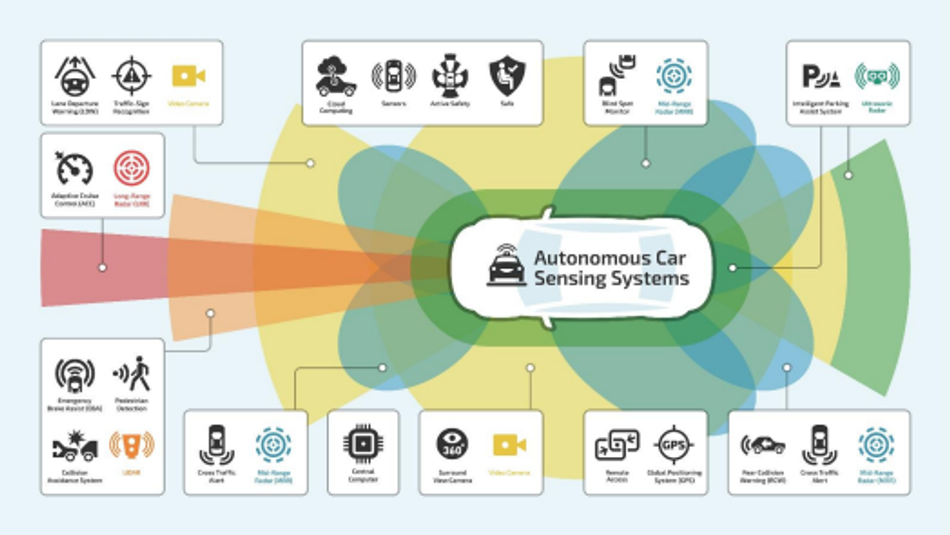
ADAS features such as lane keeping, adaptive cruise control, and automated parking depend on real-time processing of data from multiple sensors. The automobile industry is also moving toward higher levels of autonomy with each passing generation of vehicles.
Automakers incorporate redundant sensing systems and fail-operational architectures to improve safety, which increases the amount of data that must be transported and processed. Sensor fusion is used to collect various inputs and combine the data to build a coherent model of the vehicle environment. Finally, the SDV architecture brings it all together to make computing resources more centralized. Enabling these capabilities requires a high-performance connectivity architecture to meet stringent processing demands and deliver reliable communication.
Electrification Adds Continuous Telemetry Layers
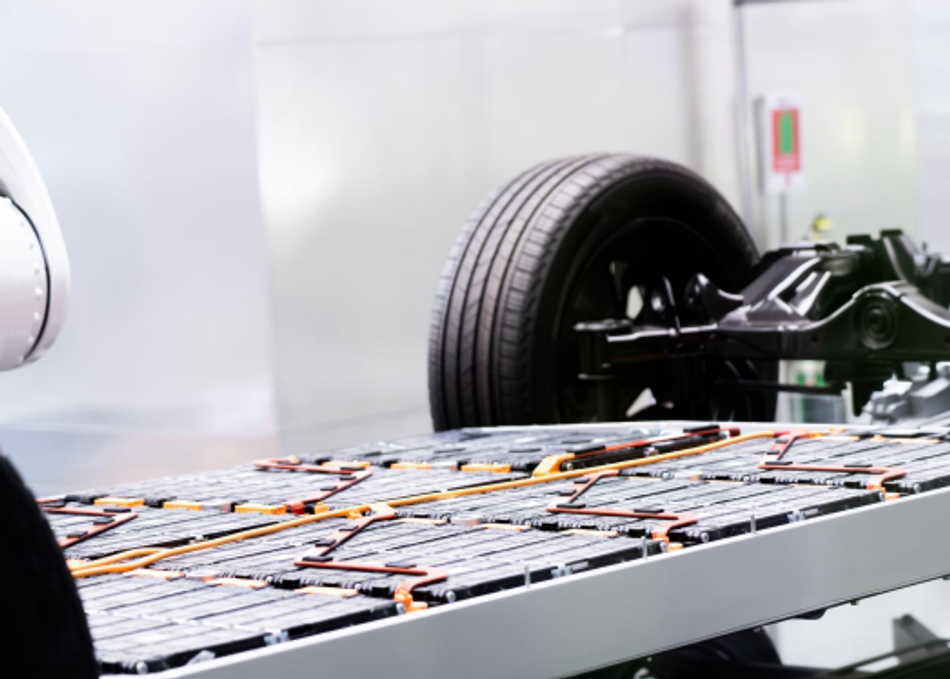
Electric vehicles (EVs) and hybrid electric vehicles (HEVs) introduce additional monitoring requirements for battery management systems and other power electronics. These systems generate continuous telemetry related to voltage, current, temperature, and state of charge, adding another layer of data traffic in addition to sensing and infotainment workloads.
Vehicles as Data Nodes in Larger Systems
Vehicle data is now applied beyond the car itself for remote diagnostics, predictive maintenance, fleet analytics, and more applications. Connected services extend data flows externally, requiring vehicle-to-everything (V2X) communication. As a result, vehicles are becoming connected endpoints within broader enterprise systems.
These trends drive compounding growth in in-vehicle data. The challenge is no longer simply collecting information but moving it reliably across increasingly complex automotive platforms.
Why Legacy Architectures Break
Electronic architectures in most traditional automobiles were developed to support relatively independent vehicle functions. These functions included engine management, lighting, and basic infotainment. Communication requirements were minimal, and each subsystem was self-contained. As vehicles became more data-intensive, this approach was difficult to sustain.
Challenges in Scaling with Data Growth
Conventional vehicles contain 70 to more than 100 ECUs, each responsible for carrying out a specific function. These controllers were designed for low-bandwidth communication and localized processing. As data volumes increase, information must move across multiple subsystems. This distributed model adds complexity and creates inefficiencies when large, continuous data streams must be shared across the vehicle.
Wiring Harness Complexity Becomes a Physical and Cost Bottleneck
Wiring harnesses are among the heaviest systems in modern vehicles. In a traditionally distributed architecture, introducing new sensors and features often requires additional point-to-point wiring. Over time, this increases the harness size and weight and makes routing more difficult to manage. Increased harness size and density cost valuable space and material, inhibiting design flexibility.
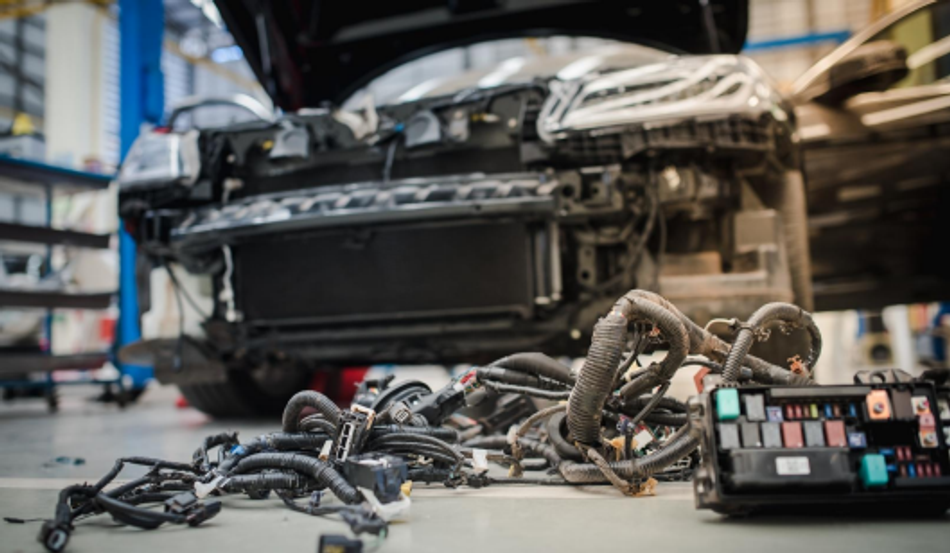 Wiring harnesses in traditional vehicle architectures can become large, heavy, and difficult to assemble. Source: AdobeStock. Bandwidth and Signal Integrity Limitations
Legacy interconnect systems were not expected to handle multi-gigabit communication. At higher data rates, problems like signal attenuation, electromagnetic interference (EMI), and timing mismatches can degrade performance. These effects become more visible as cable lengths increase and multiple high-speed channels have to operate in close proximity.
Fragmented Systems Limit Data Utilization
As data is often processed locally within individual ECUs, the vehicle’s ability to aggregate information across systems is limited. Real-time decision-making is tough in this case. Functions such as sensor fusion, centralized diagnostics, and SDV features depend on rapid access to data from multiple sources.
Reliability and Manufacturing Challenges at Scale
The number of potential failure points is directly proportional to the number of connectors and wiring paths. As dense harnesses are more difficult to assemble, inspect, and service, they extend production times and complicate diagnostics during maintenance. Additional data integrated in the same architecture does not scale well and destabilizes the system.
Modern vehicle platforms require a more streamlined and data-centric approach.
The Shift to Zonal Architectures
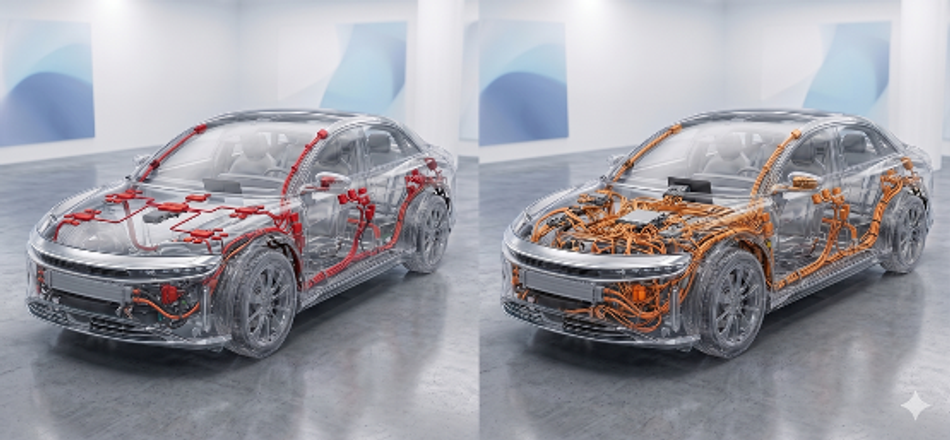
Automakers are adopting zonal architectures to address the limitations of traditional distributed designs. Instead of adding ECUs for carrying out individual functions throughout the vehicle, zonal architectures organize sensors and actuators by physical location and connect them to a smaller number of high-capability controllers, called the zonal control units (ZCUs).
Zonal Aggregation Replaces Distributed Complexity
Local sensors, actuators, and electronic modules are all connected to the nearest ZCU, which aggregates and forwards data to central compute resources. This approach reduces the number of distributed control units to just four or five controllers. The result is a simplified system that is easy to integrate and has reduced point-to-point wiring runs.
High-Speed Backbone Enables Centralized Data Flow
ZCUs communicate over a high-speed connectivity protocol, typically based on automotive Ethernet. This is the backbone of the system and supports high-bandwidth, low-latency, bidirectional communication between vehicle zones and centralized compute platforms. Data architecture is more coordinated and better supported for sensor fusion and SDV features.
Reduced Wiring, Greater Scalability, New Connectivity Demands
By shortening local connections and consolidating control functions, zonal architectures can reduce wiring length, weight, and cost. EV OEMs have managed to eliminate miles of wiring per vehicle through architectural changes.
However, as the number of connections decreases, the importance of each connection becomes more significant. The links must offer high-speed connectivity and carry more critical data, making connector performance, signal integrity, and long-term reliability non-negotiable aspects of the connectivity solutions.
Challenges and Design Requirements
Zonal architectures completely change the role of connectivity. Connectors and cables are no longer just passive components that simply link subsystems but are now critical elements of the data path, directly influencing signal quality and long-term system reliability.
To support modern automotive telemetry systems, interconnect solutions must meet various demanding electrical, mechanical, and packaging requirements simultaneously.
Signal Integrity at Multi-Gigabit Speeds
High-speed automotive links must preserve signal quality across connectors, cables, and PCB interfaces. This requires tight control of impedance, insertion loss, return loss, and skew.
With an increase in data rates, all systems become more sensitive to reflections, attenuation, crosstalk, and EMI. Even small discontinuities can affect camera image quality, performance of displays, or synchronization between sensor inputs.
These considerations apply to differential interfaces used for automotive USB and DisplayPort, as well as links used for camera and radar connectivity.
High-Density Packaging and Routing Constraints
As automakers continue adding more sensors and electronic modules, the space available for connectors and cables is shrinking.
Camera systems, mirrors, displays, and zonal controllers often require multiple high-speed interfaces in compact enclosures, creating demand for connectors with smaller size and footprint. Reducing connector size can also support broader system-level goals such as lower mass and efficient harness design.
Assembly Efficiency and System-Level Reliability
Speed is crucial in high-volume manufacturing environments, since automotive components must be assembled quickly and consistently.
Features such as audible latch feedback, polarization, labeling, and connector position assurance (CPA) are preferred, as they help in verifying correct mating and reduce assembly errors.
As discussed in the previous section, zonal architectures have fewer interconnects carrying more data and supporting more functions. Thus, a single connection problem can affect multiple systems, making assembly quality and long-term retention even more important.
Mechanical Reliability Under Harsh Conditions
Automotive interconnects are subjected to constant vibrations, mechanical shocks, and thermal cycling. They are also exposed to significant levels of dust and moisture. Connectors must maintain secure mating and stable contact resistance over the life of the vehicle, making retention systems, terminal design, and material selection significant factors for ensuring performance under extreme stress.
In high-speed applications, mechanical instability can quickly translate into electrical degradation or intermittent failures. These requirements highlight the need for specialized connectivity solutions purpose-built for automotive applications.
Molex Solutions for Reliable and High Bandwidth Automotive Telemetry Systems
Molex offers a range of automotive interconnect solutions designed to support the electrical, mechanical, and packaging requirements of modern vehicle architectures. These products address applications ranging from camera connectivity and digital displays to hybrid modules that combine multiple signal types within a single interface.
Molex High-Speed AutoLink (HSAutoLink) Interconnect System
Molex HSAutoLink and HSAutoLink II Interconnect Systems are differential pair interconnect solutions designed for high-speed, in-vehicle communication. They support protocols such as automotive LVDS, USB 2.0 and 3.0, FPD-Link III and IV, GMSL 2 and 3, 100BaseT1, and DisplayPort, making them well suited for infotainment systems, digital instrument clusters, rear-seat entertainment, and other internal data links that require reliable signal transmission.
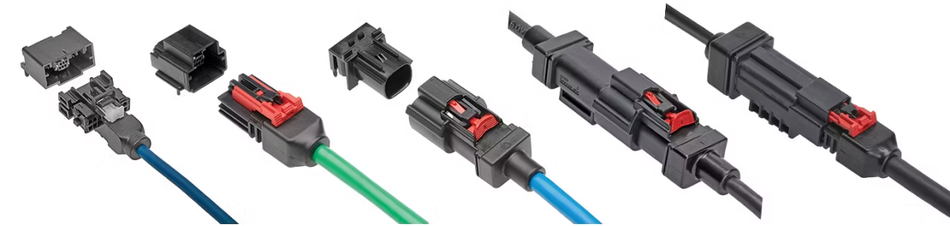
HSAutoLink II interconnects support a data transfer rate of up to 13.5Gbps and are available in sealed and unsealed configurations. The sealed variants are IP67 and IP69K-rated to work in harsh automotive environments. For mitigating EMI, the core comes with a 360-degree shielding. These connectors are designed to withstand up to 5,000 mating cycles and require a low insertion force for assembly.
Table 1: Key Features of Molex HSAutoLink II Interconnect System
Feature | Description |
Maximum Data Rate | Up to 13.5Gbps per differential pair |
Current | 1.5A (max.) |
Supported Protocols | USB 3.0, DisplayPort, Ethernet, GMSL, FPD-Link, APIX, A2B |
Connector Configurations | Wire-to-board, wire-to-wire |
Sealing Options | Sealed and unsealed versions |
Circuit Counts | 6-, 12-, and 14-hybrid circuit options |
Hybrid Versions | Supports combined high-speed data and power contacts |
Shielding | Fully shielded design for EMI protection |
Operating Temperatures | -40 to +105°C |
Environmental Protection Available with IP67 and IP69K sealing | |
Cable Options | Standard and custom cable assemblies |
Mechanical Features | Positive locking and polarization options |
Typical Applications | ADAS cameras, digital clusters, infotainment systems, telematics, zonal controllers |
Molex High-Speed FAKRA-Mini (HFM) Interconnect System
The Molex HFM interconnect system is designed for camera and sensor applications that require high speed, high-frequency performance. It is a small and lightweight interconnect system supporting frequencies up to 20 GHz and data transfer rates up to 28Gbps. This connector allows integration of multiple ports into a footprint similar to a single standard FAKRA connector, simplifying packaging in dense vehicle designs. Typical applications include rearview cameras, surround-view systems, in-cabin monitoring, and ADAS sensors.
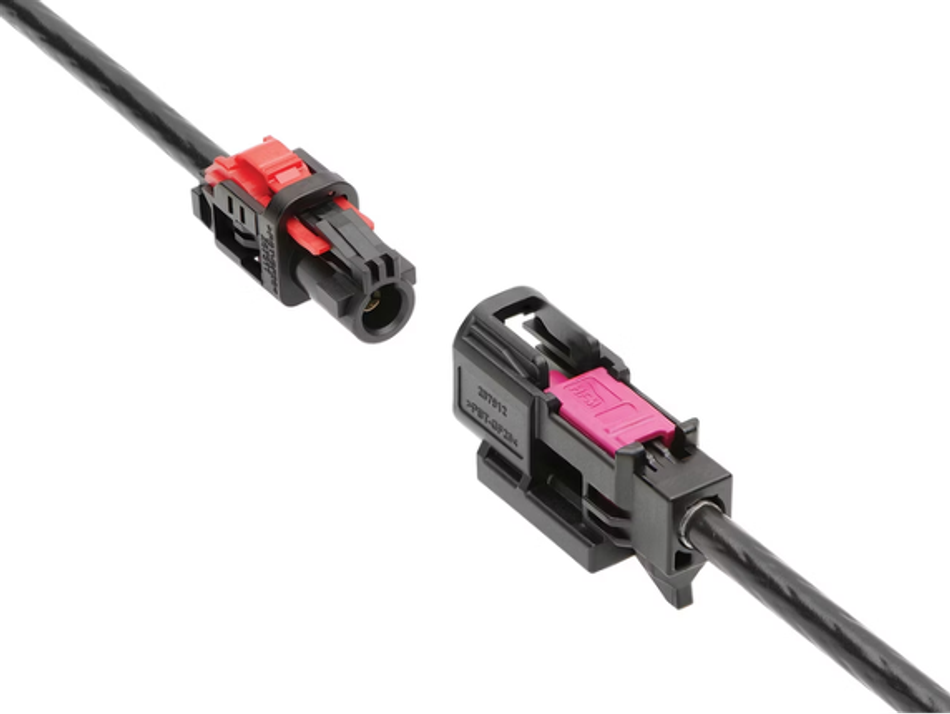
Table 2: Key Features of Molex HFM
Feature | Description |
Data Rate | Up to 28Gbps |
Frequency Range | DC to 20 GHz |
Impedance | 50 Ω |
Current Rating | Up to 1.0A |
Operating Temperatures | -40 to +105°C |
Supported Protocols | APIX, ASA-ML, Ethernet, FPD-Link III/IV, GMSL 2/3, GVIF, HDBase-T, MIPI A-PHY, PCIe |
Configurations | Single, dual, dual-stack, and quad |
Connection Types | Wire-to-wire, wire-to-module, wire-to-device |
Size Reduction | Up to 80% smaller than traditional FAKRA connectors |
Retention Features | Integrated secondary lock (ISL), optional connector position assurance (CPA) |
Sealing Options | Sealed and unsealed versions |
Validation Standards | USCAR49, USCAR2 |
Applications | ADAS cameras, radar, telematics, infotainment, V2X |
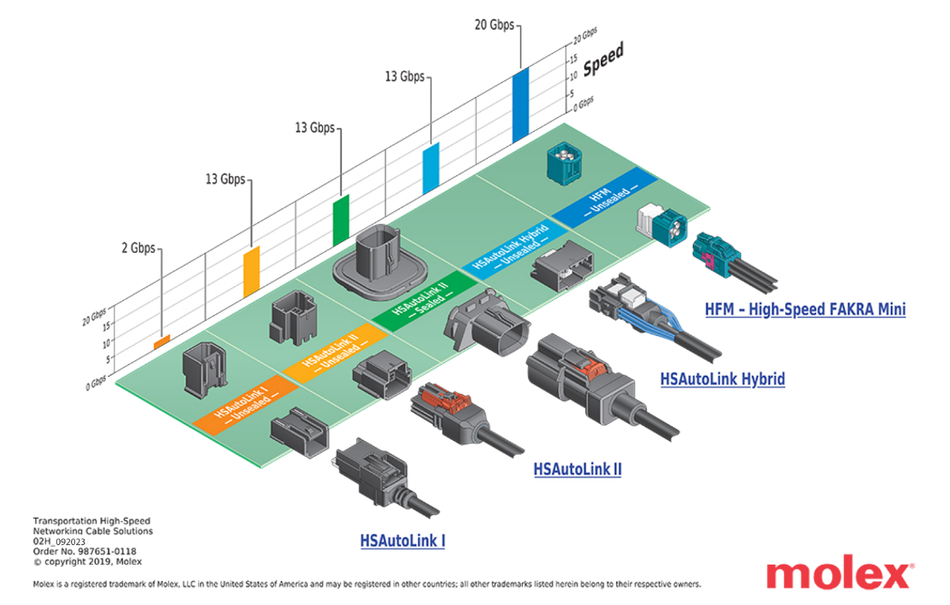 High-speed networking solutions by Molex
Molex Data and Signal Hybrid (MX-DaSH) Connector System
MX-DaSH connectors combine data and signal transmission within a single connector system. The solution can be used for terminal sizes ranging from 0.50 to 6.30 mm and supports up to 70 circuits depending on the configuration.
The MX-DaSH connector system supports multiple automotive connectivity configurations, including wire-to-wire and modular wire-to-board systems. The modular wire-to-board version uses four interchangeable cartridges arranged in a two-by-two layout that designers can customize to change terminal combinations without changing the outer connector footprint. This architecture makes it easier to adapt the connector to changing vehicle requirements while minimizing redesign and validation work across multiple models.
Positive-locking features, blade stabilization, and vibration-resistant construction help maintain reliable connections in harsh automotive environments. This design can simplify routing and integration in compact assemblies such as exterior mirrors, lift gates, and other modules that require both high-speed data and low-speed signal connections.
Table 3: Key Features of Molex MX-DaSH Connector System
Feature | Description |
Cartridge Layout | Two-by-two, wire-to-board modular architecture with four interchangeable cartridges |
Circuit Counts | Up to 70 circuits, depending on configuration |
Supported Terminal Sizes | 0.50, 1.20, 2.80, 4.80, and 6.30 mm |
Voltage and Current Ratings | Up to 14V DC, Up to 15.9A |
Operating Temperatures | -40 to +100°C |
Sealing Options | Sealed and unsealed versions |
Validation Standard | USCAR2 |
Isolation Resistance | Minimum 100 MΩ between terminals |
Maximum Mating and Unmating Force | 75N |
Contact Plating | Tin |
Applications | Zonal harnesses, mirrors, instrument panel-to-body connections, seat power and signal systems |
TTI: Ensuring Availability and Deployment at Scale
Selecting the right component for automotive programs requires evaluating a lot more than just the raw technical performance. During uncertain production cycles, lead times, supply continuity, support throughout the lifecycle, and global availability all influence design decisions, especially for platforms expected to remain in production for many years. A seemingly perfect connector that meets all electrical and mechanical requirements still comes with a risk if it cannot be sourced consistently during prototyping, validation, and full-scale production.
TTI is a leading distributor of electronic components aiming to help automakers mitigate this risk by providing access to inventory and a robust supply chain across the globe. Stocked distribution is offered to shorten procurement cycles, reduce shortages, and simplify purchasing for sourcing teams. TTI supports continuity as programs move from design to production, including inventory depth, lifecycle support, and coordination across regions and production sites.
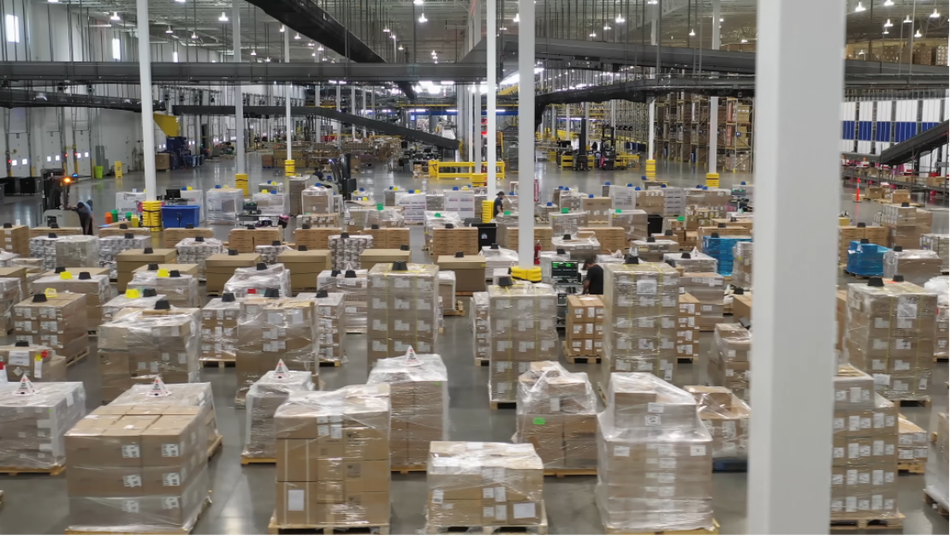
Together, Molex and TTI provide the technical foundation and the supply chain stability required to deploy reliable high-bandwidth automotive telemetry systems at scale.
Conclusion
With each passing generation, vehicles are fast evolving to become more connected, data-driven systems. Cameras, displays, ADAS, electrified powertrains, and cloud-connected services are all generating volumes of information that were never seen before now.
In such a scenario, traditional architectures based on distributed ECUs with extensive point-to-point wiring become difficult to scale. Zonal architectures address these limitations by consolidating control functions and reducing wiring complexity while relying heavily on a smaller number of critical connections. This shift makes connectivity systems a core enabler for modern automobiles.
Interconnects need to maintain signal integrity at multi-gigabit speeds, while also withstanding the harsh vibrations and thermal cycling in very tight packaging constraints typically seen in automobiles. The connectors must also be easy to assemble and have reliable performance over the entire lifecycle of the vehicle.
Molex provides connectivity solutions to meet these requirements across a wide range of automotive applications. As a key partner and distributor of Molex, TTI helps deliver the right components sought by the sourcing teams to deploy production-ready connectivity systems with greater confidence.
To learn more about Molex automotive connectivity solutions and how TTI can help accelerate your next vehicle program, visit the Molex manufacturer page on TTI.