Born for Efficiency: Southchip Brings Its Industrial Computing ICs to Munich
Southchip Showcases High Integration, High Power, and Ultra-Low IQ Design Power Solutions.

20 Nov, 2026. 5 minutes read
Modern industrial computing designs face an intense engineering squeeze. Edge compute nodes, robotics controllers, and factory automation gateways must pack increasingly complex capabilities onto compact boards without compromising thermal headroom. At the same time, these high-performance systems demand higher power delivery while simultaneously requiring ultra-low idle power consumption to maximize runtime and keep thermal dissipation to a minimum when idle.
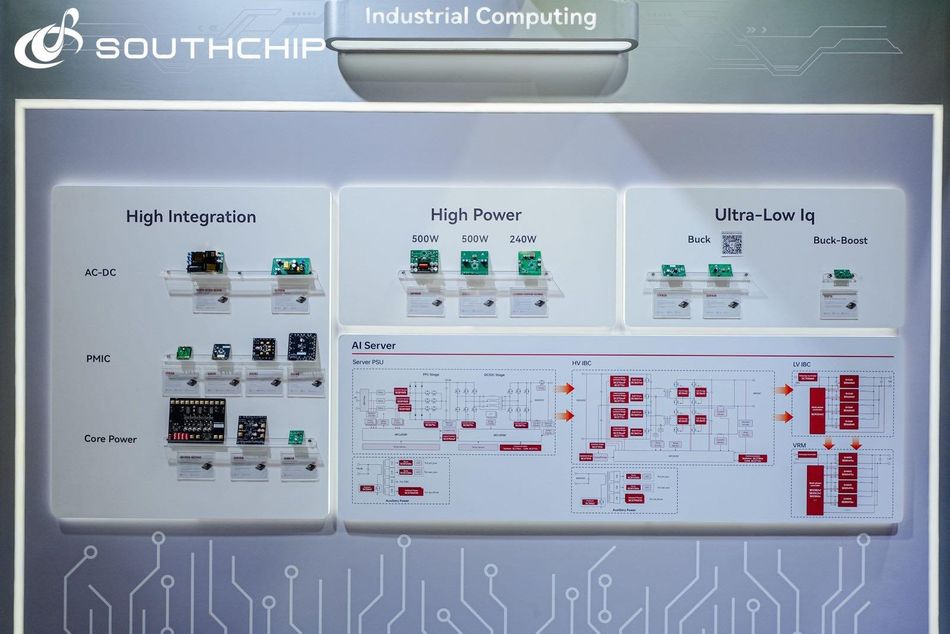
Southchip’s presence at electronica 2026 in Munich was focused on attacking these design challenges. Showcasing power solutions organized into High Integration, High Power, and Ultra-Low IQ design blocks, Southchip’s booth showcased how its silicon family helps engineers navigate hardware constraints across AI servers, renewable energy, robotics, and industrial control architectures.
From Consumer to Industrial
True to its slogan "born for efficiency," Southchip established its reputation by enabling efficient USB and wireless charging across high-volume consumer applications like chargers, power banks, smartphones, and laptops, where squeezing performance out of tiny footprints is essential.
Leveraging power, analog, and embedded IC expertise, Southchip has since expanded into automotive and industrial computing markets to fuel demanding designs with dense, efficient silicon.
For a deeper look into Southchip's power-dense IC designs, read the full article.
High Integration Means Fewer Parts between the Plug and the Processor
Space is often at a premium on dense, high-performance system boards. There are too many individual components and too many power rails needed for cores, memory, and sensors. Southchip solves these space challenges with highly integrated ICs at four critical points in the power path—input stage, secondary side, auxiliary supplies, and processor core rails—to simplify power design from the AC input to the core processing rails. Southchip's High Integration approach simplifies designs by combining functions across the power delivery chain and reducing external components.
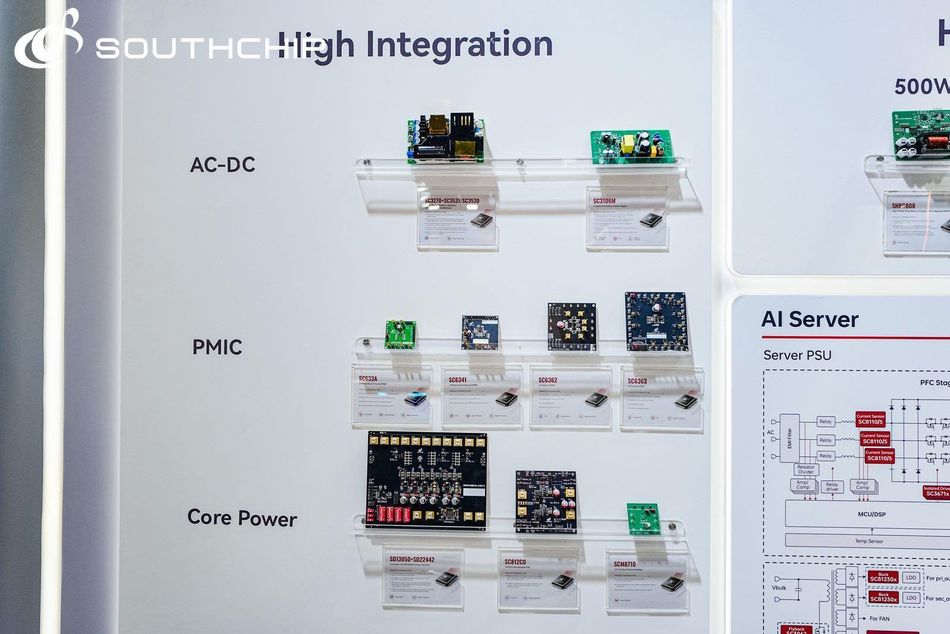
At the input stage, the SC3270 PFC+LLC combo controller integrates a high-voltage start-up circuit and gate drivers. Its multi-mode PFC (DCM, CRM, CCM) maintains efficiency across load conditions, while the LLC stage synthesizes resonant voltage. On the secondary side, SC3531 and SC3530 synchronous rectifier controllers boost efficiency for data centers and edge hardware.
For auxiliary supplies, the SC3106M dual-channel regulated auxiliary converter in an SSOP38 package generates multiple outputs from a single transformer winding, eliminating secondary DC-DC cascade stages and saving over ten external components. Featuring standby power as low as 43 mW at 230 Vac and PCCM/ZVS soft-switching, it simplifies power delivery and EMI filtering in industrial gateways, PLCs, and frequency inverters.
Downstream, Southchip's integrated PMICs consolidate multiple power rails into compact devices:
SC633A: Supports flexible 1+1 or 2+0 dual-phase operation up to 12 A, with I2C/SPMI control, providing a high-density solution for optical modules and industrial PCs.
SC6341: A two-channel, up-to-four-phase device delivering 4 A continuous and 5 A peak per phase at switching frequencies up to 2 MHz, reducing inductor footprint in AI PCs, optical modules, and edge equipment.
SC6362: A six-channel device combining four buck channels (each up to 4 A), two LDOs, and eight configurable GPIOs in a compact CSP34/36 package for SSD controllers and radar modules.
SC6363: Integrates eight regulated channels (four bucks, three LDOs, and one load switch) with dynamic voltage scaling and programmable sequencing in WLCSP-64B or QFN-46 packages for camera SoCs, ISPs, and edge computing nodes.
At the processor level, the SC812C0 point-of-load converter delivers up to 30 A from a 16 V input. Stacking up to eight units in parallel achieves 240 A total with fast transient response.
The SCM8710 buck-boost module delivers 2 A from a 5.5 V input inside a 2.5 × 2.5 × 1.1 mm package, offering 95% peak efficiency and ultra-low quiescent current for optical modules.
Southchip also introduced the SD13050 22 V/60 A DrMOS stage and SD22442 four-phase dual-channel controller for heavy-duty CPU, GPU, and SoC rails. With PMBus/PWMVID support, configurable MTP memory, and active phase shedding, they maintain high efficiency across load ranges.
Together, these devices cover the power path from AC input to the processor rail, with fewer parts in between.
High Power Delivers More Watts through the Same Footprint
Modern AI, robotics, energy storage, and automation all depend on wide-range conversion at high efficiency. The challenge, however, is delivering energy efficiently without instability or excess thermal build-up. Southchip's High Power portfolio provides high-efficiency conversion across wide input and output ranges for industrial power hardware, energy storage, and battery-operated equipment.
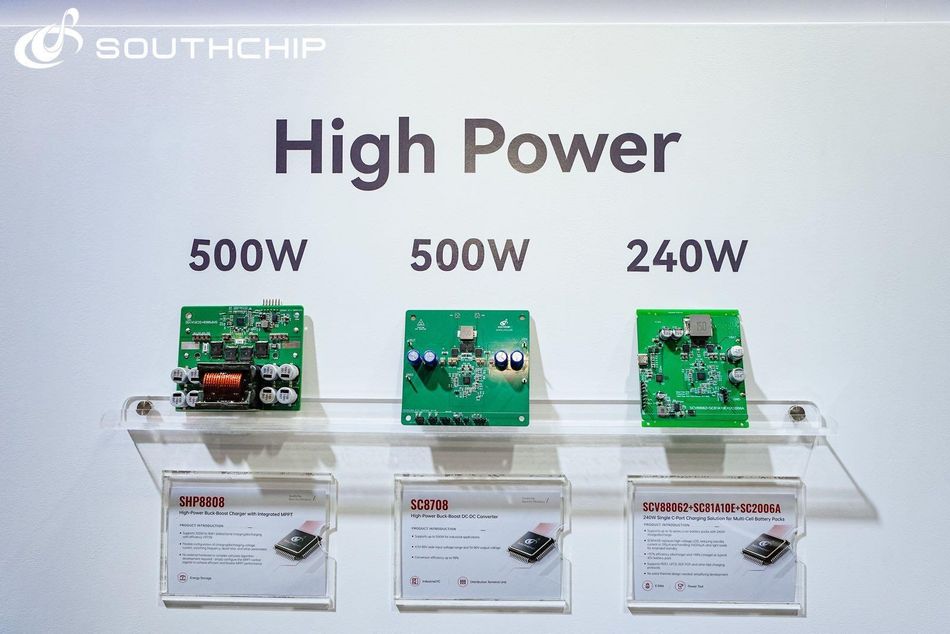
The SC8708 buck-boost converter handles up to 500 W with inputs from 4.5 V to 80 V and outputs from 5 V to 80 V at up to 98% efficiency. Housed in a QFN-36 package, it fits industrial PCs and distribution terminal units.
For bidirectional energy storage, the SHP8808 buck-boost charger supports charging and discharging from 500 W to over 1 kW at over 97.5% efficiency.
Featuring integrated MPPT, the SHP8808 allows register configuration of charging, discharging, switching frequency, and dead time, simplifying integration in energy storage and robotics as an 80 V battery charger.
For power tools and light-mobility battery packs, Southchip paired the SCV88062 80 V bidirectional buck-boost charger, SC81A10E 100 V buck converter, and SC2006A protocol IC into a 240 W single-port USB-C solution managing up to 16 series cells.
This architecture achieves over 97% discharge efficiency and 98% charge efficiency at 42 V nominal, supporting PD3.1, UFCS, SCP, and FCP protocols. Replacing a high-voltage LDO with the SC81A10E drops standby current to 100 µA while maintaining a steady 5 V rail under light loads.
The High Power lineup enables engineers to manage power conversion, scale energy delivery, and add bidirectional capabilities without increasing board footprint.
Ultra-Low IQ Extends Battery Life
Industrial equipment frequently operates in idle modes where steady quiescent current drain degrades battery life, shortens service intervals, and generates heat. To address this, Southchip focuses on the most widely used topologies—buck and buck-boost converters—developing an Ultra-Low IQ product family designed to minimize quiescent current while maintaining immediate wake-up capability.
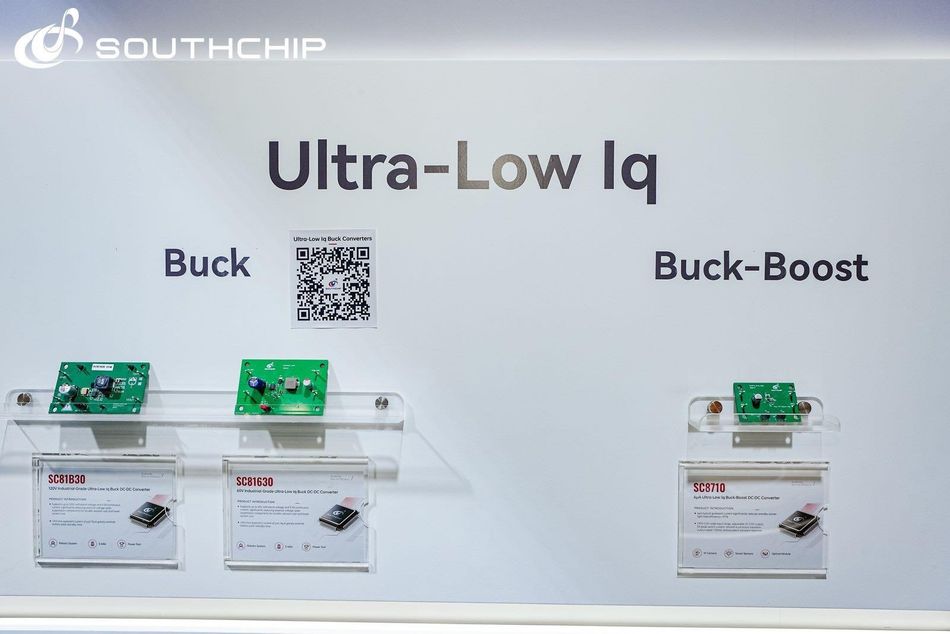
Spanning voltage ratings of 40 V, 60 V, 100 V, and 120 V with output currents from 1 A to 5 A and peak efficiencies over 98%, this low-IQ converter family comes in SOP8 and ESOP8 packages for demanding industrial environments.
Within this family, the SC81B30 buck converter handles up to 120 V and 3.5 A continuous current while drawing just 10 µA quiescent current, reducing extra spike-suppression components. The SC81630 offers a 60 V rating with 14 µA quiescent current. Both converters target robotics, e-bikes, and power tools requiring extended battery life and compact designs.
Complementing the buck family, the SC8710 buck-boost converter features a 6 µA quiescent current and >97% light-load efficiency. It offers a 1.95 V to 5.5 V input range and 2 V to 5.3 V adjustable output with <50 mV ripple in a SOT-583 package, targeting IP cameras, sensors, and optical modules.
Reducing losses in both idle and active modes extends battery runtime and minimizes waste heat for continuous industrial operation.
electronica 2026
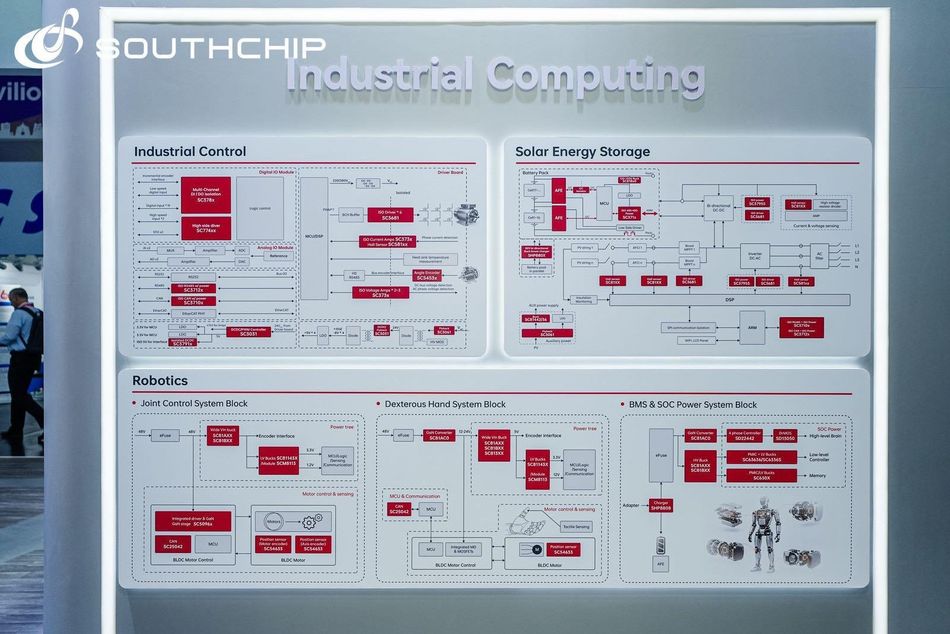
At electronica 2026, Southchip highlighted High Integration, High Power, and Ultra-Low IQ products in order to demonstrate scalable solutions for modern industrial computing challenges. Showgoers were able to see real Southchip solutions powering applications across a wide variety of use cases, from edge computing to e-bike power systems.
The exhibit provided a framework for power design all modern industrial teams need by simplifying architectures, delivering higher power density, and cutting idle power waste.
Where Southchip Is Heading
Southchip is rapidly establishing itself as a trusted, long-term strategic partner for industrial engineering teams across Europe. By collaborating directly with engineers to co-develop power ICs tailored to specific space, output, and standby requirements, Southchip can help shorten development cycles and optimize system-level efficiency.
For next-generation industrial systems, Southchip's design pillars offer a roadmap to integrate features, deliver higher power, and reduce wasted energy.
Get in touch with Southchip to start designing your next industrial computing system.