Southchip Brings Power-Dense IC Design to European Engineers
Power-dense ICs provide more current without exceeding thermal limits.

11 Nov, 2026. 6 minutes read
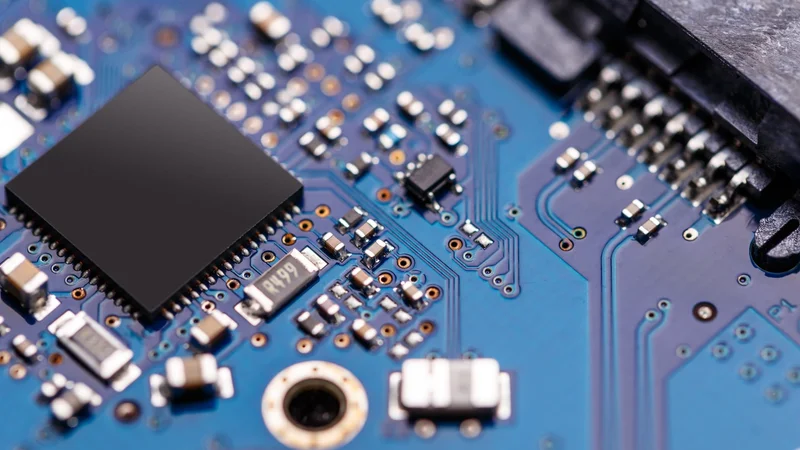
Today, engineers in automotive, industrial, and data center markets face a daunting task: deliver more output power from less board space.
From AI servers to robots, designers need more current in tighter footprints without exceeding thermal limits. Meanwhile, physical AI systems feature processors and actuators that can draw current from idle to peak in microseconds. And there’s little margin for error: a sagging rail or overheated converter can throttle a process and lead to system failure.
With that much at stake, engineers need to choose their power IC suppliers carefully. They need someone they can trust as both a technology provider and a design partner.
That's why Southchip is expanding its automotive, industrial, and AI server work in Europe. In a recent interview, Eric Yao, Head of EMEA at Southchip, explained how the company is approaching that work and helping European engineers bring the next wave of AI and electrified systems to market.
Southchip: A Worldwide Leader in Power
An established leader in the consumer sector, Southchip designs power management, analog, and embedded ICs, and it owns the IP behind each device. “Our goal is to become a worldwide leader in analog and embedded ICs,” says Yao. “That’s why our corporate slogan has always been ‘Born for Efficiency.’”
That focus on efficiency began in consumer electronics and now reaches into industrial and automotive designs. Beyond just consumer, Southchip’s product lines include:
Automotive power, driver, and USB-PD charging ICs
DC-DC converters, AC-DC converters, with Gate drivers for power devices, USB & charging controllers
Battery management & PMIC
Wireless charging solution, with transmitters and receivers
Motor drivers
Current sensors and Hall-effect switches
Microcontrollers
With this range, engineers can source many stages of a system’s power chain from one supplier. “We come from power and from consumer, but you should not treat us only as a consumer IC supplier,” Yao says. “We already have great results in automotive and industrial markets.”
 Automotive circuit board illustration. Source: AdobeStock.
Power Density for Power ICs
In several applications, customers raise the same challenge when designing a power solution: power density.
“I have worked on power ICs for almost 21 years, and one word is always in my mind,” says Yao. “Power density.” Five to ten years ago, challenges centered on basic “power conversion”. Now, engineers ask for extreme power density, delivering higher output power on constrained PCBs within thermal limits.
That demand spans markets, from zonal control units in vehicles to power delivery in AI data centers. In each market, designers trade efficiency, thermal performance, and solution size against one another. Gains in one area typically come at the expense of another, limiting how much power designers can fit on each board.
For example, a higher switching frequency shrinks a converter’s inductors and capacitors, but it also raises switching losses. Those losses then turn to heat in a smaller area, so thermal limits tighten as boards shrink.
To ease that tradeoff, Southchip develops its own smart gate drive IP – GANOPTIQ™, pairing with its advanced packaging technology. GANOPTIQ™ integrates a 100 V GaN half-bridge with high-side/low-side on-resistances of 2 mΩ/1.3 mΩ, supports up to 70 A per device with built-in current limiting, and achieves 98.45% peak conversion efficiency at 2 kW output.
Physical AI Brings Fast Load Steps and Crowded Boards
Robots and edge AI systems add power challenges on top of density. Yao groups these systems under the label “physical AI”.
First, these systems create sudden load steps that power stages must follow without letting rails sag. GPUs and NPUs can jump from idle to peak processing in microseconds. Similarly, robot actuators draw large current spikes when motors start and stop.
During each load step, output capacitors supply the extra current until the converter’s control loop responds. If that response lags, the rail droops, and a processor can throttle or reset. To handle those surges, Southchip has developed a specialized fast transient response control IP, which is integrated into its power management integrated circuit (PMIC) product line. For example, its 4-phase dual-channel PMIC, SC633A, delivers excellent transient response in a super-compact package for space-constrained edge computing applications.
Next, physical AI systems need several rails to power processor cores, sensors, memory, and high-voltage actuators. Designers have to fit every rail into tight spaces, such as humanoid robot hands with almost no free PCB area.
“Look at the robot hand,” Yao says. “There is almost no space left on the PCB for a traditional IC component.” Consequently, highly integrated solutions such as power management integrated circuits (PMICs) are increasingly favored.
The same integration logic applies to motor drive in humanoid robot hands. Southchip's 3-phase BLDC motor control MCU with integrated pre-driver, paired with its magnetic encoder position sensor, brings sensing, computation, and drive into a compact chipset for finger-joint control.
Physical AI also marks a new direction for Southchip. Southchip is investing heavily to expand its portfolio toward these applications.
 Futuristic AI server room with data flow. Source: AdobeStock.
AI Servers Move to 800V Power Architecture
Inside AI data centers, designers are moving to 800 V power architectures to support higher rack power.
In these architectures, the power chain converts an 800 V input to a 48 V bus, followed by conversion to a 12 V or 5 V intermediate bus. In a 100-kW rack, each incremental improvement in conversion efficiency enhances facility performance and reallocates critical power and thermal capacity to support additional GPUs and NPUs.
The industry broadly agrees that GaN is a great solution for these high-power stages. GaN FETs switch faster than silicon MOSFETs with lower switching losses, which raises converter efficiency. For Southchip, GaN is one product expansion for these new high-power applications, alongside the silicon-based portfolio that serves its other markets.
Beyond device choice, many AI server designers want one supplier for the full power chain instead of separate vendors at each stage. Southchip addresses that request with GaN solutions for the AC-DC and DC-DC stages. On the AC-DC side, SC3620, Southchip’s 700 V GaN platform, serves as the AC-to-DC conversion stage. Next, GANOPTIQ™, Southchip’s GaN DC-DC converter series, steps 48 V down to 12 V or 5 V for intermediate and point-of-load stages.
Instead of fabricating its own GaN FETs, Southchip integrates devices from third-party suppliers, including European ecosystem partners. “We believe true innovation happens through collaboration, not in isolation,” Yao says. Southchip plans to build new partnerships as it expands into the European market.
Shared IP Carries Expertise Between Markets
Deep experience in consumer, industrial, and automotive markets helps Southchip design better devices overall.
First, Southchip matches each application with the right process node and packaging technology instead of compromising on one design. To find where markets overlap, a dedicated Southchip team analyzes clusters of customer requirements. For example, Southchip’s gate driver IP can drive silicon MOSFETs, GaN FETs, and SiC FETs in consumer, industrial, and automotive designs. Sharing IP this way shortens Southchip’s development time and lowers IC cost, savings that Southchip passes to customers.
That shared IP has carried Southchip into automotive designs, where it now offers a growing line of automotive-grade ICs including AEC-Q100 and ISO 26262 devices. For example, ADAS controllers typically power processors, memory, and sensor interfaces from several supply rails, each with its own voltage and timing. For these designs, Southchip offers over ten automotive PMICs for cameras, mmWave radars, and zone controllers, which consolidate power supplies and reduce power-design complexity.
Similarly, consumer products now apply to vehicles, letting Southchip requalify proven wireless charging and USB PD ICs for automotive use. Yao notes that nearly every car now needs a wireless charger or USB PD power supply. Southchip’s automotive wireless charging ICs support the Qi protocol used in non-China markets, and the latest SC50080Q delivers 80 W wireless charging with support for dual charging. For USB charging, Southchip offers dual-port 240 W high-power solutions (SC8708Q + SC2006Q) as well as the highly integrated SC87580Q, which delivers up to 100 W with only one external MOSFET.
European Engineers Expect Proof Before Trust
Europe is already home to many established semiconductor companies. Yao says Southchip does not aim to replace them. “We see ourselves as a quick and highly specialized partner that complements the ecosystem,” he says. Trust takes time, and Southchip does not expect to earn it from data sheets or slides. “We know we need to gain this trust step by step,” Yao adds.
Southchip is building that trust starting with in-person engagement at events like Electronica. The company also has multinational Tier 1 customers in Asia already using Southchip, who are introducing it to their European engineering teams. Yao calls those introductions a “trust bridge,” since European engineers hear about Southchip’s design wins from their own colleagues.
Southchip has also set up a legal entity in Munich, Germany, and is actively following EU packaging and waste rules for sample shipments, with local distributors handling logistics for European customers.
"In the semiconductor industry, it’s natural for the largest suppliers to focus their intensive support on mega-accounts," Yao notes. "This often leaves highly innovative small and mid-sized companies underserved. Southchip sees this as our opportunity. We are expanding our European FAE team specifically to empower these small and mid-sized customers. With our engineers in the same time zone, they receive the direct, same-day technical support they need to keep their designs moving."
Finally, Southchip is also seeking European customers to co-develop motor drivers and sensors for robotics and factory automation. Within five years, Southchip hopes to grow from a newcomer into a long-term strategic partner for European customers. “We are not here for a quick commercial trial,” Yao says. “We want to be here to help you solve your problems.”
As Southchip continues to expand its local support across Europe, the company is eager to connect directly with the engineering community to showcase its latest power management innovations and discuss custom design challenges.
Meet Southchip’s team at electronica in Munich, 10-13 November 2026, at booth C2-471. Learn more about Southchip and contact the team here.