Beyond ChatGPT: Why the Manufacturing Industry Needs Domain-Specific AI Agents
Discover why manufacturing needs domain-specific AI agents and how tools like FACTUREE Navigator accelerate smarter, faster procurement decisions.

29 Jan, 2026. 5 minutes read
When lead times are tight, procurement speed becomes a competitive advantage. Yet for many manufacturing teams, the earliest stages of procurement are often where delays begin. Back-and-forth discussions around alloy selection, tolerance requirements, finishing options, and delivery timelines can easily add days—or even weeks—to production cycles.
Fortunately, this paradigm is starting to shift thanks to specialized AI-driven tools integrated into manufacturing service platforms. Questions such as “What is the best aluminum alloy and manufacturing process for a lightweight heat sink with complex fins?” can now be answered in seconds. Instead of waiting for multiple supplier responses, users of these agents receive clear, data-driven recommendations covering material selection, process suitability, and design considerations. In other words, a conversation that could once have taken days is resolved in seconds.
This is the new reality of procurement, where specialized AI agents can play the role of a specialized technical colleague. These tools, available 24/7, provide quick insights based on reliable, engineering-grade data. FACTUREE, an online manufacturing platform with a network of over 2,000 qualified production partners, recently introduced a new large language model called FACTUREE Navigator. Unlike ChatGPT, this always-on chat tool is trained exclusively on validated, proprietary data.
The Rise of AI
Agents in Procurement
These days, procurement isn’t just about comparing quotes. Engineers and buyers have to navigate complex choices involving materials, processes, sustainability, and supply chains. Every decision they make has a downstream impact on cost, performance, and even manufacturability.
To alleviate the complexities of this task, AI solutions are becoming increasingly common in procurement. The majority of specialists (including technical purchasers, engineers, developers, and managers in SMEs) are now embracing AI-powered tools to speed things up. In fact, a recent study conducted by online procurement platform FACTUREE showed that 60% of professionals are already using AI for material and supplier research, automated quote requests, risk assessments and more.
Specialized AI procurement tools have a multitude of functions, including:
Generating real-time recommendations on topics like material choice, process suitability, and finishing options
Offering instant design feedback that can help minimize iteration cycles
Providing insights into the supplier’s capabilities to determine if they align with the customer’s technical requirements
Being available 24/7 and providing rapid insights even when human agents are not available
Ultimately, with AI tools at their fingertips, procurement teams are unlocking new efficiencies, enabling them to make informed decisions. This frees them from endless back-and-forth with manufacturers and empowers them with context-driven, actionable insights.
Breaking Down Knowledge Barriers
Specialized AI agents offer procurement teams easy access to a wealth of valuable information. In short, these tools are helping to democratize manufacturing knowledge.
On a technical level, specialized AI solutions can equip customers with trusted information upfront, giving them greater context and direction when placing their order. For example, the AI agent might suggest the use of a newer production method, such as additive manufacturing. The AI agent can explain in clear terms the advantages of using this technology in relation to the project’s requirements in a manner in line with the customer's technical expertise.
AI agents also reduce the amount of time spent researching production methods, finishing options, material grades, specific tolerances, and more. Rather than poring over long articles or navigating through pages and pages of a supplier’s website, users get focused information from a trusted source. This enables them to make manufacturing decisions with confidence. Not only does this speed up procurement, but it also reduces costly miscommunication between departments.
Introducing the AI Agent FACTUREE Navigator
The new AI agent, FACTUREE Navigator, functions like a new member of the procurement team. One who is available at any time to answer questions from procurement managers, engineers, or anyone seeking reliable insights.
The web-based FACTUREE Navigator tool was developed in-house by a small team that took time alongside their regular jobs to create the free tool. They had the goal of dramatically enhancing the customer experience and helping orient people in the procurement process. Developed within just four months, the FACTUREE Navigator is trained on validated, proprietary data that the company has systematically collected since 2017. This means that every answer generated by the FACTUREE Navigator is informed by over 600,000 data points on materials, processes, and finishes.
“It is at your side like an experienced engineering colleague. The answers are precise, practice-oriented, and available at any time.”
- Chantal Kasper, Head of Marketing at FACTUREE.
The AI agent FACTUREE Navigator was built with accessibility as a central tenet. This is illustrated by the fact that it is free to use, available in five languages, and requires no login. (On this last point, all inquiries are processed anonymously. It is only when the user formally requests a consultation or quotation that they will share personal data.)
"The strength of the FACTUREE Navigator lies in the combination of validated data with practical application knowledge,” said Christopher Walzel, CPO at FACTUREE. “In this way, it provides precise, actionable answers for procurement—always in compliance with the strictest data protection guidelines.”
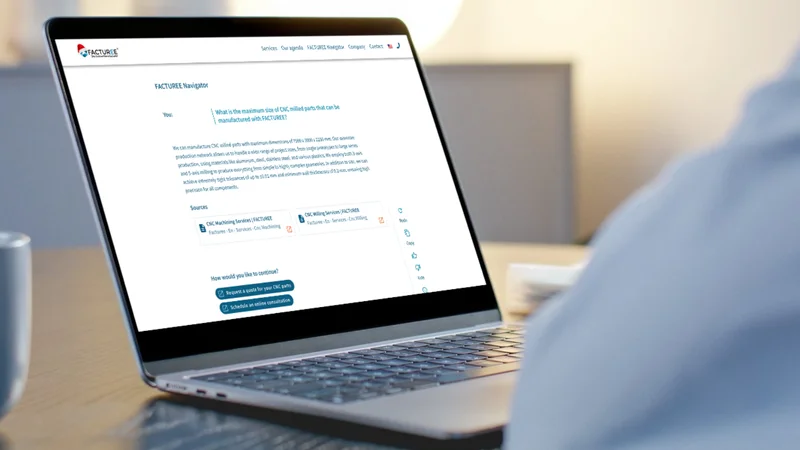
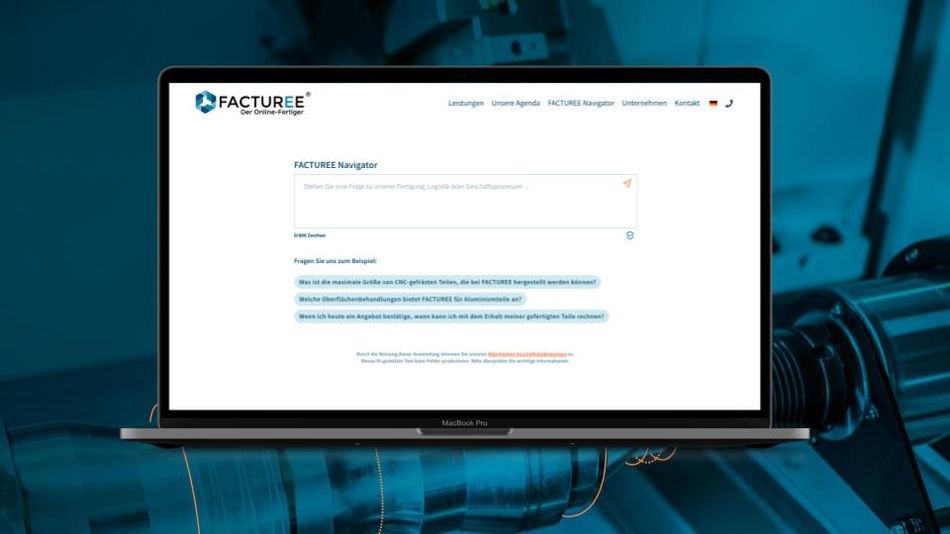
From the user’s perspective, the FACTUREE Navigator is exceptionally easy to use thanks to its user-friendly interface. On screen, users are presented with a simple text input box and a list of helpful prompt examples, for example, “What is the maximum size of CNC milled parts that can be manufactured with FACTUREE?”
Once a question has been submitted, the AI agent quickly generates a conversational response. In our example, the answer would be, ”We can manufacture CNC milled parts with maximum dimensions of 7500 x 3000 x 2200 mm.” This succinct answer is also supported by some additional context and information about CNC capabilities.
Below are just a few examples of questions the FACTUREE Navigator can answer:
What types of metal post-processing methods are available for an aluminum part
What manufacturing process and material combination would be best suited for a heat exchange component with built in cooling channels?
How can I reduce machining time for a complex bracket?
Which post-processing method is best for stainless steel parts with cosmetic finishes?
The FACTUREE Navigator provides internal sources for its responses so users can follow a relevant link or download useful PDFs. The tool also facilitates the next steps, such as requesting a quote or scheduling a consultation with the FACTUREE team.
Overall, the goal of the AI agent FACTUREE Navigator is to share its in-depth manufacturing experience and knowledge in an easy-to-use, always-on way. Unlike generic AI tools, the FACTUREE Navigator will never answer questions about competitors and won’t compare different services. It is designed to advise customers within the FACTUREE range based on the company’s proprietary data. FACTUREE also notes that the AI-powered solution does not replace the final, critical inspection by an engineer, especially for safety-relevant parts.
Conclusion
AI agents are transforming manufacturing procurement by prioritizing user experience, speed, and continuous availability. The FACTUREE Navigator demonstrates how domain-specific AI agents, trained on proprietary and validated data, can deliver real-time manufacturing insights that procurement professionals can trust. Rather than replacing engineers, these tools augment decision-making, helping teams move faster while reducing uncertainty. In practice, it feels less like using a chatbot and more like having a senior manufacturing engineer available directly in the browser, ready to support better decisions, faster.