3D Printing vs. CNC Machining for Prototypes: When Is Each the Better Choice?
The choice between 3D printing and CNC machining is the most common decision regarding manufacturing methods that must be made before placing the first order for prototypes. The correct answer depends on tolerance requirements, material specifications, component geometry, and schedule.

26 Aug, 2026. 3 minutes read
This article was first published on
www.facturee.deAdditive vs. Subtractive Manufacturing Processes: What's the Difference?
CNC machining encompasses traditional subtractive manufacturing processes.
In this process, material is removed from a solid block of metal or plastic until the desired shape is achieved.
Typical processes in this field include turning and milling, particularly high-precision CNC milling.
3D printing, on the other hand, refers to additive manufacturing processes. The component is built up layer by layer. Common technologies such as Fused Deposition Modeling (FDM) and Selective Laser Sintering (SLS) operate on this principle. However, they differ significantly in terms of resolution and mechanical properties.
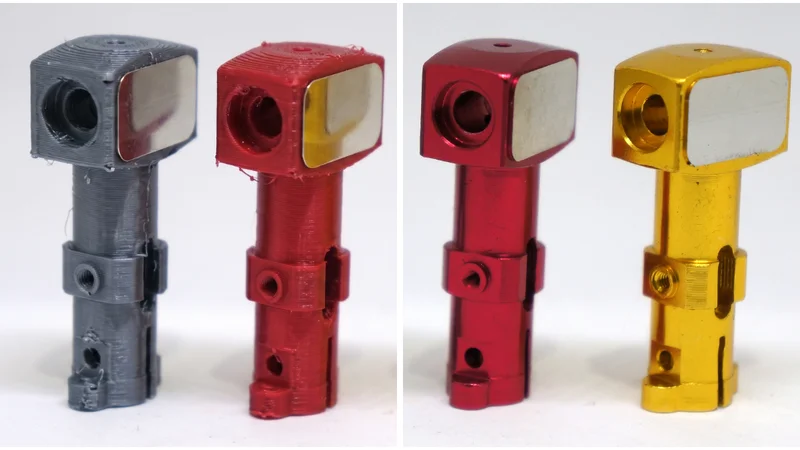
The key difference in practice: Subtractive processes deliver higher dimensional accuracy, better surface quality, and material properties equivalent to those of mass-produced parts. Additive manufacturing technologies offer greater design freedom and faster iteration—especially in the early stages of development.
The two processes are not mutually exclusive. Many projects combine additive and subtractive manufacturing. 3D printing is used for early geometry validation, while CNC machining is used for functional prototyping.
When is CNC machining better than 3D printing for prototypes?
FACTUREE recommends CNC machining for prototyping if at least one of the following four conditions applies.
- Condition 1: The material must be equivalent to that used in production. FACTUREE manufactures prototypes from the same alloy as the eventual production part (aluminum 6061, aluminum 7075, stainless steel 316, brass CW614N, PEEK, Delrin). Using the same alloy and a comparable delivery condition increases the reliability of functional tests. However, whether results can be applied to the production part must be evaluated based on the subsequent manufacturing process and qualification requirements.
- Condition 2: The project requires high precision and tight tolerances of less than ±0.2 mm. With the appropriate geometry, tolerances of approximately ±0.05 mm or tighter can be achieved on specific features. General tolerances should be specified based on the drawing, the nominal dimension, and the agreed-upon tolerance class.
- Condition 3: The geometry has no internal features that cannot be milled. CNC machining is the more reliable choice for prismatic parts, rotational parts, bores, threads, and mating surfaces. Completely enclosed channels and highly complex lattice structures may require additive manufacturing processes. Freely accessible free-form surfaces can often be CNC-milled.
- Condition 4: Fewer than three iterations are planned over the next two weeks.
FACTUREE delivers CNC prototypes made of aluminum in as little as 3 business days. For frequent geometry changes, 3D printing is faster per cycle.
The choice of the more cost-effective process should be based on the specific geometry, size, quantity, and post-processing requirements.
When is 3D printing better than CNC machining for prototypes?
FACTUREE recommends 3D printing for prototypes in the following situations.
- Condition 1: The component contains internal channels, lattice structures, or undercuts that cannot be accessed with standard machining tools. 3D printing offers greater geometric freedom but is subject to process-specific design limitations.
- Condition 2: The component is in the early stages of design validation, during which dimensional accuracy and material properties are not yet critical. SLA and SLS deliver models in 1–2 business days at significantly lower unit costs than CNC.
- Condition 3: More than three design iterations are planned within two weeks. A change in geometry during 3D printing requires only an update to the CAD file—no new setup or machining process is needed.
- Condition 4: The component is needed for a design review presentation, not for mechanical functional testing. For a model intended solely for presentation purposes, CNC machining may be cost-prohibitive.
Read the article on FACTUREE's website to find out more about the selection criteria, how to evaluate manufacturing procedures correctly, and more: https://www.facturee.de/en/3d-printing-vs-cnc-for-prototypes/