Sound and Vibration Analysis Takes Flight in Aerospace
The aerospace industry's pivot toward drones and electric air taxis has created an urgent noise problem, and the measurement science to address it is migrating directly from automotive NVH labs.

17 Apr, 2026. 8 minutes read
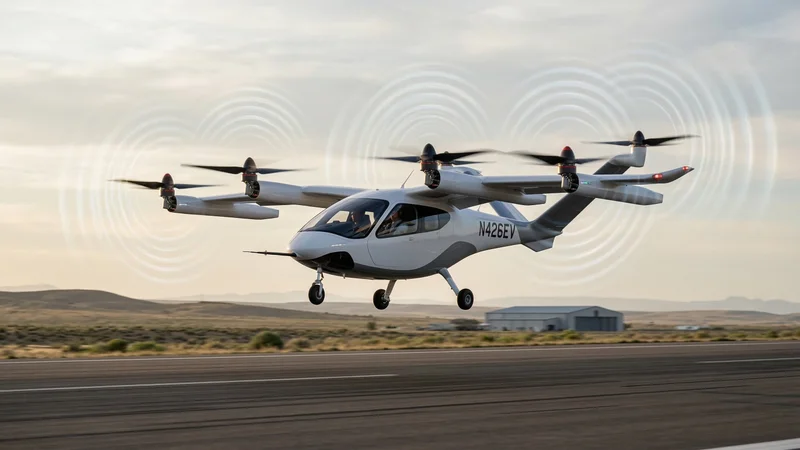
Drones and electric vertical takeoff and landing (eVTOL) aircraft are arriving faster than the measurement science needed to certify them. Community noise acceptance is the single largest non-safety barrier to urban air mobility deployment, with EASA's 2021 social acceptance study finding that noise ranked as European citizens' second-highest concern about air taxis, trailing only safety.[1] Yet the acoustic tools and standards that govern conventional aviation were never designed for the noise these vehicles produce.
HEAD acoustics, founded in 1986 by Prof. Dr. Klaus Genuit in Herzogenrath, Germany, has spent nearly four decades building expertise in binaural measurement, psychoacoustic analysis, and sound quality engineering. These capabilities, rooted in and refined over decades of automotive noise, vibration, and harshness (NVH) work, address both sides of the aerospace noise challenge: making aircraft quiet enough for communities below and comfortable enough for passengers inside, all under severe weight constraints that limit traditional acoustic treatments.
This article explains why conventional noise metrics fall short for this vehicle class, and how HEAD acoustics' measurement, analysis, and simulation tools address each dimension of the problem.
Decibels Alone Don't Capture How Annoying Drone Noise Really Is
Understanding why drones sound so much worse than their decibel readings suggest requires looking beyond the numbers. A-weighted sound pressure level (dBA), the default metric in most noise regulations, cannot predict how annoying multirotor drone noise actually is. Multiple independent studies — at institutions including KAIST, Empa in Switzerland, RWTH Aachen, and Delft University of Technology — converge on the same conclusion: at equivalent sound exposure levels, multirotor drone noise is perceived as substantially more annoying than jet aircraft, helicopter, or road vehicle noise.[2]
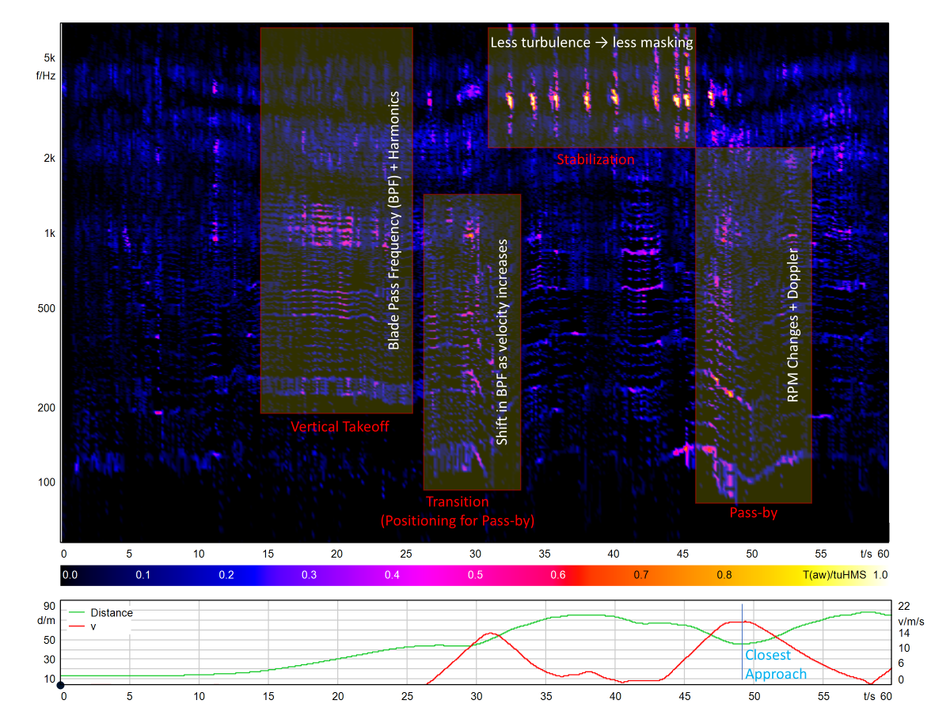
The reason lies in the acoustic signature. Multirotor drones produce strong tonal components at the blade-passage frequency and its harmonics, with multiple rotors operating at slightly different RPMs creating complex beating and modulation patterns.[3] Researchers at the Swiss Federal Laboratories for Materials Science and Technology (Empa), working in their 22-loudspeaker AuraLab, found that tonality, sharpness, and loudness were the psychoacoustic parameters most strongly linked to drone noise annoyance.[4] Meanwhile, the Effective Perceived Noise Level (EPNL) used in aircraft certification caps its tonal correction at 4.0 dB — a ceiling that researchers at RWTH Aachen have shown is inadequate for multi-rotor tonal content.[5] The Aures tonality method, standard in automotive sound quality, significantly outperforms EPNL for these complex sounds.[6]
In short, the aerospace industry needs metrics that reflect how people actually hear and respond to drone noise, not just how loud it is on paper. That is the domain in which HEAD acoustics has operated for decades.
HEAD Acoustics' Psychoacoustic Answer
HEAD acoustics has been quantifying subjective sound perception since its founding. The company's ArtemiS SUITE software platform includes dedicated psychoacoustic analysis modules that calculate the very parameters research identifies as most critical. The basic module covers Zwicker loudness, sharpness, fluctuation strength, and tonality in accordance with DIN 45681. The advanced module builds on the Sottek Hearing Model — a proprietary approach that models the human auditory system's signal processing — to deliver refined analyses of loudness, roughness, and tonality.
The Sottek Hearing Model is particularly relevant for aerospace. Its tonality analysis detects disturbing tonal components even in sounds with rapidly changing characteristics, such as those from electric motors — making it directly applicable to the modulated tonal signatures of multirotor drones. This capability contributed to the development of ECMA-74, the international standard for automatic detection and classification of tonal components. ArtemiS SUITE further implements standards including DIN 45631/A1, ISO 532-1, and ECMA 418-2, providing a standards-compliant foundation for emerging aerospace noise evaluation.
Capturing What Passengers and Communities Actually Hear
Knowing which psychoacoustic parameters matter is only useful if engineers can capture them accurately in the environments where drones and eVTOL aircraft actually operate. That requires measurement hardware designed for human-centric sound capture.
Binaural Field Measurement
HEAD acoustics' approach starts with capturing sound the way humans actually perceive it. The company's HMS and HSU families of artificial head measurement systems record binaurally, using anatomically accurate ear replicas that preserve the spatial cues our auditory system relies on to assess sound. This matters because the perceived annoyance of a sound depends heavily on its spatial properties, something monaural microphones cannot capture.
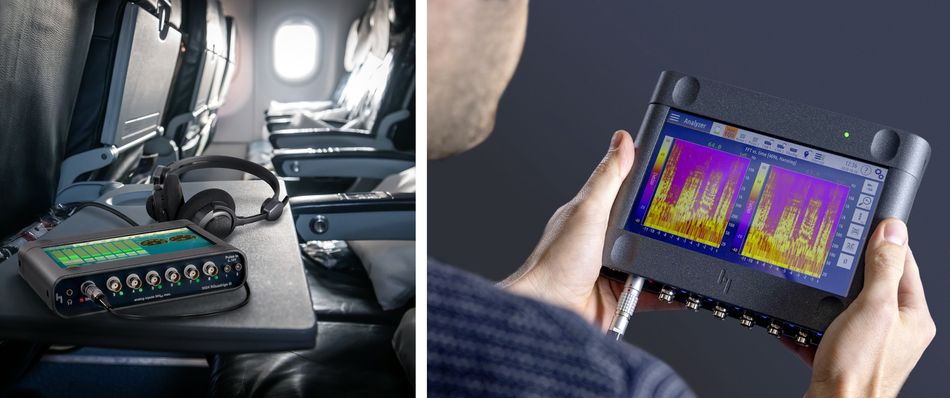
The SQuadriga III mobile frontend brings laboratory-grade, 8-channel measurement to the field. For aerospace, HEAD acoustics developed an additional variant, the SQuadriga III-V1, which offers the ability to eliminate the lithium-ion batteries to comply with aviation regulations and air freight restrictions in flight-test environments.[7] These tools capture both exterior community noise during flyovers and interior cabin sound quality during flight, the two critical measurement scenarios for this vehicle class.
From Measurement to Design Decisions
Capturing accurate acoustic data is the starting point, but the true benefit comes from converting that data into actionable design improvements. Measurement data feeds directly into ArtemiS SUITE for analysis, but HEAD acoustics' workflow extends into active design support. The PreSense NVH simulator lets engineers experience and evaluate sound designs in a virtual environment before physical prototypes exist. In the automotive domain, PreSense already underpins active sound design workflows, enabling interactive tuning, variant comparison, and jury panel validation, all without building hardware prototypes. This approach maps directly to eVTOL cabin sound tuning, where prototypes are especially expensive and scarce.
The SoundSeat multimodal playback system adds another dimension by reproducing not just audible sound but the coupled vibrations passengers feel through their seat. This is an important distinction: passenger comfort in eVTOL aircraft depends on the full sensory experience, not just what reaches the ears. HEAD acoustics' SQala jury testing software then supports structured listening studies — the same methodology that Wisk Aero uses at Boeing's Critical Listening Facility[8] and that NASA employs in its VANGARD studies, exposing hundreds of participants to recorded eVTOL sounds across multiple U.S. cities.[9]
Tracing Vibration From Rotors to Airframe
Acoustic perception is one half of the equation. The other is understanding where problematic noise and vibration originate in the structure itself, and that is where vibro-acoustic diagnostics come in.
The Drone Development Example
During drone development, sound and vibration serve as early warning indicators of hidden structural problems. Engineers first establish a baseline by characterizing how the motor, mounts, and frame behave dynamically. If a design change — such as switching to lighter motor mounts — introduces a new 'buzz,' recapturing the structural dynamics can reveal a resonance that could lead to future failure: loosening bolts, deformation, or motor breakdown. This feedback loop enables informed decisions that improve both reliability and performance — and it is exactly the workflow HEAD acoustics' vibro-acoustic diagnostic chain supports.
Transfer Path Analysis
To diagnose the root cause of such issues, engineers need to trace how vibration travels from its source through the structure to the point where it becomes audible. Transfer Path Analysis (TPA), the established technique for tracing automotive powertrain noise through body structures, applies directly to eVTOL motor-to-cabin vibration paths. HEAD acoustics' ArtemiS SUITE TPA modules support methods including indirect force determination, effective mount transfer functions, and airborne attenuation determination. The TPA Project calculates individual noise contributions from each path. It generates a complete vibro-acoustic model, with results that can be synthesized in the time domain and fed directly into PreSense for virtual prototyping. The company's Binaural Transfer Path Analysis (BTPA) approach further enables troubleshooting of specific noise issues, as they would actually be perceived. It was originally developed for isolating automotive problems, like inverter whine and rotor-order noise, and it transfers naturally to eVTOL applications.
Modal Analysis and Order Tracking
Once vibration paths are mapped, the next step is to identify the structural resonances that amplify noise and to separate the contributions of individual rotors. The modal analysis project identifies structural resonance frequencies and mode shapes using the LSCF method with stability diagrams and MAC matrices — essential for ensuring drone and eVTOL frames do not operate near resonance. The companion impact measurement module supports the roving hammer and accelerometer methods for structural characterization. Order tracking, standard in automotive powertrain development, maps directly to rotor-order analysis. eVTOL vehicles with six to twelve propellers create complex order spectra where individual rotor contributions must be separated, and run-up measurements identify resonance crossings during motor spin-up.[10]
Sound Source Localization
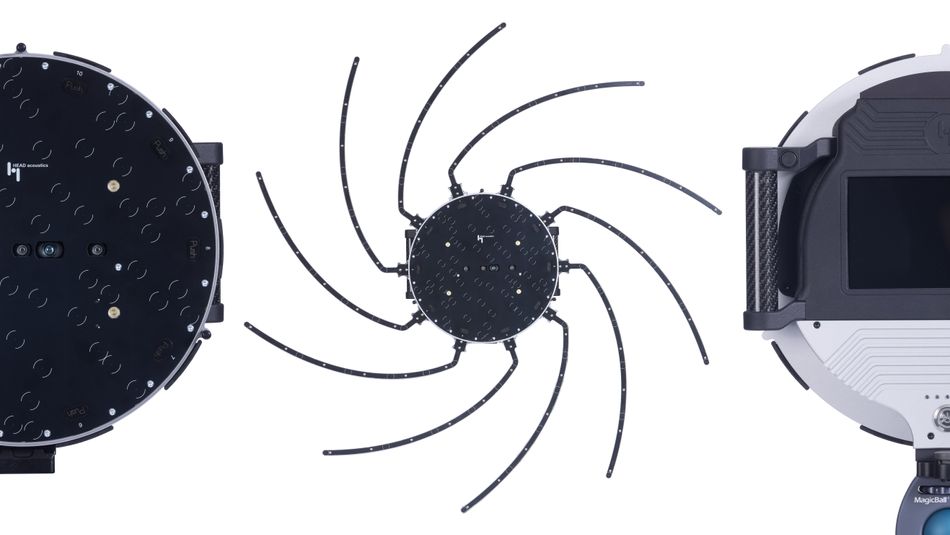
Visual localization provides clarity when a noise problem has been identified, but its physical source remains unclear. The HEAD VISOR acoustic camera, paired with the VMA V array of up to 120 MEMS microphones, uses beamforming and AI-based Neural Deconvolution to localize noise sources in real time. Neural Deconvolution is currently the only commercially available real-time deconvolution method, dramatically improving the precision of source identification. For drone development, engineers can visually pinpoint which motor, mount, or structural component is responsible for a problematic sound — replacing trial-and-error troubleshooting with targeted diagnosis.
Automotive NVH Expertise Finds a Natural Second Home in Aerospace
The capabilities described above, psychoacoustic evaluation, binaural measurement, transfer path analysis, modal analysis, and sound source localization, were all originally developed for the automotive industry. The reason they translate so directly to aerospace is rooted in physics. Electric motors produce tonal frequencies governed by powertrain topology and speed. Inverter switching noise creates torque ripple that manifests as propeller tonal emissions in drones, the identical mechanism that drives EV drivetrain tonal noise. And the absence of combustion-engine masking makes subtler sounds prominent — the same "unmasking" challenge that reshaped automotive NVH when EVs arrived.
HEAD acoustics' ArtemiS SUITE offers over 150 analysis methods, including the complete psychoacoustic, TPA, and order-tracking toolchain for both community noise assessment and cabin sound quality assessment. The company has already moved toward aerospace: the battery-free SQuadriga III-V1 was developed for flight testing, and HEAD acoustics exhibited at AERO 2019, demonstrating aircraft interior noise optimization and headset testing. Regulatory urgency reinforces this timing. EASA's NPA 2025-03, published in August 2025, proposes the most comprehensive VTOL noise certification rule to date, targeting adoption by 2027.[11] The FAA is expanding its Rules of Particular Applicability framework, with six drone-specific certifications issued in 2023.[12] These developments are locking in measurement methodologies within two to three years.
Bridging the Measurement Gap Before the Window Closes
The convergence of electric propulsion, urban operations, and immature noise standards has created a measurement science gap in aerospace that automotive NVH expertise is positioned to fill. Psychoacoustic metrics, not decibels, will determine whether communities accept drones and air taxis overhead. The vibro-acoustic diagnostic chain that automotive engineers rely on daily transfers almost directly to eVTOL development. And the regulatory window is open but closing.
HEAD acoustics' distinctive advantage lies in its psychoacoustic depth — the very capability that independent research consistently identifies as most lacking in current aerospace noise assessment. The tools, methods, and expertise to solve aerospace's acoustic challenges already exist. They have been proven across nearly four decades of automotive sound-quality engineering. Now they are taking flight.
Check them out at the Future of Vertical Flight, May 5-7, 2026!
References
- EASA (2021). Study on the societal acceptance of Urban Air Mobility in Europe. Available at: easa.europa.eu/sites/default/files/dfu/uam-full-report.pdf
- Woodcock, J. et al. (2025). Human response to eVTOL drone sound: an online listening experiment exploring the effects of operational and contextual factors. Frontiers in Acoustics, 3. Available at: frontiersin.org/journals/acoustics/articles/10.3389/facou.2025.1624669/full
- Raza, W. and Stansbury, R.S. (2025). Noise Prediction and Mitigation for UAS and eVTOL Aircraft: A Survey. Drones, 9(8), p.577. Available at: mdpi.com/2504-446X/9/8/577
- Kawai, C. et al. (2024). Short-term noise annoyance towards drones and other transportation noise sources: A laboratory study. The Journal of the Acoustical Society of America, 156(4), pp.2578–2595. Available at: pubs.aip.org/asa/jasa/article/156/4/2578/3316980/Short-term-noise-annoyance-towards-drones-and
- Sahai, A.K. and Stumpf, E. (2013) 'A comparative analysis of the subjective assessment of standard and noise abatement flight procedures', Proceedings of the Inter-Noise Congress and Conference, Denver, CO, pp. 255–270. Available at: ince.publisher.ingentaconnect.com/contentone/ince/incecp/2013/00000246/00000001/art00034
- Torija, A.J. et al. (2019). On the assessment of subjective response to tonal content of contemporary aircraft noise. Applied Acoustics, 146, pp.190–203. Available at: sciencedirect.com/science/article/abs/pii/S0003682X1830611X
- HEAD acoustics (2021) 'Mobile measurement technology above the clouds — even without battery' [Press release]. Available at: head-acoustics.com/news-events/press-releases/press-details/show/mobile-measurement-technology-above-the-clouds-even-without-battery
- Wisk Aero (2023) 'The science of silence: understanding the impact of noise on passenger comfort in UAM'. Available at: wisk.aero/newsroom/the-science-of-silence-understanding-the-impact-of-noise-on-passenger-comfort-in-uam
- Colucci, F. (2023) 'Lost in the noise', Vertiflite, May/June. Available at: evtol.news/news/lost-in-the-noise
- Garg, S. et al. (2025) 'Active vibration reduction for eVTOL aircraft through rotor speed modulation', Aerospace Science and Technology. Available at: sciencedirect.com/science/article/abs/pii/S1270963825002834
- Aviationweek.com. (2025). EASA Proposes Noise Certification Rules For EVTOLs | Aviation Week Network. Available at: aviationweek.com/aerospace/advanced-air-mobility/easa-proposes-noise-certification-rules-evtols
- Faa.gov. (2022). Noise Certification of UAS/AAM using Rules of Particular Applicability | Federal Aviation Administration. Available at: faa.gov/about/office_org/headquarters_offices/apl/aee/noise/uas_noise_certification