Smart socks that alleviate pain
Diabetes leads to nerve damage in half of all people affected, starting in the feet. The smart sock from ETH spin-off MYNERVA helps sufferers feel the ground again when walking and alleviates their chronic pain.

22 Oct, 2025. 4 minutes read
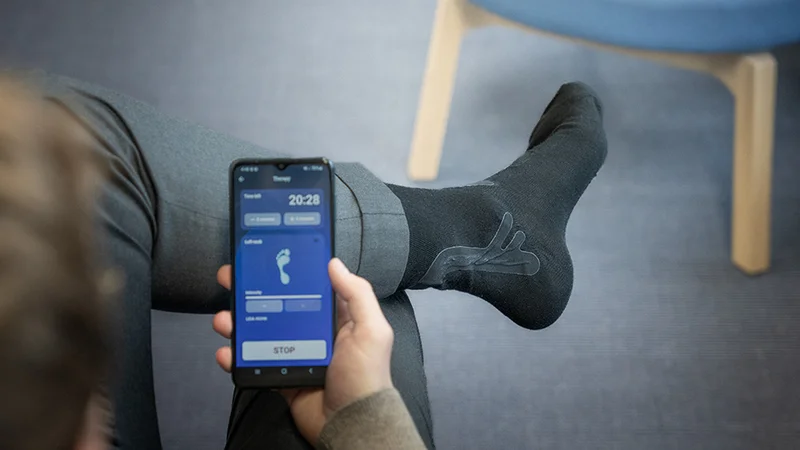
The smart sock artificially generates lost sensations in the sole of the foot. While the wearer is walking, invisible pressure sensors on the sole of the sock create a map of pressure distribution and electrodes stimulate the nerves accordingly. (Image: Michel Büchel / ETH Zurich)
This article was first published on
ethz.chParadoxically, MYNERVA’s success story begins with people who cannot wear socks. It begins with a girl who spends her free time devouring books on therapy methods for amputees: “I’ve been fascinated by the development of phantom pain ever since I was a child,” says Greta Preatoni, founder and CEO of MYNERVA. She comes across as confident and successful, with a child-like curiosity that continues to drive her, shining brightly in her eyes. To better understand how the brain works, Preatoni studied psychology and neuroscience. After graduating, however, she felt lost: “I wanted to start my own business, but I had no money, no team and no idea,” she says.
From phantom pain to a widespread disease
But Preatoni is a go-getter who makes her own luck. So, she went back to what interests her and found what she was looking for at ETH Zurich. Despite not having a background in engineering, she worked her way up to a doctoral position in the laboratory under neuro-engineer Stanisa Raspopovic, conducting research on prosthetic legs that allow amputees to feel the ground and at the same time reduce phantom pain. The potential of these neuroprostheses sparked Preatoni’s business mind: together with post-doctoral researcher and co-founder Giacomo Valle, she went looking for broader applications for the technology. What they discovered is that diabetic neuropathy – nerve damage caused by diabetes – triggers the same symptoms of loss of sensation and chronic pain.
Approximately half of the 560 million diabetics worldwide develop neuropathy during the course of their disease. Elevated blood sugar levels damage nerves and the blood vessels that supply them. The calf nerve, which transmits sensations from the sole of the foot to the brain, is particularly affected. Sufferers have difficulty walking, putting them at increased risk of a fall. The sensory loss means that they don’t notice pressure points and the resulting foot ulcers and wounds until a later stage. In the worst-case scenario, this can lead to severe infections that end in amputation.
An alternative to painkillers
ETH spin-off MYNERVA wants to halt this downward spiral as early as possible. Its smart sock “Leia” can artificially restore sensation to the soles of the feet. Invisible pressure sensors on the sole of the sock create a map of pressure distribution while the wearer is walking. A small computer in the sock shaft then converts this information into electrical signals. Sewn-in electrodes transmit the signals directly to healthy parts of the nerves, literally bypassing the damaged nerve sections.
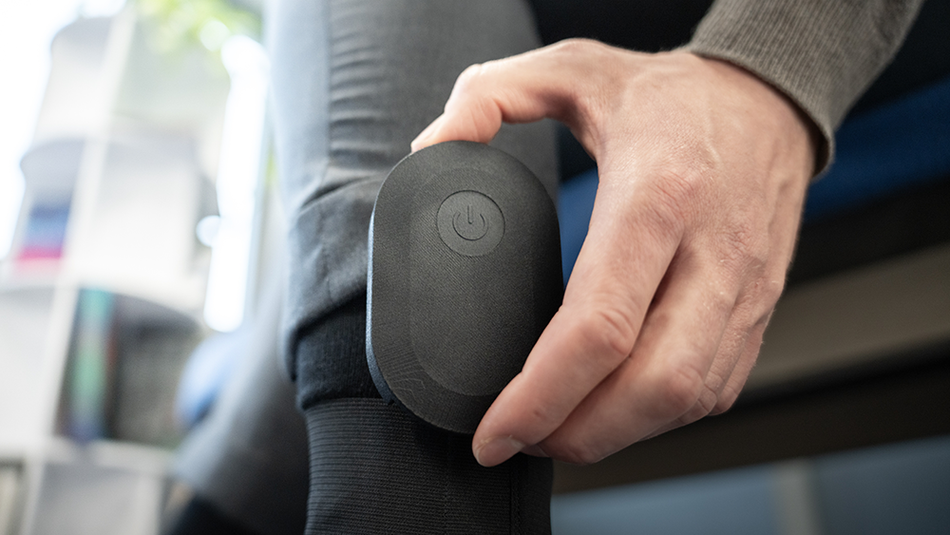
With the help of artificial intelligence, the system adapts the stimulation of the nerves to the individual wearer and external conditions. Thanks to this fine-tuning, the treatment is personalised to the specific needs of each individual patient and alleviates the pain associated with neuropathy. Stimulating specific nerve strands causes the body to release chemical messengers that inhibit pain transmission. The sock has the potential to replace the conventional approach to treatment, which involves strong painkillers. “Many sufferers want an alternative that doesn’t cause side effects or dependency,” says Preatoni.
History in three plastic boxes
The Italian scientist and her team have been working on this alternative for five years now. The history of MYNERVA fits into three plastic boxes, which stand inconspicuously on the office shelf. They contain all the prototypes, from the fully wired, stiff overshoe to versions with Velcro, zips or laces, and finally the current sleek design, which looks almost exactly like a normal sock. The team, which has since grown to ten, spared no effort in making the system as simple as possible. The sock is operated via a smartphone app for convenience.
At the bottom of one box is Leia, the namesake of the smart sock. With its two sewn-in cushions, the early prototype is reminiscent of the Star Wars princess’s hairstyle. “It’s a fun fact that keeps our team together,” says Preatoni, chuckling. The office is full of energy and a little bit hectic, says the entrepreneur. She loves her team and lives for the start-up. Her commitment is paying off: in 2023, not only did she receive the ETH Medal for her doctoral thesis, but she also made it onto Forbes’ 30 Under 30 Science & Healthcare.
The home straight
Since 2023, MYNERVA has also been part of Wyss Zurich. The funding programme, run by philanthropist Hansjörg Wyss, supports start-ups in making the leap from scientific discovery to applied therapy. MYNERVA is already on the home straight: last June, the team won the Grand Prize at the Venture Award, covering the costs of patents and approval by the U.S. Food and Drug Administration (FDA). If everything goes smoothly, the soft launch in the USA is scheduled for 2027. After that, the team hopes to conquer the markets in Switzerland, the United Kingdom and the Middle East.
This autumn, the team will also launch the first long-term study to find out whether the Leia sock can prevent secondary diseases, such as foot ulcers, thanks to the improvements in gait pattern. The literature even suggests that continuous electrical stimulation can improve nerve supply and partially restore nerve function. “It would be a dream come true if we could prove that Leia can do this,” says Preatoni, her eyes shining.
This is how the intelligent sock works. (Video: MYNERVA)