Robotics Lab at embedded world North America
How Embedded Systems, AI, and Human-Centered Design Are Driving the Future of Robotics

10 Aug, 2026. 5 minutes read
Robotics is expanding across manufacturing, automotive production, aerospace, healthcare, logistics, and industrial automation. Despite their different uses in various industries, all modern robots share the same procedural requirements: sensing conditions, processing data, making decisions, and acting in the physical world.
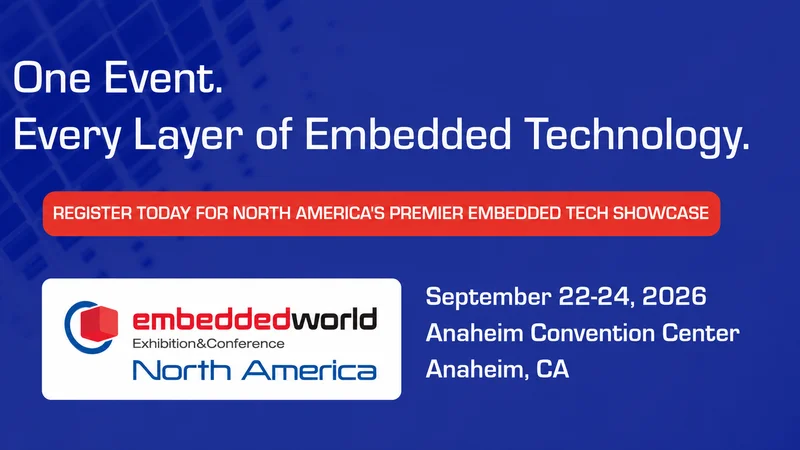
embedded world North America will take place from September 22nd to the 24th, 2026, at the Anaheim Convention Center in Anaheim, CA, US. It provides a focused platform for the embedded technology community across the United States, Canada, and Mexico. Organisers expect more than 5,000 visitors, over 250 exhibitors, more than 60 technical sessions, and 100,000 square feet of exhibition space.[1]
The Robotics Lab is a hands-on show-floor feature connecting embedded systems, AI, human-machine interaction, and practical applications. It shifts attention from robots as finished machines to the technology stack behind them.
Why Robotics Belongs at an Embedded Systems Event
Embedded Systems as the Foundation of Robotics
Robots depend on microcontrollers, systems-on-chip, sensors, real-time operating systems, connectivity, and embedded software. Sensors collect data, processors interpret it, and software turns it into movement. Timing is critical because delays can affect accuracy and safety.
AI cannot compensate for weak sensing, limited processing, high energy use, or unreliable control. The wider embedded world platform encompasses the components, modules, operating systems, communication systems, and design tools that underpin this foundation.[2]
Robotics as a Clear Use Case for Embedded Innovation
Robotics combines hardware, firmware, software, AI, and connectivity. A mobile robot may process urgent tasks locally while sending selected data to an edge or cloud platform.
This makes technical choices visible. Processing delays affect movement, sensor errors affect decisions, and network loss can interrupt remote functions. Robotics therefore matters to engineers, developers, integrators, product managers, and research leaders. It also provides a practical way to examine productivity, safety, automation, and industrial change. [3]
The Robotics Lab Visitor Journey
A Structured Four-Zone Experience
The approximately 800-square-foot Robotics Lab is planned as a journey through four connected zones: Embedded Intelligence, AI and Autonomy Engine, Human-Machine Interaction, and Industry Applications and Future Robotics.
The route moves from control components to decision-making, interaction with people, and final industry use. It shows that autonomy depends on the embedded platform, data, software, AI models, interfaces, and operating environment.
From Embedded Intelligence to Industry Application
Embedded systems provide sensing, processing, and control. AI adds perception, learning, and autonomy. Human-machine interaction connects robots with operators, while industry applications place the complete system in environments with specific safety, performance, and reliability needs.
Following this sequence helps visitors see how decisions at one level affect those at other levels. A strong AI model may still fail on limited hardware, while a capable robot may remain difficult to use if its interface is unclear.
The Four Robotics Lab Zones
Zone 1: Embedded Intelligence
This zone covers microcontrollers, SoCs, sensors, RTOS platforms, and connectivity. Together, they manage robotic control, collect operational data, support predictable timing, and connect robots with other systems.
The main point is simple: every intelligent robot begins with an embedded platform designed for its task.
Zone 2: AI and Autonomy Engine
Machine learning supports pattern recognition and adaptive behaviour, while computer vision enables inspection, object detection, and navigation. Simulation allows teams to test and improve systems before physical deployment.
AI processing may run on the robot, at the edge, or in the cloud. On-device and edge processing can reduce latency, while cloud systems can support training, storage, and coordination. Research on edge robotics identifies reduced latency, mobility, location awareness, and real-time processing as key benefits. [4]
Zone 3: Human-Machine Interaction
This zone includes cobots, control displays, AR and VR, voice and gesture control, and safety systems. These tools can support training, monitoring, programming, and maintenance.
Robots working near people need clear status information, predictable movement, accessible emergency controls, and defined limits. Augmented and mixed reality can support robot control, training, monitoring, and clearer communication between people and machines. [5] Human-Centered design should make robotic behaviour easier to understand without hiding uncertainty or risk.
Zone 4: Industry Applications and Future Robotics
The final zone connects robotics with automotive manufacturing, aerospace, healthcare, logistics, industrial automation, smart factories, and emerging fields.
Requirements differ by sector. Factory robots may work in controlled cells, warehouse robots must handle changing routes and people, and healthcare systems require close attention to safety, privacy, hygiene, and reliability.
Displays should explain not only what a robot does, but also the sensors, processing systems, safety controls, and operating conditions behind it.
Hands-On Experiences and Technical Programming
Interactive Show-Floor Elements
The lab can include live robotics demonstrations, AI inference examples, cobots, sensor walls, simulation tools, AR and VR interfaces, gesture control, and industry-specific application pods. These displays can show how sensor input becomes an AI result and then a physical action.
embedded world North America offers a hands-on technical setting where companies can demonstrate technologies directly to engineers and other technical visitors.[3] Demonstrations should also state whether processing is remote, routes are pre-mapped, or models are trained for selected objects.
Engagement Through Learning Formats
Ten-minute technical sessions, expert-led tours, and workshops can cover robotics programming, sensing, simulation, and AI model tuning.
Tours can connect the four zones, while workshops let visitors examine trade-offs involving processing, memory, power, and deployment. These formats can serve embedded engineers, robotics and AI developers, product leaders, and technical executives.
Value for Attendees, Exhibitors, and Sponsors
Attendee
For attendees, the lab shows how robotic systems move from individual components to deployment. It brings together embedded systems, AI, HMI, and industry applications, and connects robotics trends with practical challenges in sensing, integration, connectivity, safety, and reliability.
Compared with a standard booth display, live and interactive exhibits offer a more active way to understand how robotic technologies operate in real applications.
Exhibitor and Sponsor
For exhibitors and sponsors, the lab can offer zone-level sponsorship, ownership of selected demonstrations, branded robotics experiences, and participation in technical sessions, tours, and workshops.
Direct engagement with engineers and decision-makers can support lead generation and provide a clearer way to show real-world technology impact. The official exhibitor information also presents live demonstrations, technical discussions, brand visibility, and lead generation as key reasons for participation. [3]
Sensor companies can demonstrate data collection, processor suppliers can show performance under timing and power limits, and software providers can present tools for simulation, control, or deployment.
Sponsored activities should be clearly identified, while technical content should discuss limits and compatibility rather than present products as universal solutions.
Conclusion
Robotics is one of the clearest examples of embedded systems becoming intelligent physical machines. The Robotics Lab can present the complete embedded-to-AI pipeline by connecting embedded intelligence, autonomy, human interaction, and industry applications.
As robotics adoption grows across U.S. industries, hands-on demonstrations, technical sessions, tours, and workshops can help engineers and decision-makers understand both the opportunities and practical requirements of deployment.
The lab’s value lies not only in displaying robots but in explaining the technologies, operating conditions, and design choices behind them.
For more info about embedded world North America, check out their event page.