Rapid prototyping: the path to fast product development
Rapid prototyping (3D printing, CNC, casting) speeds up product development, cuts costs & risk—turning ideas into tested prototypes fast.

07 Sep, 2026. 3 minutes read
This article was first published on
www.facturee.deRapid prototyping enables fast, agile product development—from concept to finished prototype in no time. In this article, you’ll learn how companies are using 3D printing, CNC machining, and other digital processes to shorten development cycles, accelerate innovation, and respond more quickly to market demands.
Why are speed and agility crucial in product development?
In an increasingly competitive market, speed and agility in product development determine success or failure. Companies that can quickly implement, test, and optimize their product ideas gain a decisive advantage—whether in terms of time to market, new ideas, or responding to customer requirements.
Modern processes such as rapid prototyping, CNC machining or additive manufacturing enable prototypes to be produced quickly and economically. This allows concepts to be validated at an early stage and adjustments to be made in an agile manner - without long development cycles or high tool costs.
An agile development process ensures flexibility, especially when dealing with complex requirements and changing conditions. Instead of months-long wait times, iterative steps with short feedback loops enable dynamic product development. This is ideal for various industries such as mechanical engineering, medical technology, and consumer electronics.
Agility in development also means reliability: errors are detected early, and adjustments are implemented quickly. Combining digital workflows, automated manufacturing processes, and fast decision-making saves time and money. And this, in turn, increases the pace of development.
Speed and agility are key factors in modern product development. They enable companies to respond more quickly to the market, act on customer feedback, and maintain a competitive edge in dynamic markets.
What is rapid prototyping?
Rapid prototyping is a process for the rapid creation of prototypes. It is therefore a preliminary model of a product. This principle is by no means limited to physical objects. It can also be applied to Software, services or processes transferred.
Teams can use rapid prototyping Recognize earlywhether an idea is viable. In addition Potential weaknesses identified and Feedback from the field before significant resources are invested. This results in a more stable, well-thought-out end product.
At its core, rapid prototyping embodies the philosophy of "fail fast, fail cheap". In this way, errors can be admitted at an early stage in order to learn from them. Development costs are reduced without jeopardizing the entire process.
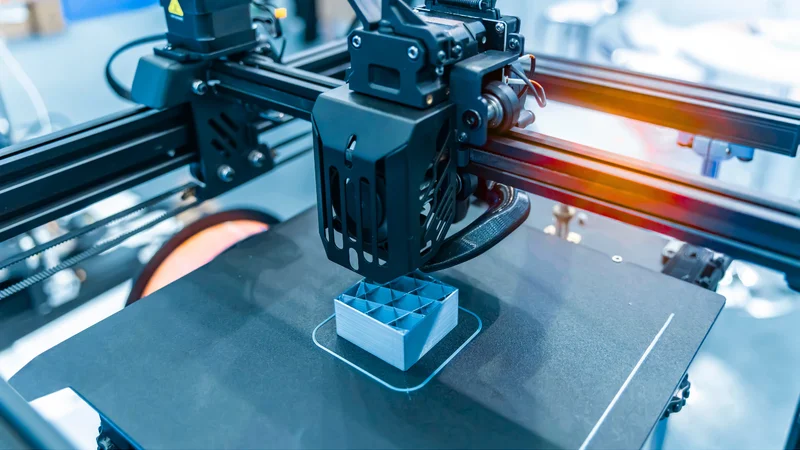
Rapid prototyping has revolutionized product development in many different industries. In the manufacturing industry, components can be produced quickly and cost-effectively using state-of-the-art technologies such as rapid tooling. This allows new ideas to be quickly transformed into functional models.
In rapid prototyping, digital CAD data is converted directly into real components. Precise parts are created using processes such as CNC milling or selective laser sintering (SLS). These parts already have the mechanical properties of the final product.
Rapid prototyping makes it possible to implement complex geometries economically without the need for expensive tools or molds. This allows design, function and accuracy of fit to be tested and optimized at an early stage.
What is the process and procedure for rapid prototyping?
The rapid prototyping process consists of five steps, from the concept phase to the preparation for mass production. It is designed to, Quickly transform ideas into tangible results. The aim is to develop, test and optimize functional prototypes in the shortest possible time.
| Step | Description | Goals & advantages | Typical procedures / tools |
| 1st concept phase - from the idea to the digital model | The starting point is a product idea or a functional concept. From this, a 3D CAD model which serves as the basis for production. | Early visualization, simulation and detection of potential design errors. | CAD software, simulation tools |
| 2. data preparation & material selection | Preparation of CAD data and selection of the suitable manufacturing process and materials. | Optimum combination of material properties, tolerances and costs. | 3D print data (STL, STEP), material analysis |
| 3. production of the prototype | Digital production without toolmaking. The prototype is Quickly produced - often within a few hours or days. | Short throughput times, flexible production, low costs. | 3D printing (SLS, SLA, FDM), CNC milling, vacuum casting |
| 4. test, review & iteration | The prototype will be Functionality, accuracy of fit and resilience checked. Results lead to new iterations. | Early error detection, continuous improvement, learning process in the development cycle. | Testing and measurement technology, CAD revision |
| 5. optimization & preparation of series production | The validated prototype is used for Basis for series production. Findings are incorporated into design and process optimization. | Reduced development costs, shorter time-to-market, higher quality. | Series production planning, quality assurance |
The rapid prototyping process is Agile, digital and highly efficient. Through the iterative process of Design, manufacture, test and customize a validated product model is created in record time. This enables companies to react more quickly to market requirements and implement innovative solutions with low risk.
Rapid prototyping speeds up development, cuts costs, and lowers risk across industries like automotive, medical, and aerospace—using 3D printing, CNC machining, and casting to turn ideas into tested parts fast. Read the full content on FACTUREE: https://www.facturee.de/en/rapid-prototyping-the-way-to-fast-product-development/
If you are interested in prototyping, check out our prototyping page: https://www.facturee.de/en/services/prototyping/