Podcast: Stop & Go No More: AI Cuts Intersection Emissions
In this episode, we explore how AI-powered eco-driving—smartly adjusting vehicle speeds to minimize stops and unnecessary acceleration—can reduce carbon emissions at city intersections by 11 to 22 percent.

14 Aug, 2025. 13 minutes read
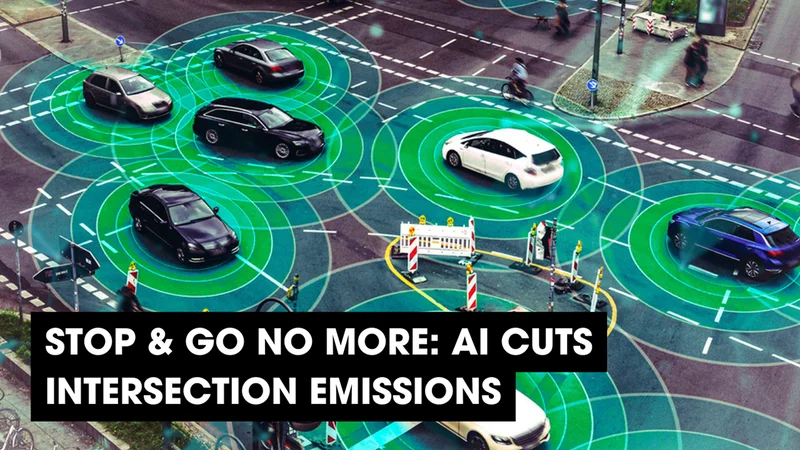
In this episode, we explore how AI‑powered eco‑driving—smartly adjusting vehicle speeds to minimize stops and unnecessary acceleration—can reduce carbon emissions at city intersections by 11 to 22 percent. Even partial adoption yields significant results, making this a scalable and impactful strategy for greener, safer urban mobility.

This podcast is sponsored by Mouser Electronics.
Episode Notes
(3:07) - Eco-driving measures could significantly reduce vehicle emissions
This episode was brought to you by Mouser, our favorite place to get electronics parts for any project, whether it be a hobby at home or a prototype for work. Click HERE to learn more about the rise of automotive telematics and their critical role in reducing carbon emissions!
Become a founding reader of our newsletter: http://read.thenextbyte.com/
Transcript
Imagine if your car could cut pollution by 20%, get to your destination safer and faster just by controlling the speed at which you cruise through green lights. There's a team from MIT that says this technique called eco driving can do exactly that. And it works even if only one in 10 cars in the road are using it.
What's up friends, this is The Next Byte Podcast where one gentleman and one scholar explore the secret sauce behind cool tech and make it easy to understand.
Daniel: What's up, folks? Like we said today, we're talking all about eco driving, which is a way that you can help cut pollution, get to your destination faster. Some research pioneered by MIT and ETH Zurich. But before we talk about what eco driving is and why it's important, let's talk a little bit about Fleet Telematics with our sponsor of today's podcast episode, Mouser Electronics. If you listen to the podcast for more than one or two episodes, you're probably not surprised that we're mentioning Mouser at this point, but it's because it's our favorite place to get electronics for work projects, for personal projects. But on top of them being super reliable as an electronics distributor, they also have these awesome deep connections with all different parts of industry. They know what's going on. They know what's, you know, just across the horizon. They know what's, where the puck is headed. And instead of just holding that information to themselves, they do a great job of making technical resources that are easy to read, easy to understand and kind of keep everyone up to date with what's going on at the cutting edge. It's really well aligned with what we like to do on the podcast. So that's why we're close friends with them. But we're going to link one of their technical resources about keeping up with the growth of fleet telematics, talking about the automotive telematics industry. I heard about it a lot while I worked in the automotive industry for a little while. But this fleet telematics industry is really, really growing. And part of it is because people want to have connected cars. They also fleet owners want to be able to understand how each of their cars are doing. It helps you understand how fleets track, plan, stay connected on the road. Also, can help with predictive maintenance and all this stuff, basically making sure that fleet owners keep their cars on the road. There's an interesting tidbit in here talking about the technical specifications of some of the different fleet telematics antennas too. And I think that this is an awesome primer because this technology can definitely be used in helping make cars connected as a part of the eco driving topic we're talking about on the podcast today. So, you should check that out in the show notes.
Farbod: And just as a testament to how on the ball Mouser is with these topics, the article that we're linking is from July 15th and the article that we're going to talk about today is from last week. So super, super close to like Daniel was saying, the cutting edge of academia and industry and all the good things.
Daniel: And in growth markets too, right? The automotive telematics industry is supposed to grow 15.1% per year through 2032. So fast growth rate, they're on the hot topics and they've got awesome technical resources to help connect you with all them.
Farbod: What more could you ask for?
Daniel: Not much. All right, so let's talk about eco driving. And really the premise here is that stopping and starting at traffic lights is one of the most inefficient parts of your entire driving experience. That wastes a ton of fuel. Stopping and starting at traffic lights alone on average in the US based on traffic patterns is about 15 % of total road emissions just from you sitting and waiting at lights. So, the premise here is like, if stopping and starting is less efficient than continued driving, let's figure out a way to make sure that you can do continued driving. The most simple way of explaining it is like eco driving is their premise. It's like, can we force traffic to flow in a way that cars only ever cruise at controlled speed while they're headed toward a red light. And by the time they get to the red light, it turns green so they can pass through at this continued speed. Basically, never forcing you to slam on your brakes, never forcing you to do this stop-go pattern that releases a lot of emissions and also puts a lot of wear and tear in your car and also creates a lot of traffic. So, it's kind of this triple headed beast that we've got where people are like hitting the gas, punching it, slamming on their brakes at a red light waiting, then hitting their gas, punching it again to another red light and waiting. That causes crashes, that causes traffic, that causes emissions, that causes unnecessary wear and tear in your car. So, the panacea here MIT thinks is trying to find a form of eco-driving where everyone drives just at the average rate of flow of traffic and no one actually has to do stop and go.
Farbod: And what's interesting and what we'll get into the details, but a little bit of a spoiler. My pessimistic mind was like, well, there's no way that you can get all drivers to abide by this perfect eco-driving routine, right? Daniel and I, live in Northern Virginia. We're known for a lot of things here, like having some of the best public schools, but also some of the worst drivers in the country. So, all I'm thinking is there's no way that the folks of Northern Virginia are gonna abide by this. But apparently, as long as something like 10% of the cars abide by it, because of the daisy chaining effect of one car behaving this way so the car behind them has to follow their behavior, it can actually allow you to embrace something like 25 to 50% of the maximum benefits possible. So not only is this real, it could be like scalable to our average daily lives as well.
Daniel: No, I've got a personal story that kind of relates to this.
Farbod: Do tell.
Daniel: I'm just like pretty, I get pretty frustrated with traffic. I want to make sure that cars are flowing the way that they're supposed to. So, when I'm driving, I'm trying to do my part and I'm trying to not like slam on my brakes that the person behind me slams on their brakes. creates this domino effect that you can have people slamming on their brakes. If they're in bumper-to-bumper traffic, they'll be slamming on their brakes for like hours after the original disruption was even gone. So, I try to make sure that when I'm driving, I'm going like kind of a steady speed with not a lot of acceleration, not a lot of deceleration. I would go on the Waze app and you know, like when there's traffic, it tells you what the average speed is through that stretch of traffic. So, it displays like, there's stop and go traffic for the next five miles. And the average speed over those next five miles is only 17 miles per hour. So, I would try and set my car on cruise control at like 16 or 17 miles per hour and try and like get the people in my lane all like cruising at this slow speed. At the time it's because I didn't want to like put unnecessary wear and tear on my brakes or kill my own fuel economy because I was trying to be cheap and save money. But like, this is kind of like the eco driving effect there is if you can control car speeds so that drivers glide through lights, they avoid hard stops, they reduce their fuel usage, their brake usage, their wear and tear on their engine, you only need about 10% of drivers to do it to where you reach this critical mass where you achieve just about 50% or more of the total benefit, but with less than 10% of the population because other cars start to follow the smoother drivers and they start to drive the way that everyone else is driving. In the past, we've done small eco driving tests that gave mixed results. And I would consider myself one of those small eco driving tests. No one's ever tried to roll this out across the board. And we've got smart cars now that can talk. They're connected to the cloud through fleet antennas, like the ones we talked about at beginning of this episode. They're connected to the cloud that can communicate with traffic lights, understand what the light signals are, understand what the current traffic is and don't even need your car to do this. Everyone's got apps on their phone that do it. I mentioned Waze as an app, as an example, that could help inform drivers on how they need to glide through lights, how they are able to avoid traffic and avoid extra pollution. This study was fully completed in simulation. So, they haven't actually rolled this out in the real world yet, controlling people's cars from the cloud to dictate what speed they should be driving. But they did a study where they simulated about 6,000 different intersections in Atlanta, LA, San Francisco, cities known for having some awful traffic. And they tested about 1 million different scenarios in traffic through those 6,000 intersections. And what they were trying to do is checking several different factors like street layouts, car types, weathers, traffic light timing. And then on top of this, they layered some deep reinforcement learning, form of AI learning to help teach the cars to pass through the light smoothly. And they kind of found this optimized model where they made sure that any intersection, any interaction didn't hurt nearby streets, but on these test streets and these test intersections, through these 1 million simulated scenarios, there was a total possible opportunity of about 22 % reduction in emissions with safer driving, with slightly faster or similar speed traffic, but reducing the total emissions by about one fifth. And that was with full adoption. When they kind of scaled it back and looked at the optimization problem, they found that they could get 70 plus percent of the benefits from only 20% of the intersections if they picked them pretty strategically, which I think is awesome because I think it makes it more palatable for people to be like, oh, we only need 20% of drivers on the road. We only need 20% of these intersections participating in this program to get 70 plus percent of the benefits. That's roughly 15% emissions reductions, just from 20% of the intersections participating in this type of program.
Farbod: Dude, and that's really what stuck with me. But then again, pessimistic hat on. Like you were saying, this is simulation, is there any credibility to it? Of course, everything works out well on the computer, but is it gonna work out that way in real life? And then you read about how they went about everything you just said, credit where credit's due. They really try to do their homework here. Which by the way, totally makes sense. We have MIT-ETH Zurich and the Utah Department of Transportation. So, you have some of the best researchers working with the people on the ground whose job it is to deal with these problems on a day-to-day basis. Of course it's gonna be a success. But to give you guys insight about why I think that this is more than just a simulation that you can write off. Like Daniel was saying, there were a lot of factors they took into play here. 33 to be exact, and they range from like temperature to road grade, to geometry of the intersection, like so many different things. And the way they went about understanding the impact of eco-driving on intersections, at first, they were trying to map out every single intersection because they're all so unique. But these networks, like if they were to scale this, even with AI, it would take forever and it would just not work. So, they dumbed down the problem into, hey, if we optimize at intersection A, how would this impact the relating, the neighboring intersections B and C? So, by dumbing down the math, they made something that's so relatable that like the average driver like Daniel and I could totally understand. Like, hey, if I slow down my car here and prevent people from like, you know, like he was saying, stepping on it and stopping at this intersection, then the one by my house, which is the next one, the load is gonna be lighter there as well. So, it's like a super scalable, generic algorithm that they've implemented here. But then the cherry on top, at least in my opinion, their simulation had every single car, every single eco car act as its own independent agent. That means it's not technically coordinating with all the other ones to achieve the goal, but the reward is based on all of them working optimally. So that means in the real world, Daniel and I going down the same road don't need to synchronize on the speed that we're going.
Daniel: We don't need the central control on both of our throttles to make sure we're going the same speed. We're just incentivized to drive the same speed or drive the right speed so that we reduce traffic and reduce emissions.
Farbod: Bingo! And that, thought that was sick. I'm like, yeah, they've really take factored in the human element here. At least that's what it seems like to me.
Daniel: As close as they could through simulation for sure. And they definitely were super in depth, super thorough. And I also found it encouraging that they tested for different types of cars as well. I can see a lot of people saying like, oh, like maybe this works really, really well for electric cars, but not gas or maybe not hybrid. They found that where, you know, basically regardless of car type, it was just as safe as human driving, if not safer, just as fast as human driving, if not faster. And then obviously I think they found improved benefits with electric and hybrid cars but they were still able to achieve similar benefits that they're having right now, even with normal ICE cars. So, it was interesting to see them get this type of distribution across the entire driving population, not trying to idealize it into like, oh, just electric cars or just hybrids or just smart connected cars that can all be centrally controlled. Like it seemed like they try to take as much of the real-world population distribution into account. And their simulation still showed a meaningful benefit that in my mind justifies this being tested to see, yes, can we start running this on a couple of people's phones in a certain type of controlled area or run it on their cars, built it into their newer cars or something like that. There's a lot of people out there who are selling like assistive driving technology as an aftermarket retrofit to cars now. Like Comma AI as an example, I would love to see them maybe partner with Comma and use this as an opportunity to try and implement something like this to see if we can actually reap the benefits from a pollution perspective, from a traffic perspective, from a safety perspective with even just a few controlled drivers in a controlled scenario and use that as an opportunity to build a more compelling body of evidence to say, hey, maybe this city in this state should be willing to test this and roll it out as an example. And that's kind of the stepping stone approach we need to take if something like this is going to get implemented more broadly.
Farbod: That's a perfect integration. I didn't even think about it, but you're absolutely right. This is where you can bring the hardware and the software together, even if it's a small group of people and make a very valuable direct impact immediately. So, I don’t know about you but super hyped!
Daniel: Yeah, and I could see a world in which like cities are incentivizing you to get this to kind of participate in this program. If there's a financial benefit, I'm sure there's a lot of people on their daily commute that would be willing to participate as a part of this. I'm trying to think of people, yeah, Farbod is raising his hand, for folks that are in the audio. But I'm also thinking of like, who are like in these cities where they did a lot of the simulations in Atlanta, in SF, in LA, SF got me thinking. What percent of SF's road population in the city right now is Waymo's? Probably not close to 10%. But like, if there's a couple key dominoes you could knock down to get to that 10 to 20% adoption rate pretty quickly. Like, I don't know if across San Francisco between Waymo's, Uber's and Lyft's, if you were able to roll this out across that entire fleet, I bet you that makes up more than 10 to 20% of the total drivers. And that's only three decision makers you have to convince. I would love to see this get rolled out in a test city like that. And all it takes is one city doing something like this, making a meaningful impact for everyone, for the rest of the cities to say, oh, this is cool. I want to do that too.
Farbod: And to go back to what you're saying about incentives, there's a precedent for that where energy companies provide rebates and incentivize people to set up the thermostats that lessen the load on the grid. There's entire companies built around this idea. So, I think the human behavior is there and the market is ripe for something like this.
Daniel: I would love to see it.
Farbod: So would I, man. So would I.
Daniel: All right. Let's wrap it up here. What do you say?
Farbod: Let's do it.
Daniel: All righty folks, MIT scientists are not forcing you to buy a brand-new electric car to save the environment. They're creating a driving trick that works with the car you already have. This team from MIT and ETH Zurich says that 15% of road pollution comes just from idling, stop and go at red lights, but we could cut that by up to 22% with technology we already have. It's called eco-driving, helps cars cruise to hit green lights at a controlled speed instead of stopping at a red light and then flooring it to the next green light. And even if only one in 10 cars use it, it doesn't slow traffic down at all. It is completely safe and it creates faster commutes and less pollution for everyone. And that's why MIT scientists are not going to make you buy a new fancy electric car just to save the environment.
Farbod: Money. I love it.
Daniel: We're wrapping it up here?
Farbod: Let's do it.
Daniel: All righty. See you, everyone.
As always, you can find these and other interesting & impactful engineering articles on Wevolver.com.
To learn more about this show, please visit our shows page. By following the page, you will get automatic updates by email when a new show is published. Be sure to give us a follow and review on Apple podcasts, Spotify, and most of your favorite podcast platforms!
--
The Next Byte: We're two engineers on a mission to simplify complex science & technology, making it easy to understand. In each episode of our show, we dive into world-changing tech (such as AI, robotics, 3D printing, IoT, & much more), all while keeping it entertaining & engaging along the way.