Making Neuromorphic Edge AI Design-Ready with Verified ECAD Models
BrainChip has partnered with Supplyframe to make its AKD1500 neuromorphic edge AI co-processor available as a design-ready component within the Supplyframe electronics design ecosystem.

30 Jul, 2026. 5 minutes read
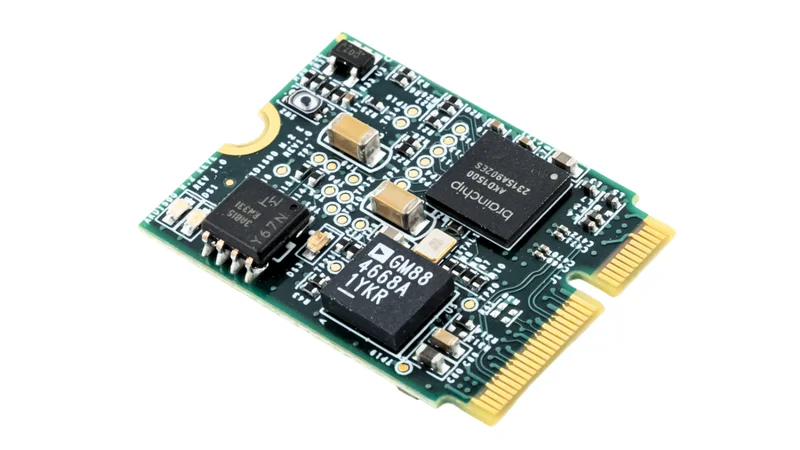
A new edge AI processor becomes a practical design option once engineers can evaluate it inside a real system architecture. Engineers need to connect it to the host, define its power architecture, account for its package, and determine whether it fits the electrical, mechanical, and manufacturing constraints of the product.
To support that evaluation, verified schematic symbols, PCB footprints, and 3D ECAD models for BrainChip’s AKD1500 Akida chip will become available across more than 25 design-tool formats, including Altium Designer, KiCad, and Autodesk Eagle. The AKD1500 is a neuromorphic edge AI co-processor designed to accelerate low-power inference alongside a host CPU using PCIe or microcontroller using SPI for event-based computation.
This BrainChip-Supplyframe partnership gives engineers a more direct route from studying the AKD1500’s architecture to placing the device within a schematic and PCB layout. With the component definition already available, teams can focus earlier on the factors that determine if neuromorphic acceleration is suitable for the system, including host connectivity, board area, and prototype requirements.
Moving a Processor from Datasheet to Design
Before a processor can be assessed at system level, its datasheet information must be translated into design assets the ECAD environment can use. The schematic symbol defines how engineers interact with the device electrically, the footprint determines how it will be mounted and routed on the PCB, and the 3D model establishes its physical position within the assembled product.
Creating these assets manually requires engineers or component librarians to interpret pin tables, package drawings, pad dimensions, pitch, orientation markers, and mechanical tolerances. Each value must then be entered correctly into the selected ECAD platform and checked against the manufacturer’s documentation.
This work is especially consequential for a processor with numerous power, ground, control, and data connections. A symbol with an incorrect pin assignment, for instance, can propagate an electrical error into the schematic. Similarly, a footprint with the wrong pad geometry or package orientation can create assembly problems, while an inaccurate 3D model can lead to conflicts with an enclosure, heatsink, connector, or neighboring component.
Some errors are identified during schematic review or design-rule checking; others remain undetected until PCB fabrication, assembly, or prototype bring-up, when correcting them becomes substantially more expensive. Even an accurate manually created model must often be reviewed internally before a design team is willing to use it in production work.
Supplyframe’s DesignSense Models service moves this preparation upstream by providing verified schematic symbols, PCB footprints, and 3D models in formats compatible with widely used ECAD tools. As engineers evaluate the AKD1500, the verified files establish a common component definition that can be used across schematic capture, board layout, mechanical review, and design collaboration.
Engineers remain responsible for designing and validating the surrounding power, clocking, communication, and host-interface circuitry. The verified assets provide a reliable starting point for that work, allowing technical evaluation to begin with the device placed inside the intended hardware architecture.
Adding Neuromorphic Acceleration to an Existing Host
The AKD1500 is an edge AI co-processor based on BrainChip’s Akida neuromorphic processing architecture. It operates as a dedicated accelerator connected to an x86, Arm, or RISC-V host through PCI Express or lower-power serial interfaces.
This allows engineering teams to add dedicated AI acceleration to systems built around an existing CPU or microcontroller architecture. BrainChip positions the Akida processor for applications including industrial sensing, robotics, medical devices, wearables, smart cameras, and other systems constrained by power consumption and heat dissipation.
According to BrainChip, the AKD1500 delivers up to 800 effective GOPS and operates at less than 1 mW per GOP. The processor is manufactured on GlobalFoundries’ 22FDX platform and is intended for sub-watt edge inference workloads.
Its architecture uses event-based computation and exploits sparsity within neural network activations and kernels. Computation is triggered by relevant activity rather than requiring every element in a dense representation to be processed during each operation. Reducing unnecessary data movement and arithmetic activity can lower the energy required for workloads that contain significant sparsity.
Akida also supports on-chip learning for applications requiring local adaptation. BrainChip describes this capability in terms of one-shot and few-shot learning, where a deployed system can learn from a limited number of examples without transferring all sensor data to a remote training environment. Potential uses include personalization, anomaly recognition, and adaptation to changing operating conditions.
Model development and deployment are handled through BrainChip’s MetaTF software environment. Developers can work from TensorFlow, Keras, and PyTorch workflows, then convert, optimize, quantize, compile, and deploy supported models to the Akida hardware.
Evaluating Neuromorphic Hardware Earlier in the Design Cycle
Making the AKD1500 available inside the ECAD workflow allows engineers to evaluate the device in the context of the complete product architecture. This is particularly relevant for edge AI systems, where processor selection affects power budgets, thermal limits, board area, sensor interfaces, host performance, and mechanical design.
Earlier access to verified design data also makes feasibility studies more representative. Engineers can assess how the co-processor fits alongside the host, estimate the supporting circuitry and routing effort, and identify potential layout or enclosure constraints before committing to a prototype. This gives teams a clearer view of the integration cost associated with neuromorphic acceleration alongside the processor’s performance and efficiency specifications.
The shared component definition can also improve coordination across electrical, PCB, mechanical, and manufacturing teams. Each discipline can work from the same verified package and design data as the architecture develops, reducing the risk of inconsistencies between schematic capture, board layout, mechanical modeling, and production review.
BrainChip’s AKD1500 ECAD files will be available through Supplyframe’s component-search and schematic-selection workflow, as well as through BrainChip’s website. Products with available models will carry a verified-model badge, and engineers will be able to download the format required by their ECAD environment. According to the partnership announcement, this is intended to reduce the time between component discovery and schematic placement from hours to minutes.
Lowering the Evaluation Barrier for Neuromorphic Hardware
The practical value of the partnership lies in allowing engineers to evaluate a specialized AI architecture through the same component-selection and PCB design processes used for the rest of the hardware platform. Verified ECAD assets remove an early library-development task and allow teams to direct more effort toward power integrity, interface timing, thermal behavior, software compatibility, and workload performance.
As teams explore neuromorphic acceleration, the AKD1500 can now enter the design workflow alongside the host processor, sensors, memory, and interface components. This brings the technology into the stage where architectural assumptions can be tested against the physical and electrical requirements of a deployable edge AI product.
For more details on the partnership and the available AKD1500 design models, read the full press release from BrainChip and Supplyframe.