Inside embedded world North America 2026
Where Embedded Meets Agentic AI

26 Oct, 2026. 5 minutes read
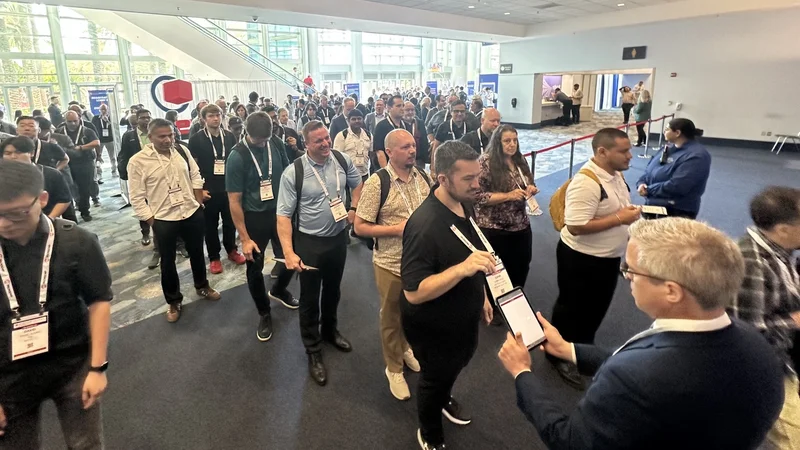
embedded world North America closed its third edition on September 24 at the Anaheim Convention Center, featuring over 100 sessions, and the first to put two hands-on features on the floor: a Robotics Lab and an Edge AI Hackathon. The show brought attendees and exhibitors together for an evolutionary look at the future of embedded engineering. While trade floors typically show a finished product, the build stations allowed engineers to see what it takes to get a system working. In 2026, the focus was almost entirely about putting AI on constrained hardware.
Agentic Systems Move to the Edge
Deepu Talla, Vice President of Robotics and Edge AI at NVIDIA, opened the program on Tuesday with "The Next Evolution of Embedded: Open Platform for Autonomous, Agentic Systems." His talk covered humanoids, industrial arms, mobile robots, and factory automation, focusing on machines that act rather than machines that classify.
Guneet Bedi, SVP & General Manager of Arduino, took the other side of the same stage with "Powering the Age of AI in the Physical World for Everyone." Arduino's position was breadth: the same platform should serve a student prototyping on a bench and an industrial developer shipping a product.
The two talks agreed that intelligence is moving into the device and that the embedded developer is the one who has to make it work. They diverged on what limits adoption. Talla framed the answer as an open platform with enough capability to run autonomous, agentic workloads; Violante framed it as an accessible platform that lowers the cost of entry for the widest range of builders.
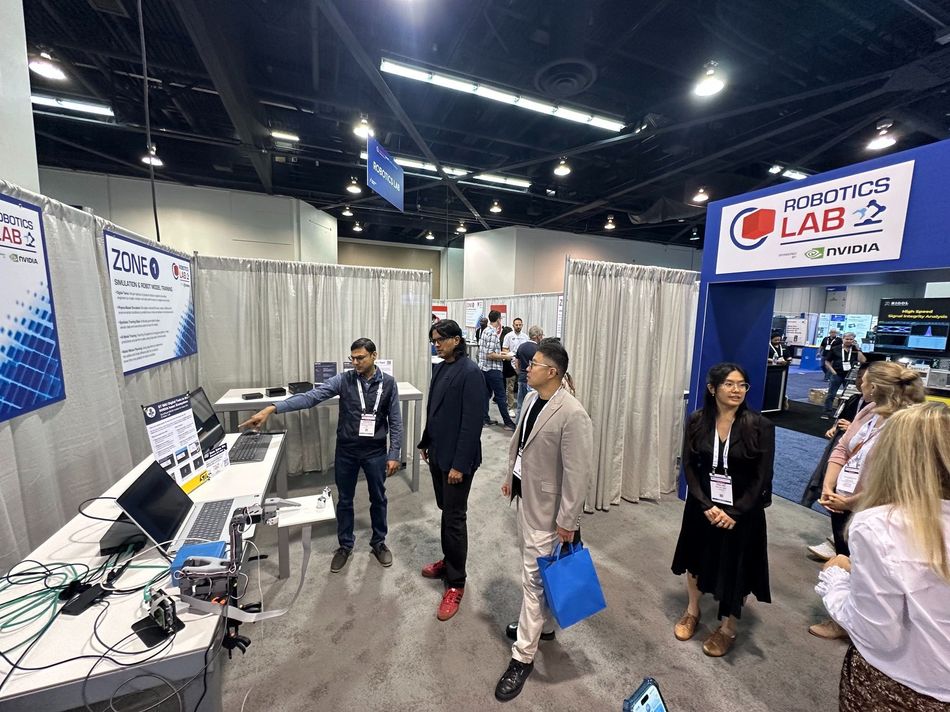
The Robotics Lab: Four Stages of Building an Intelligent Machine
The Robotics Lab, sponsored by NVIDIA, covered roughly 800 square feet and took visitors through a robotics development progression in four zones: simulate, compute, interact, apply. The organizers framed the sequence as training the robot, giving it intelligence, letting it interact with the world, and putting it to work. The order mirrored the embedded stack that the show as a whole was built around, from AI models and processors through sensors, software and control systems, and it showed how those separate technologies became one integrated machine.
Zone 1: Simulation and Robot Model Training
The first zone covered the virtual environment where a robot was designed, simulated and trained before it reached hardware. Digital twins, physics-based simulation and synthetic training data stood in for the real world, and the zone extended to AI model training, reinforcement learning, robot motion planning and virtual testing and validation. Starting here made a practical point: a failure found in simulation cost far less than one found on a bench.
Zone 2: Edge AI Computing and Deployment
The second zone followed a trained model onto the machine itself. It covered the computing that let a robot process data and make decisions locally and in real time: edge AI processors, GPUs and NPUs, embedded computing, AI inference, model optimization and real-time processing, along with ROS and ROS 2 and the wider AI software frameworks. This was the same squeeze the Hackathon teams felt, where a model that worked on a laptop had to fit the frame rate and power budget of a small board.
Zone 3: Sensing, HMI and Actuation
The third zone connected a robot's digital intelligence to its physical surroundings. Cameras and computer vision, LiDAR and radar, IMUs and proximity sensors handled perception. Voice and gesture interfaces and touchscreens handled interaction with people. Motors, servo systems, motion controllers, robotic arms and grippers turned decisions into movement. Hackathon teams met this boundary too: CRATE built its interface around hand gestures, and Embedx fought a base servo that was too weak to turn its arm.
Zone 4: Vertical Applications
The final zone tied the technology stack to business and operational outcomes by showing complete robotic systems built for specific industries. It spanned manufacturing (assembly, inspection and material handling), logistics (autonomous mobile robots, warehouse automation and package handling), healthcare (surgical and assistive robotics), automotive (autonomous systems and factory robotics), agriculture (autonomous equipment and crop monitoring), defense and aerospace (autonomous vehicles and robotic systems) and retail (inventory and service robots).
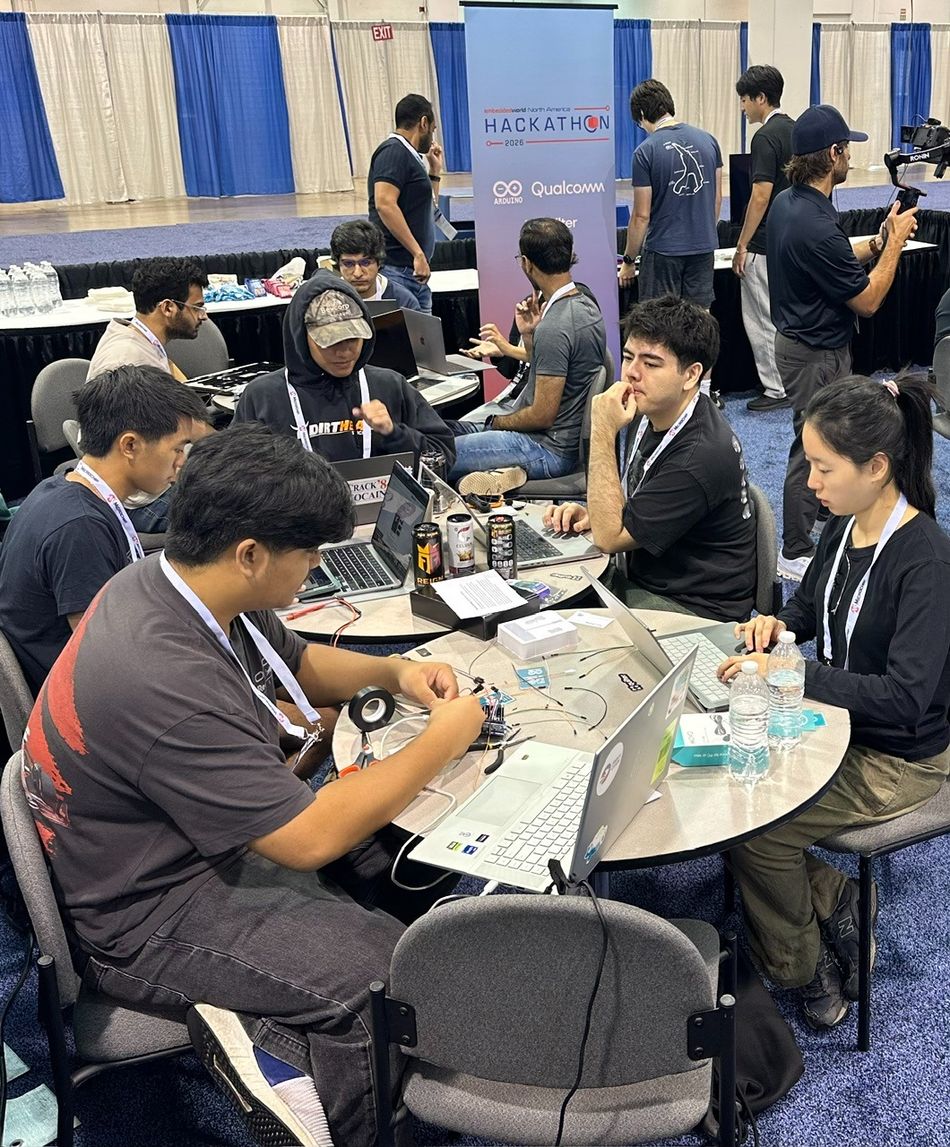
The Hackathon: Edge AI Under Real Constraints
The inaugural Edge AI Hackathon, presented by Arduino and Qualcomm with support from Quilter (robotics) and ASUS (sustainability), put twelve university teams on the show floor to build working on-device AI systems in a few days. Every team got the same challenge box built around the Arduino UNO Q, trained its models in Edge Impulse, and had to run the final demo on the UNO Q itself. Laptops were allowed for development and nothing else, and no outside hardware was permitted. Four tracks, four winners.
Industrial Automation: Gesture Recognition on Device. Team 3, CRATE
Team: Chaaruhaas Kandregula, Howie Zhang, Terek Johnson, Peixing You
Warehouse workers with full hands could not touch a screen, so CRATE built a touchless control system around three gestures: confirm, skip, and cancel. A camera read the gesture, and the board answered with LED icons and buzzer tones. The track required inference under 200 ms, and the team landed at about 175ms.
The hard part was the swipe. A single frame of a swipe looked a lot like a thumbs-up, and the model kept confusing them. The team retrained more than eleven times, each round aimed at the specific failures from the last, and lifted accuracy (mAP@50) from about 0.5 to 0.94. Venue wifi blocked device-to-device traffic, so they worked over a phone hotspot.
Sensing: Sound Event Classifier. Team 8, Zotduino
Team: Edward Chhun, John Hu, Ryan Biglou, Tommy Pham
Zotduino built LifeLine, an elder-care monitor that listened for falls, breaking glass and fire alarms and showed alerts on an LED matrix. There was no camera and no cloud audio, which mattered in a bedroom or bathroom. A 10-second cancel window kept false alarms from reaching family members.
Their first model labeled every sound a fire alarm. Dropping the audio sample rate from 44 kHz to 18 kHz and retraining fixed that. False positives stayed high until the team recorded about 25 minutes of their own fall sounds. Glass-break detection stayed weak at the end of the event.
Sustainability: Waste Sorting Vision. Team 10, Zot, Rot, or Not
Team: Erik David Piolo, Jeffrey Fan, Juliat Delgado
Zot, Rot, or Not built a smart conveyor that used machine vision to sort items into recycling, organic waste, or trash and reported the result on an OLED screen. The model was trained on 244 images and reached 89.6% validation accuracy.
The hardware fought back in small ways. The OLED stayed dark until the team moved it from pins A4/A5 to the UNO Q's dedicated I2C pins, and code uploads were slow. Public wifi was off limits, and phone hotspots were too noisy to hold a connection, so the team never tested the full system end to end.
Robotics: On-Device AI for Motion and Navigation. Team 5, Embedx
Team: Abhinandan Sharma, Devansh Gupta, Mitali Agrawal, Riyansh Chaturvedi
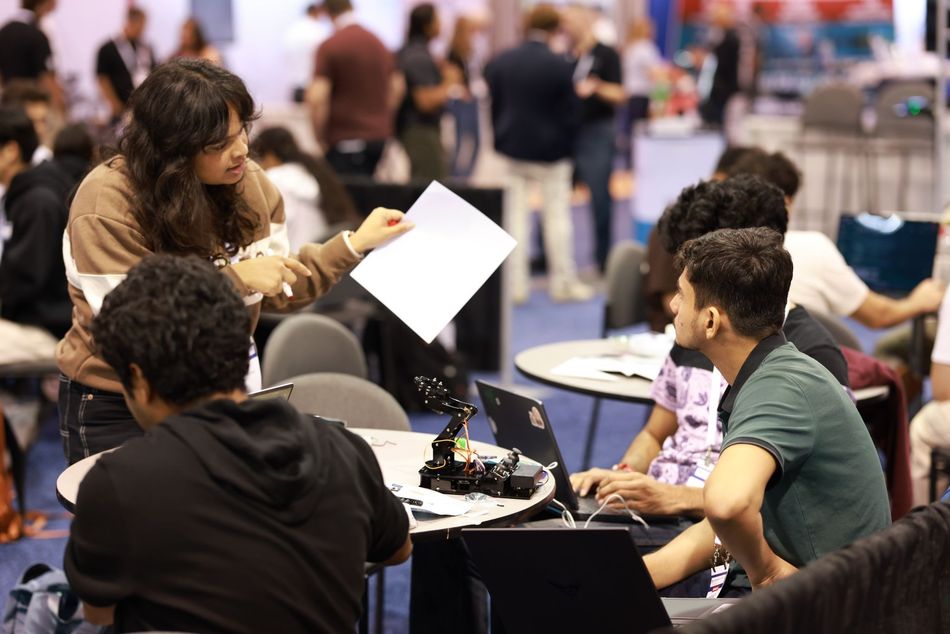
Embedx built a robotic arm that spotted a blue cube, worked out how to grasp it, and paused when an obstacle appeared. The UNO Q ran the vision and sent detections over Bluetooth to an ESP32 that drove the servos.
The base servo was too weak to turn the arm and sometimes browned out the board. The physical arm also sat about 3cm off what the kinematics math predicted, so the team wrote a calibration tool to close the gap. To keep frame rates usable on the board, they cut the vision input to 320 pixels.
What's Next
embedded world North America was part of a larger network that included the flagship show in Nuremberg (Germany), as well as editions in China and India. Looking ahead, ewNA '27 will move to a new location at the Long Beach Convention Center and will take place October 12-14.