Edge AI in Action
Highlights from the 2026 embedded world North America Hackathon

14 Oct, 2026. 4 minutes read
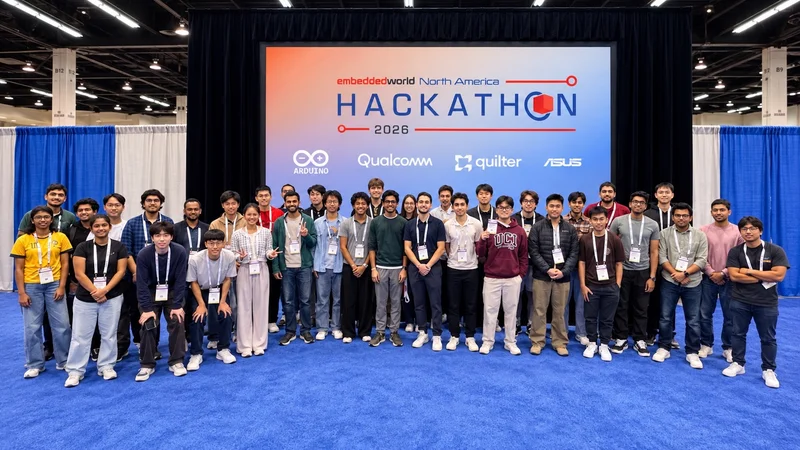
Embedded AI moved from concept to working prototype at the first-ever embedded world North America Hackathon, where student teams were challenged to turn real-world problems into functional Edge AI solutions.
The competition brought together 52 students across 12 teams, who had two days to develop solutions across four challenges: industrial automation, sensing, sustainability and robotics. Each team worked with an Arduino UNO Q, while the hackathon was powered by Arduino, Qualcomm, Quilter and ASUS.[1]
Two Days of Learning, Building and Problem-Solving
Rather than simply proposing concepts, participants had to develop working solutions within a tightly constrained timeframe. Teams had to learn unfamiliar tools, build hardware and software systems, train or integrate AI models, troubleshoot problems and demonstrate their results.
That intensity was reflected in comments from Giovanni Salinas, Technical Advisor and Judge from Supplyframe, who said the challenges required students to learn new skills before they could even begin developing their solutions. He praised their drive, positive energy and problem-solving approach throughout the two-day event.
Ben Jordan, Judge from Quilter, highlighted another dimension of the competition. He noted that although the solutions were creative and technology-driven, the results showed the continuing importance of human judgement in deciding what should be built and how technology should address practical problems.
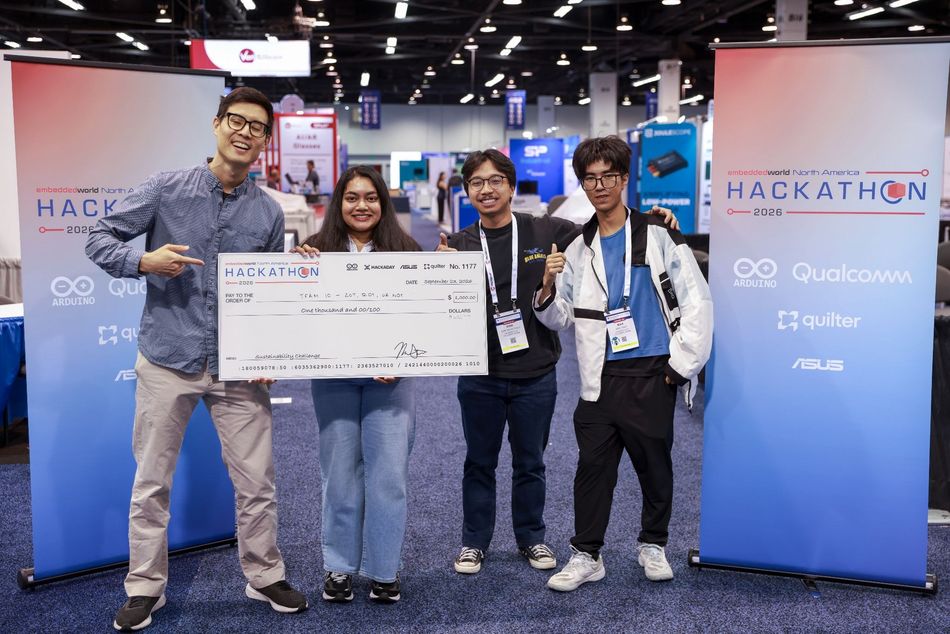 Team 10. Source: Supplyframe.
Sustainability: ZOT ROT or NOT
Team 10, ZOT ROT or NOT, won the Sustainability Challenge with a camera-powered conveyor designed to distinguish recyclable material, organic waste, and trash. [1]
The team's Hackaday.io project describes a system in which a camera captures objects moving along a conveyor while the Arduino UNO Q processes the images locally. The system classifies items into the three categories and communicates the result to an OLED display, LEDs, and the sorting mechanism. [2]
The team also documented its Edge Impulse object-detection model. Its initial unoptimised model achieved 89.6% validation accuracy, with an estimated on-device latency of 5 milliseconds. [3]
Explore ZOT ROT or NOT on Hackaday.io
The project demonstrated a practical application of local computer vision: instead of relying on remote processing, the classification pipeline operates directly on the embedded system.
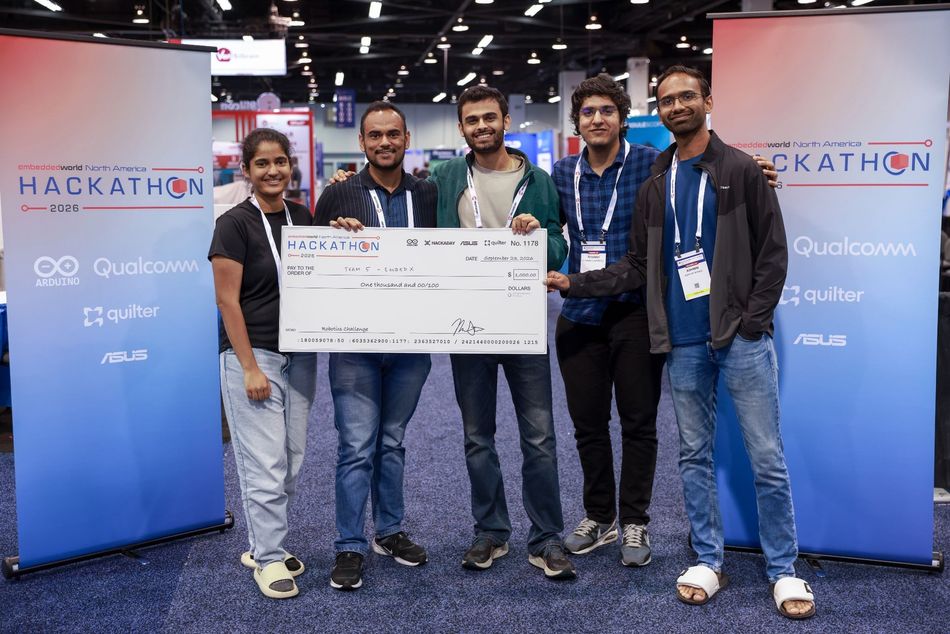 Team 5. Source: Supplyframe.
Robotics: EmbedX
Team 5, EmbedX, won the Robotics Challenge with an on-device AI system for robotic motion and navigation.[1]
The project combined machine vision with robotic control, demonstrating how an embedded platform can connect perception with physical movement. The challenge highlighted an important characteristic of Edge AI: intelligence becomes more valuable when it can respond directly to information collected from the surrounding environment.
Rather than treating AI as a separate software function, the project connected sensing, computation, and physical action into a single system.
Explore the EmbedX Robotics project on Hackaday.io
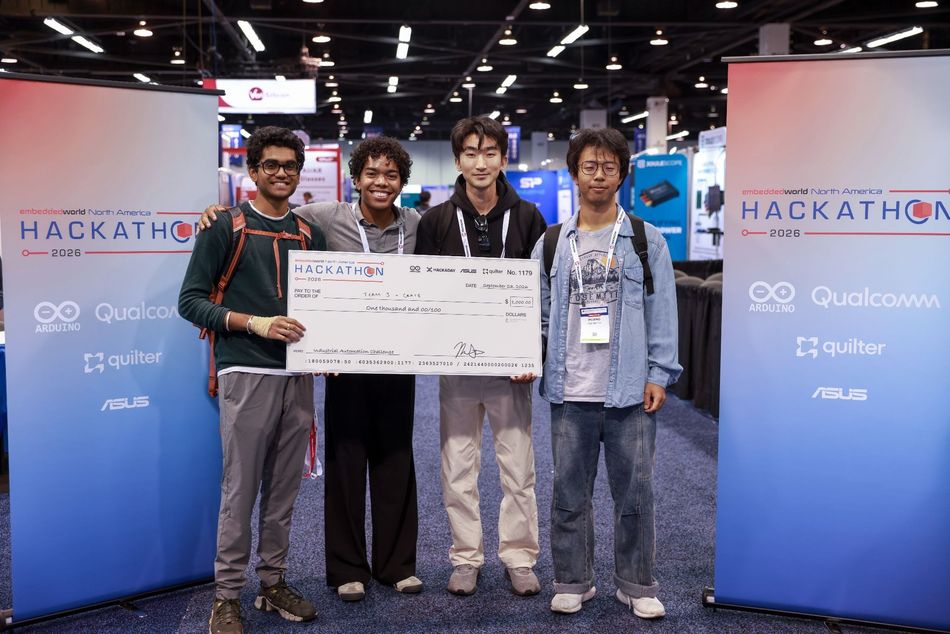 Team 3. Source: Supplyframe.
Industrial Automation: CRATE
Team 3's CRATE — Chironomy Recognition As A Touchless Experience won the Industrial Automation Challenge.[1]
The project uses an Arduino UNO Q, a camera, and a gesture-recognition model to identify hand gestures and translate them into commands. The team's Hackaday documentation states that it used a YOLOv5-based classifier and a dataset containing more than 450 images captured during the hackathon. [4]
The final system reportedly achieved an average inference time of about 175 milliseconds and a 0.94 mAP@50 score, while displaying recognised gestures through the Arduino's LED matrix. [5]
CRATE demonstrated how computer vision can be used to create alternative human-machine interfaces, particularly in environments where touch-based interaction may not always be convenient.
Sensing: Zotduino
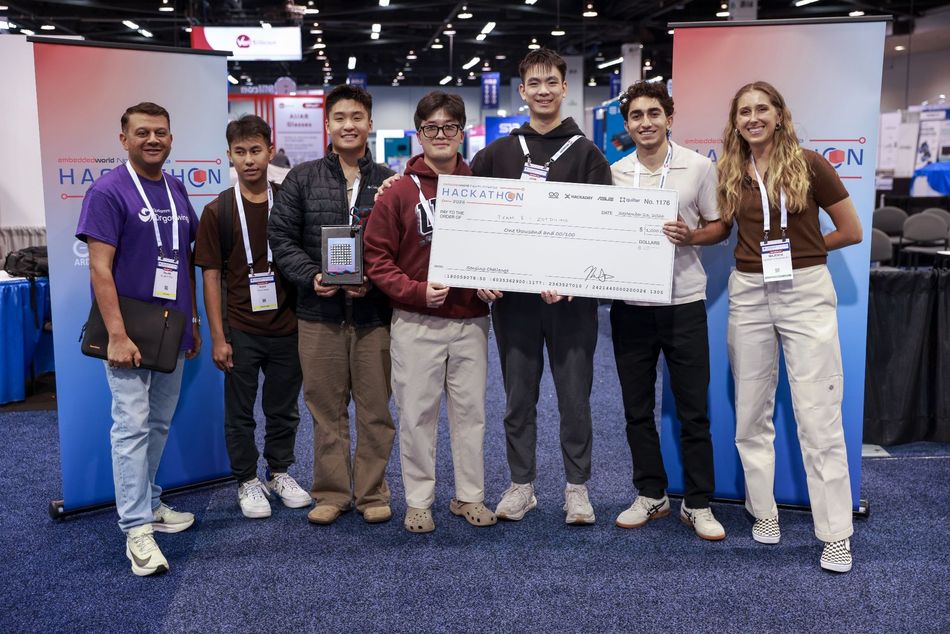
Team 8, Zotduino, won the Sensing Challenge with a sound-event classification system designed around the needs of an elderly person living alone. [1]
The concept focused on recognising potentially important household sounds, including events such as falls, broken glass and fire alarms, while maintaining privacy. According to the team's project documentation, sound classification was performed locally on the Arduino UNO Q, meaning audio did not need to be sent away from the device for processing. [6]
The team explained that its design deliberately avoided cameras and cloud-based audio processing. A local classifier analyses the sound, while the system can provide a visual indication through an LED matrix.[6]
This approach demonstrated one of the practical benefits of Edge AI: intelligent sensing can happen close to the data source while reducing the need to transmit sensitive information elsewhere.
Explore Zotduino on Hackaday.io
Making Embedded AI More Accessible
Across the four winning projects, a common theme emerged: AI was not treated as an isolated software capability. Each team connected machine learning with physical hardware, sensors and real-world actions.
Rajan Mistry, a judge from Quilter, described the experience as an opportunity for students to learn new technologies, overcome engineering challenges and turn ideas into reality. He also pointed to platforms such as the Arduino UNO Q as making innovation more accessible.
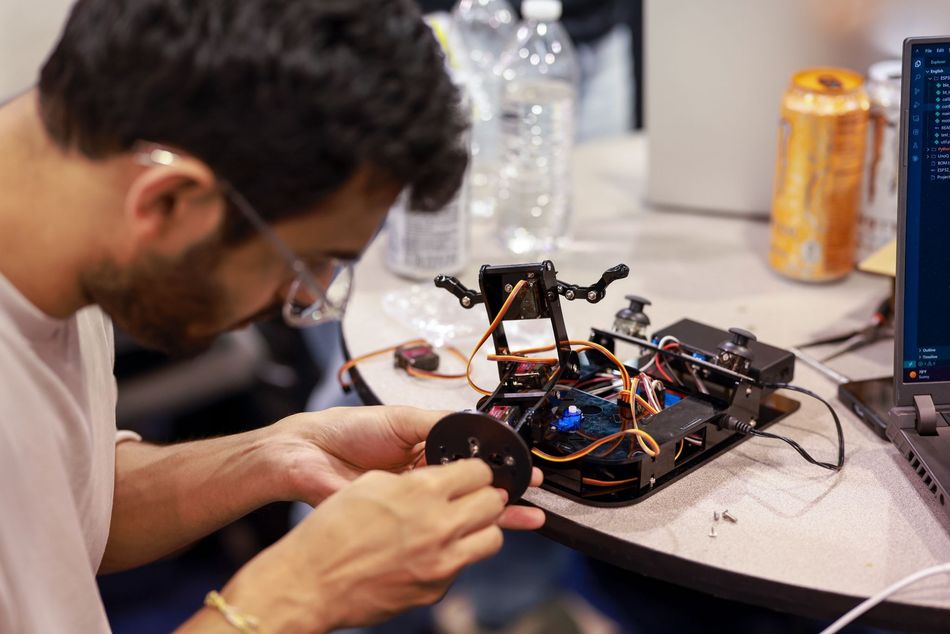
The projects reflected that accessibility in different ways. ZOT ROT or NOT applied computer vision to waste sorting; CRATE used vision for touchless interaction; Zotduino explored privacy-conscious sound classification; and EmbedX connected AI with robotics.
 2026 embedded world North America Hackathon. Source: Supplyframe.
From Ideas to Working Systems
The 2026 hackathon demonstrated the growing practicality of Edge AI in embedded development. Students took a problem, selected appropriate sensing and computing tools, integrated AI, and built a working prototype in just two days. [1]
Perhaps the most important takeaway was not any single project, but the workflow shared by all four teams: understand a practical problem, experiment with available technology, iterate quickly, and connect intelligence to the physical world.
As embedded AI continues to develop, that ability to move quickly from an idea to a functioning system could become increasingly important. The hackathon clearly demonstrated that the next generation of embedded engineers is already experimenting with that approach.
References
- Hackaday. Post-event announcement for the first-ever embedded world North America Hackathon. LinkedIn, 2026. https://www.linkedin.com/company/hackaday/
- Hackaday.io, “ZOT ROT or NOT.” Project description and system overview for the camera-powered waste-sorting conveyor using Arduino UNO Q.
https://hackaday.io/project/206767-zot-rot-or-not - Hackaday.io, “Object Detection Model ZOT ROT or NOT.” Model accuracy, dataset and on-device latency details.
https://hackaday.io/project/206767-zot-rot-or-not/log/251074-object-detection-model - Hackaday.io, “CRATE: EWNA Hackathon Team 3 — Files.” Dataset and YOLOv5 model information.
https://hackaday.io/project/206741-crate-ewna-hackathon-team-3 - Hackaday.io, “CRATE: EWNA Hackathon Team 3 Final log.” Inference performance, model score and system details.
https://hackaday.io/project/206741-crate-ewna-hackathon-team-3/log/251101-final-log - Hackaday.io, “EWNA Hackathon Team 8 — How we came up with the idea.” Privacy-focused sound classification concept and local processing approach.
https://hackaday.io/project/206738-ewna-hackathon-team-8/log/251059-how-we-came-up-with-the-idea