From Isolated Commands to Agentic Systems: What Agentic Living Reveals About the Evolving AI Roles
Hey Tuya showcases how agentic Physical AI evolves assistants from isolated commands into systems that learn context, coordinate devices, and act reliably across real-world environments.

14 Jan, 2026. 4 minutes read
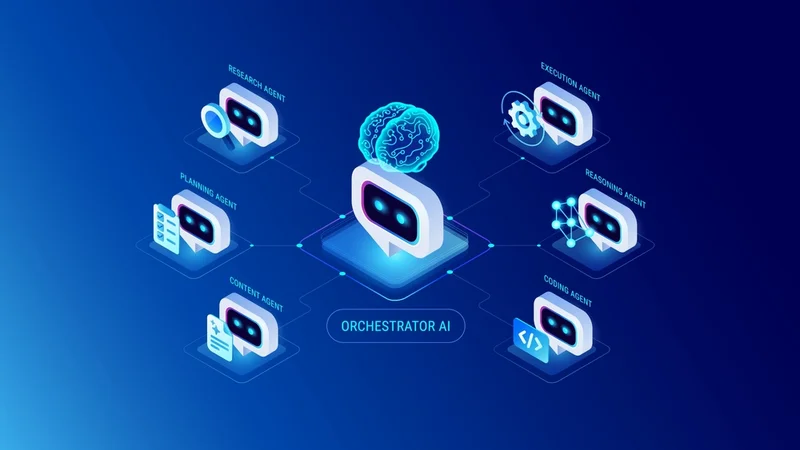
Over the past decade, artificial intelligence has largely existed within digital interfaces, such as phones, computers, and smart displays, responding to prompts and executing isolated commands. As connected environments become more common, expectations for AI are changing. Users increasingly want assistants that operate continuously, adapt to routines, and interact with the physical world rather than remaining confined to screens.
As smart homes enter the era of agentic AI, several structural limitations remain unresolved. Unstable latency in real-world networks undermines continuous decision-making. The absence of true long-term memory prevents assistants from learning household routines over time. And fragmented device orchestration means user intent rarely translates into coordinated, verifiable action across devices. Together, these gaps keep most smart assistants confined to isolated commands rather than end-to-end execution.
It is within this context that Hey Tuya is built, on top of Tuya Smart’s Physical AI Engine (PAE), a foundational “driving system” designed to support AI hardware operating in complex, real-world environments. Rather than treating intelligence as a purely digital layer, PAE is intended to enable AI models to transition from reasoning on screens to acting reliably within physical spaces.
Multi-Device Collaboration: Turning Intent into Action
Hey Tuya is designed to become a comprehensive AI life assistant capable of sensing environments, learning user habits, and coordinating with physical devices. Unlike traditional AI assistants confined to individual devices, Hey Tuya aims to break the boundaries of screen-based interaction. Users will be able to summon their AI assistant from anywhere, whether through the Tuya App, smart speakers, control hubs, or even AI toys and wearables. It will enable multi-device collaboration, orchestrating smart devices and equipment to deliver a connected and intelligent experience throughout daily life.
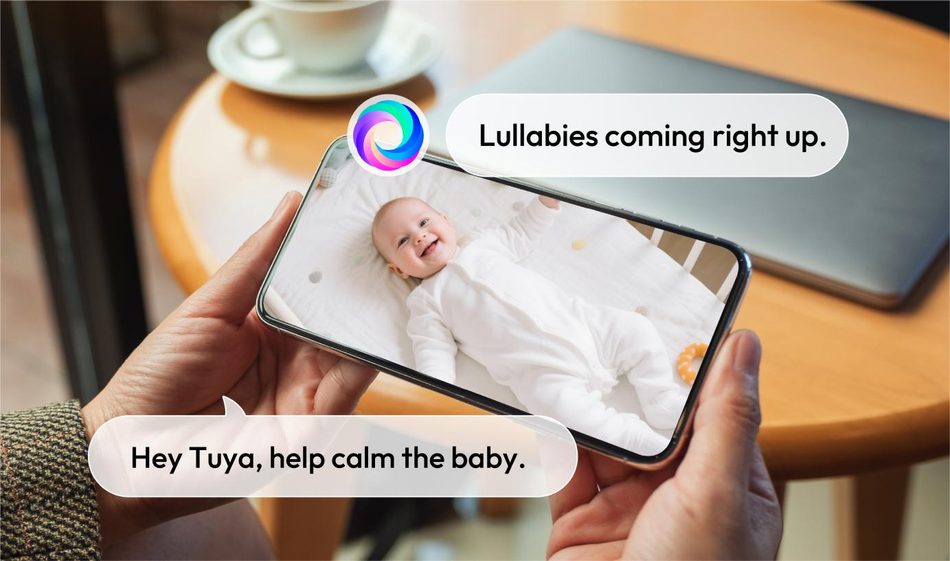
Hey Tuya is expected to feature short-term and long-term memory, designed to learn and adapt to users’ routines, environmental preferences, and habits. Rather than reacting solely to direct commands, the assistant is intended to anticipate needs, such as preparing the home environment ahead of arrival or adjusting settings based on learned habits, and enabling interactions that feel more continuous and contextual.
Expanding Smart Life Beyond the Home
Initially, AI assistants were designed to cater to specific environments, mostly confined to single-use applications such as answering questions, setting alarms, or playing music. However, with Hey Tuya, the platform seeks to break out of these limited boundaries and establish a fully connected environment that stretches beyond the home. While much of the focus remains on residential settings, the underlying architecture behind Hey Tuya can also extend into commercial spaces where coordinated device intelligence and automated decision-making are increasingly relevant. This wide applicability makes Hey Tuya a future-proof solution, capable of evolving alongside advancements in AIoT.
Full-Scenario Coverage: From Home to Office and Beyond
Hey Tuya’s capabilities are designed to span diverse life scenarios, taking on different roles:
Home Security Guardian
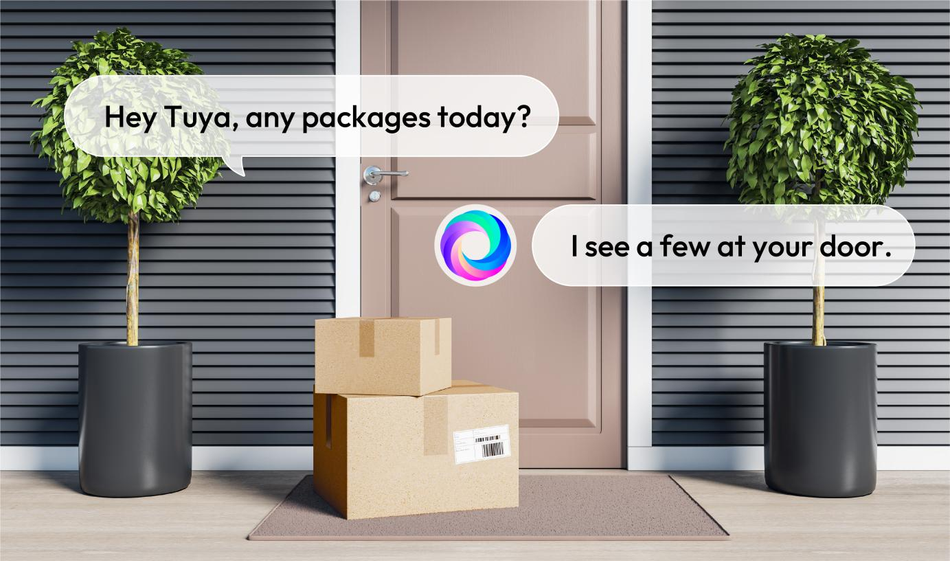
Expected to provide round-the-clock security, with image recognition and retrieval, converting results into easy-to-understand voice or text alerts for clear safety status. This will enable households to feel safe and secure with minimal effort, as Hey Tuya continuously learns and adapts to each home’s unique characteristics, evolving to anticipate potential security risks.
Energy-Saving Expert
Aimed at monitoring and analysing energy consumption in real time, proactively suggesting strategies like turning off idle devices, shutting off appliances during weekend trips, or adjusting AC temperatures according to weather and seasonal changes, enabling users to save energy effortlessly. The AI will continuously optimize energy use based on a family’s routines, seasonal weather, and real-time environmental data, significantly reducing energy costs while maintaining optimal comfort.
Health Coach
Expected to focus on both physical and mental well-being, offering support for calorie recognition, tracking sleep and exercise data, and generating personalized health reports. These capabilities will be powered by cutting-edge AI models that analyse vast amounts of health-related data, enabling Hey Tuya to make personalised recommendations and track progress over time.
Efficient Work Assistant
Hey Tuya offers services like meeting minutes generation, real-time multilingual translation, content summarization, and mind mapping to enhance productivity. A live, work-focused assistant will help users streamline their professional lives, reduce workload stress, and improve efficiency, all while learning about their preferences and adapting to the evolving work landscape.
Personal Life Secretary
Expected to manage daily tasks such as reminders, holiday alerts, pet and plant care, and family health monitoring for an organized life. By integrating with personal calendars, smart appliances, and health monitoring systems, Hey Tuya can provide a comprehensive assistant that keeps daily tasks in check while learning and adapting to users' daily rhythms.
Powered by Tuya’s Physical AI Engine
Deploying AI in physical environments introduces challenges that do not exist in purely digital systems, including unstable connectivity, fragmented execution across devices, and the need for memory that persists beyond individual sessions. Tuya’s Physical AI Engine (PAE) is designed as a system-level response to these constraints, enabling AI systems to move from digital cognition to physical execution.
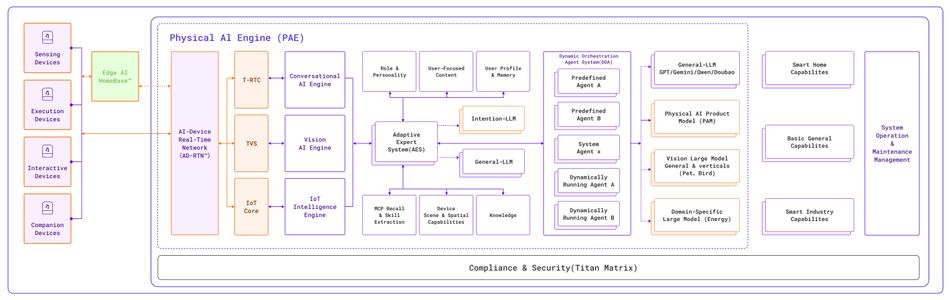
One fundamental requirement for agentic AI is long-term, individual memory. PAE’s OmniMem Individual Long-Term Memory Engine is designed to support a persistent and evolving memory system across real-world usage scenarios, allowing the assistant to build continuity over time rather than resetting with each interaction.
Real-time execution presents another major bottleneck for Physical AI. PAE incorporates real-time communication engines, including AI-Device Real-Time Network (AD-RTN) and Tuya Real-Time Communication (T-RTC), to accelerate AI-device interactions and maintain stable performance across complex and variable network environments.
Beyond individual device intelligence, Physical AI requires orchestration, meaning the ability to translate intent into coordinated action across systems. PAE’s Dynamic Orchestration Agent (DOA) is designed to support this layer, enabling AI agents to reason, plan, and execute actions across multiple devices rather than operating in isolation.
By integrating an AI capability chain spanning conversational intelligence, vision-based perception, and IoT intelligence, PAE enables flexible and customizable model combinations suited to diverse scenarios. This approach prioritizes adaptability and execution over reliance on any single model or modality.
Designing for Continuous, Environment-Aware Intelligence
Recent demonstrations of Physical AI systems emphasize a move away from single-interface control toward continuous, environment-aware execution. In this model, AI operates quietly in the background, coordinating devices and responding to context rather than waiting for explicit commands.
Hey Tuya reflects this design philosophy by focusing less on interaction mechanics and more on system-level intelligence, where sensing, reasoning, and action are tightly integrated across the physical environment.
With this strategic rollout, Tuya ensures that Hey Tuya is ready to meet the varied demands of global users, addressing their needs for an AI life assistant that learns and evolves with them, integrating across devices, environments, and routines.