Engineering Stability into Compact Methane Sensing Systems
Learn how compact methane sensors use TDLAS, 1.6 µm detection, and InGaAs photodiodes to deliver stable, repeatable sub-ppm CH₄ measurements in industrial environments.

19 Mar, 2026. 4 minutes read
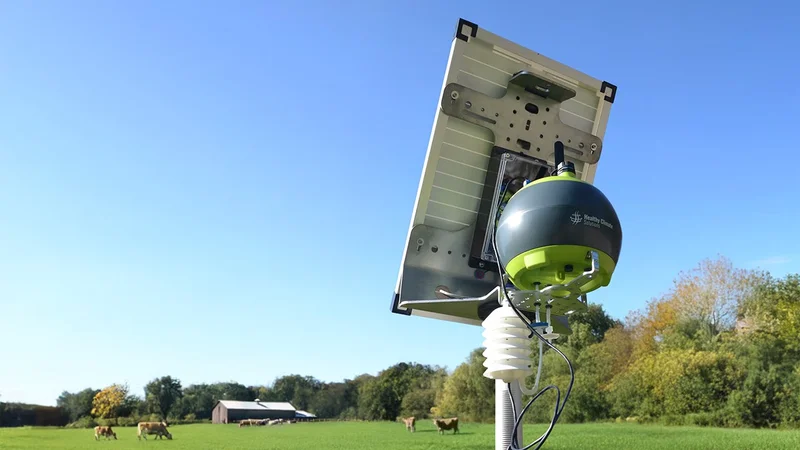
Axetris LGD Compact CH₄ system deployed for continuous outdoor methane monitoring.
This article was first published by Hamamatsu Photonics.
Methane (CH₄) has a short-term warming potential roughly 80 times higher than carbon dioxide over a 20-year period [1][2]. As regulatory and research frameworks increasingly require direct methane measurements, sensing technologies are moving from laboratory environments into continuous field deployment.
In the European energy sector, methane monitoring requirements now emphasize measured emissions rather than estimated values [3]. At the same time, livestock research programs are conducting long-term measurement campaigns to refine national methane inventories [4]. These shifts are placing new emphasis on compact, stable, and repeatable sensing systems capable of sustained operation in uncontrolled environments.
Delivering sub-ppm methane detection in such conditions requires more than spectroscopic sensitivity. It demands system-level engineering.
Axetris and the Architecture of Compact TDLAS Modules
Axetris, part of the Leister Group and based in Switzerland, develops laser gas detection (LGD) modules using tunable diode laser absorption spectroscopy (TDLAS). Its systems are deployed across applications, including oil and gas leak detection, fence-line monitoring, livestock emissions research, and medical breath analysis.
The design philosophy behind these modules centres on compact form factors combined with long-term stability. In research and regulatory contexts, the credibility of methane data depends not only on instantaneous accuracy but on repeatability over extended periods.
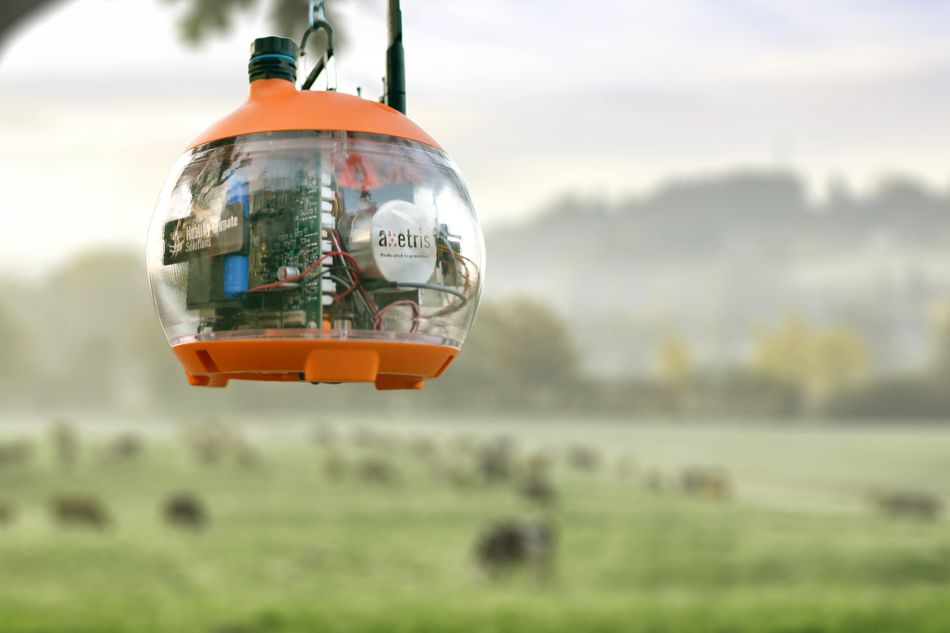
Axetris’ LGD Compact CH₄ systems are used in European livestock monitoring programs to study how diet, housing conditions, and animal behaviour influence methane emissions [4]. These installations operate in barns and outdoor environments, where dust, humidity, vibration, and temperature swings introduce additional sources of instability. Maintaining sub-ppm resolution under such conditions is a nontrivial engineering problem.
Why 1.6 µm Near-Infrared Detection Is Used
Methane absorption is strongest near 3.3 µm, but Axetris’ compact modules operate around 1.6 µm in the near infrared. The decision reflects a balance between spectroscopic strength and system practicality.
The 1.6 µm region is supported by mature telecom-grade diode lasers and InGaAs photodiodes, enabling compact, field-ready architectures. However, methane absorption in this band is weaker than in the mid-infrared. Detecting sub-ppm concentrations, therefore, requires resolving very small changes in optical transmission.
Because the optical path length in compact modules is limited by mechanical constraints, system noise, wavelength stability, and alignment tolerance become dominant performance factors.
Stability Challenges in Compact Optical Paths
In a TDLAS system, a diode laser is tuned across a methane absorption feature while a photodiode measures transmitted intensity. Several interdependent variables influence performance in compact designs.
Thermal drift can shift the laser wavelength relative to the absorption line. Mechanical stresses may alter beam alignment within the short optical path. Environmental vibration and temperature cycling can introduce slow variations in optical coupling.
At low methane concentrations, detector characteristics directly define sensitivity limits. Dark current and intrinsic electronic noise must remain low enough to distinguish absorption-induced signal changes from background variation. Polarization fluctuations can further modulate detected intensity if not controlled.
In compact modules, these factors cannot be addressed independently. Optical, electrical, and mechanical elements must be engineered as a cohesive system.
The Role of Hamamatsu InGaAs Photodiodes in the Detection Chain
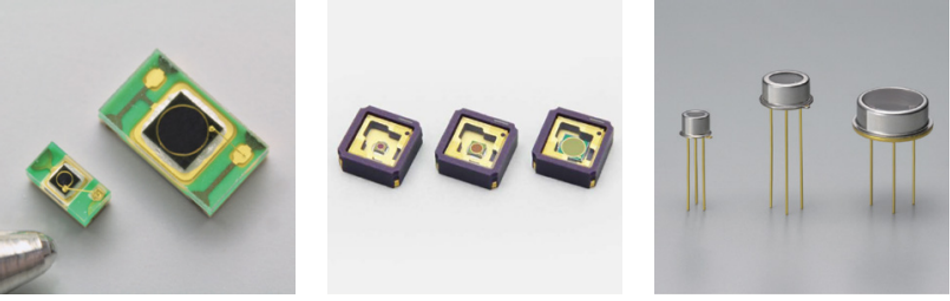
Within Axetris’ methane sensing architecture, InGaAs PIN photodiodes supplied by Hamamatsu Photonics serve as the core detection element. Their selection is tied to performance parameters relevant to near-infrared, sub-ppm detection.
Low dark current and low noise are essential at 1.6 µm, where methane absorption signals are small. Maintaining the signal-to-noise ratio under these conditions directly affects the achievable resolution. A sufficiently large active area improves tolerance to minor beam displacement caused by thermal expansion or mechanical stress, helping preserve measurement stability.
Polarization dependence loss (PDL) is another important parameter in compact optical systems. Fluctuations in polarization state, introduced by fibre routing or environmental conditions, can lead to signal variations. Low-PDL detector behaviour reduces this source of instability.
Integration of the photodiode within Axetris’ compact architecture extended beyond simple component selection. Packaging configuration, cap design, and anti-reflection considerations were optimized during development to support alignment stability and minimize stray optical effects. These integration efforts reflect that detector performance in field systems depends not only on intrinsic specifications but also on mechanical and optical coupling within the module.
Over more than a decade of deployment, this detection platform has been used in both industrial and research contexts, where consistency and long-term reliability are critical to maintaining dataset integrity.
Field Deployment: From Industrial Sites to Livestock Barns
Axetris’ methane sensing modules are used in oil and gas applications for leak detection and perimeter monitoring. In these environments, systems must operate outdoors, tolerate vibration, and maintain calibration stability under temperature variation.
In livestock research installations, continuous barn-level monitoring enables investigation into how feeding regimes and housing conditions influence methane emissions [4]. These studies rely on stable measurements across months or years, where small systematic drift could compromise longitudinal comparisons.
The shift toward measured methane emissions increases the importance of sensor repeatability. As methane data feeds into regulatory reporting and environmental modelling, sustained stability becomes as important as sensitivity.
Engineering Implications
Sub-ppm methane detection in compact systems is not achieved solely by selecting a strong absorption band or a high-performance laser. It requires controlling cumulative error sources across the entire optical chain.
Axetris’ approach illustrates how compact TDLAS modules operating at 1.6 µm can leverage mature telecom-compatible components while addressing integration challenges related to alignment, polarization behaviour, detector noise, and long-term stability. Within that architecture, the InGaAs photodiode plays a foundational role in preserving signal integrity under real-world conditions.
As methane monitoring expands across industrial and agricultural sectors, engineering priorities are increasingly centred on stability, reproducibility, and lifecycle performance. Compact sensing systems must not only detect methane at low concentrations but do so consistently over extended deployments.
References
[1] Mar, K. A., et al. (2022). Beyond CO₂ equivalence: The impacts of methane on climate, ecosystems, and health. Environmental Science & Policy, 134, 127–136.
[2] United Nations Environment Programme, “Methane emissions are driving climate change. Here’s how to reduce them,” UNEP News and Stories, 20-Aug-2021. https://www.unep.org/news-and-stories/story/methane-emissions-are-driving-climate-change-heres-how-reduce-them
[3] European Commission. (2024). Questions and Answers on the EU Regulation to reduce methane emissions in the energy sector.
[4] Schep, C. A., et al. (2023). Inventarisatie van methaansensoren en validatie van de Axetris LGD Compact-A CH₄ ten behoeve van continue emissiemonitoring in de melkveehouderij. Wageningen Livestock Research, Report 1456.