AI Resilience: Protecting Software Against AI-Assisted Reverse Engineering
AI can help an analyst navigate a binary and make sense of unfamiliar code. Manufacturers need to understand how much of their software valuable logic these tools can expose.

16 Nov, 2026. 5 minutes read
Once someone obtains the firmware for an industrial gateway, they can study its behaviour outside the manufacturer’s development environment. Downloadable updates may provide the binary directly; extracting it from a device depends on the protections in place. Reverse engineering then works backwards from the compiled implementation to establish what the software does and how it does it.
Competitors may look for proprietary algorithms, while attackers search for vulnerabilities or ways around licence checks. Connecting AI to analysis tools gives them another way to investigate that code. For engineering teams, the concern is whether work that once demanded sustained manual attention becomes easier to pursue. Here, AI resilience means making that analysis and subsequent abuse more difficult, even when the product itself contains no AI.
Rising Vulnerability Disclosures and CRA Deadlines
Product security teams already face a substantial workload. In its September 2026 analysis, Google Threat Intelligence Group reported 5,045 vulnerability disclosures in January and 10,740 in August. Assignment practices and vendor disclosure cycles affect those totals, making them a poor guide to AI’s precise contribution. Manufacturers still have to identify which disclosures affect their products and determine how those flaws could be exploited.
For manufacturers supplying products within scope in the EU, the Cyber Resilience Act adds a firm reporting timetable. Article 14 obligations have applied since 11 September 2026. On becoming aware of an actively exploited vulnerability in their product, manufacturers must report without undue delay, issuing an early warning within 24 hours and a vulnerability notification within 72 hours. Both deadlines run from awareness, with reports submitted through the Single Reporting Platform to the coordinating incident response team and ENISA.
The main CRA obligations apply from 11 December 2027, although reporting also covers qualifying products released earlier. Binary analysis or discovery of an unexploited flaw does not itself trigger this duty: active exploitation requires reliable evidence of malicious use without the system owner’s permission.
How AI Agents Investigate Compiled Software
Reverse engineering tools have long helped analysts organise unfamiliar code. IDA, first released in 1991, brought structure to assembly and cross-references. Decompilers added a higher-level representation, and Ghidra became publicly available in March 2019. AI extends this workflow by helping interpret results and choose what to inspect next. Anthropic’s Model Context Protocol, introduced in November 2024, provides a standard way to connect models to external tools.
In a Ghidra integration, the roles are distinct. Ghidra displays instructions, pseudocode and cross-references; an MCP server makes selected operations available to the model. The model reads the results and requests further analysis. One community plug-in lets it list and decompile functions, search strings, follow references, rename functions and variables, and add comments. Decompiled pseudocode remains a reconstruction that needs checking against the binary.
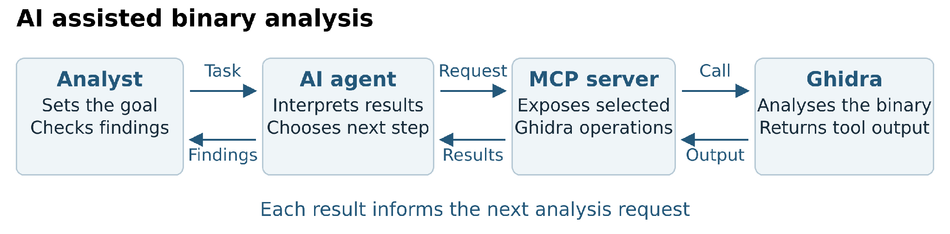
Suppose an analyst wants to locate a licence check. The agent could search for relevant strings, follow references to candidate functions and examine their decompiled output. It might then inspect callers to work out which conditions govern acceptance, recording tentative names as it goes. Each result informs the next request. A suspected validation routine might lead to a failure path or another caller, gradually building a picture that spans several functions.
With this integration, the analyst can explore those relationships without copying every function into a chat. Less navigation effort could make more targets economical to investigate, although the saving needs measuring on actual firmware. Finding a check, explaining its behaviour and demonstrating a reliable bypass are separate achievements. The plug-in’s own demonstration includes human steering.
Verification remains essential. A September 2026 preprint found that code reconstructed by systems using large language models could compile and pass supplied tests yet behave differently on other legitimate inputs. The study evaluated reconstruction systems, so it does not establish this agent’s error rate. It does show why plausible code is insufficient evidence of faithful reconstruction.
Threat actors are already using AI for research. Google’s May 2026 report described UNC2814 prompts concerning TP-Link firmware and APT45’s repetitive vulnerability-analysis prompts. Those observations do not establish how quickly an actor could compromise firmware. In a separate web application case, Google assessed with high confidence, based on exploit artefacts, that AI supported discovery and weaponisation of a two-factor authentication bypass zero-day. Exploiting the flaw in the unnamed open-source administration tool required valid credentials. A hardcoded trust assumption undermined its authentication logic, illustrating the value of examining whether exceptions contradict an intended security rule. Google worked with the vendor to disrupt the planned operation.
Protecting Critical Code Against AI-Assisted Analysis
For manufacturers, these workflows provide a way to test how much effort protection adds to an investigation. Obfuscation makes a program’s structure and intent harder to infer. Anti-tamper measures resist modification, while exploit mitigations constrain specific attacks. Each addresses a different part of the problem.
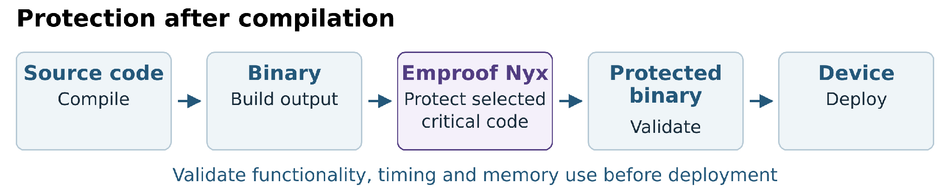
Emproof describes Nyx as a binary transformation step applied after compilation, without requiring access to source code. Teams can protect selected critical functions, with transformations designed to preserve intended functionality. They still need to validate timing, memory use and correctness on the device. A proprietary control algorithm may warrant protection, for example, while a function with tight real-time constraints may require a different balance between protection and performance.
How confusing the output looks is a poor measure of success on its own. An April 2026 preprint found that reasoning models remained effective at deobfuscating pseudocode under substantial tested transformations. The study did not evaluate Nyx or complete industrial firmware. Manufacturers therefore need evidence from the protected code they intend to ship.
Start with a representative released binary and one valuable function or security boundary. Give an authorised analyst a recorded time and compute budget to investigate it with Ghidra and AI. An afternoon can provide an initial indication of exposure. Define the result in advance: for a licence function, require a verified explanation of the acceptance conditions, checked against instructions and runtime behaviour.
Then compare the original and protected builds using the same tasks, tools and budgets across repeated runs. Record model versions, prompts and human interventions, alongside verified findings and analyst effort. Account for preparation and expert validation as well as compute costs, and check the protected build’s resource overhead. This gives the team a basis for judging whether protection makes valuable logic more expensive to recover. Use those results to discuss protection for your most valuable code with Emproof.