3D Printing vs. Injection Molding for Prototypes
Choosing between 3D printing and injection molding is one of the key decisions in product development—especially in case of prototyping.

28 Aug, 2026. 3 minutes read
This article was first published on
www.facturee.deChoosing between 3D printing and injection molding is one of the key decisions in product development—especially when moving from the initial concept to a functional prototype.
The correct answer depends on four variables: quantity, material specifications, part geometry, and schedule. This guide covers all four. Get specific recommendations from FACTUREE based on over 9 years of experience in online manufacturing.
What is the difference between 3D printing and injection molding?
Injection molding is a forming manufacturing process. Molten plastic is injected under high pressure into a mold that contains the desired geometry as a negative. After cooling, the finished part is removed from the mold. The mold can be used thousands to millions of times.
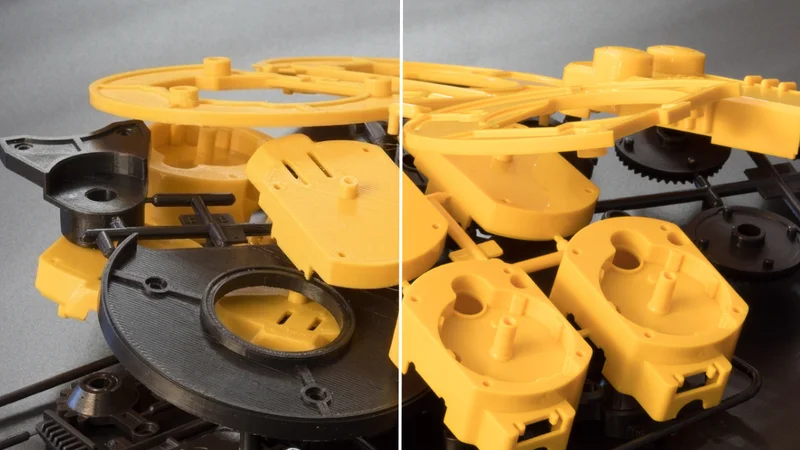
3D printing, on the other hand, refers to additive manufacturing processes. The part is built up layer by layer based on a CAD model. Common technologies such as FDM, SLA, MJF, and SLS operate according to this principle. However, they differ significantly in terms of resolution and mechanical properties.
Injection molding enables material properties close to those of mass production and a high degree of repeatability. Delivery times vary by project and depend on the choice of material and the mold design. 3D printing offers a high degree of flexibility for small batch sizes, although cost-effectiveness must always be evaluated on a case-by-case basis.
The two methods are not mutually exclusive. Many development projects use 3D printing for early design iterations. They switch to injection molding only once the geometry has been finalized and properties representative of mass production are required.
When is injection molding better than 3D printing for plastic prototypes?
FACTUREE recommends injection molding if at least one of the following four conditions applies.
- Condition 1: The material must be equivalent to that used in production. FACTUREE manufactures injection-molded prototypes from the same resins as the eventual production part (PP, PA, ABS, PC, POM, TPE, LSR). This means that functional test results can be directly applied to production qualification without the need for re-qualification due to a change in material.
- Condition 2: In terms of cost-effectiveness, injection molding is the better choice. Whether injection molding is more cost-effective than 3D printing depends on the break-even point, which is determined by tooling costs, geometry, material, printing process, post-processing, and total quantity.
- Condition 3: The geometry is suitable for injection molding. Components with uniform wall thicknesses, draft angles, and no deep undercuts are ideal for injection molding. The process then delivers the highest repeatability and smooth surfaces without the need for post-processing.
- Condition 4: The part is needed for end-user testing or market validation. If the prototype must match the eventual production product in terms of appearance and feel, injection molding is the more suitable process.
If none of these conditions apply, 3D printing is the more cost-effective choice for that particular development phase.
When is 3D printing better than injection molding for plastic prototypes?
FACTUREE recommends 3D printing for prototypes in the following situations.
- Condition 1: The component is in the early design validation phase, where material properties and production-grade equivalence are not yet critical. SLA and SLS deliver models in 1–2 business days without tooling costs.
- Condition 2: More than three design iterations are planned within two weeks. A change in geometry during 3D printing requires updating the CAD file, but does not require a new tool or a new setup process. However, it is necessary to re-examine the build orientation, support structures, data preparation, and process parameters.
- Condition 3: The component requires a high degree of geometric freedom, which would require design adjustments in injection molding (e.g., draft angles). Nevertheless, 3D printing also has process-related limitations, such as minimum wall thicknesses, overhangs, the need for support structures, the handling of closed cavities, material removal, as well as build volume and post-processing.
- Condition 4: Small quantities are required. For small quantities, 3D printing is often more cost-effective because there are no tooling costs. However, the decision must always be made on a project-by-project basis.
Read the article on FACTUREE's website to find out more about the selection criteria, how to evaluate manufacturing procedures correctly, and more: https://www.facturee.de/en/3d-printing-vs-injection-molding-for-prototypes/