The Future AI Driven Data Centres: Bridging Performance and Sustainability
Discover how advanced interconnect solutions by Amphenol are powering the next generation of AI-driven, sustainable data centers.

16 Dec, 2025. 7 minutes read
Future AI Driven Data Centres
The Evolution of AI Data Centers
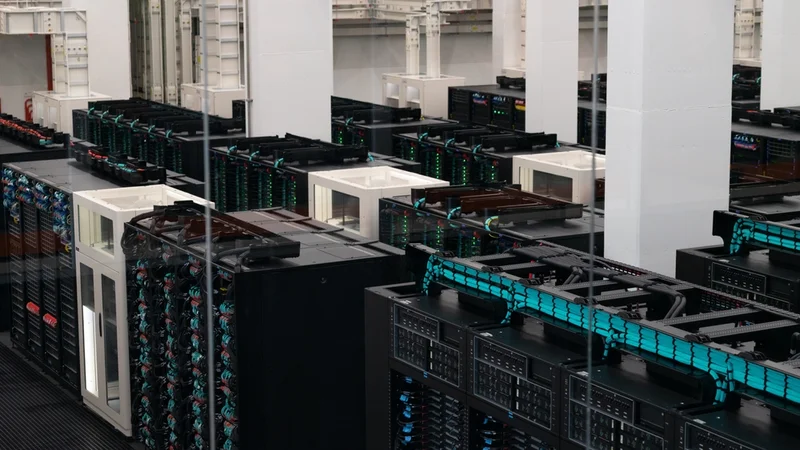
During the past years, the rise of Generative Artificial Intelligence (GenAI) models (e.g., GPT, Gemini, Llama) has led to a surge of Artificial Intelligence (AI) systems and applications. This surge has, in turn, propelled data centers with capabilities that go far beyond traditional (Central Processing Unit) CPU-centric distributed computing towards demanding architectures with support for massive parallel workloads and near-zero latency. In the past, data centers were primarily developed and deployed in order to serve general-purpose enterprise applications, web hosting, and transactional databases. Nowadays, these facilities are completely reimagined and redesigned in order to host fleets of Graphic Processing Units (GPUs) and custom accelerators that are connected in complex mesh topologies, which sometimes comprise tens of thousands of devices.
This transformation of compute paradigms is best illustrated based on the demanding training of Large Language Models (LLMs), which can require many thousands (e.g., 100,000) of interconnected GPUs. This is a scale and speed that legacy server-rack setups cannot deliver. Specifically, legacy 100G/200G links are no longer sufficient to maintain line-rate performance in these environments, which asks for a redesign toward modular architectures, phased power delivery, and disaggregated compute and memory resources.[1] The business motivation behind this redesign is to support advanced AI workloads that drive productivity, to enable smarter automation, and to open new markets for GenAI and other AI applications like autonomous vehicles, healthcare diagnostics, high-frequency trading, and edge intelligence. Supporting these applications requires unprecedented parallel computing needs and scalable growth in east-west traffic across racks. Moreover, most of these applications deploy deep learning pipelines, which require ultra-high bandwidth and dense GPUs clusters.
Overall, we are witnessing a shift toward AI-first data centers, which increase the requirements for bandwidth, power density, and latency. For instance, it is nowadays common for computing density per rack to exceed 40 kW, which drives innovations in power delivery and cooling. Furthermore, signal integrity and power efficiency requirements are of equal importance as raw compute capability. This creates market demand for innovative interconnection solutions that provide a foundation for exascale performance.
The Main Pillars of Next-Generation Interconnect
The exponential demand for bandwidth in the next generation of AI data centers is a catalyst for major leaps in interconnect technology, which is moving rapidly from 400G to 800G Ethernet and is expected to reach 1.6T fabrics in the near future. Specifically, it is common for AI clusters to generate more than 400 Gb/s of rack traffic, which requires 800G fabrics to sustain line-rate performance and avoid compute bottlenecks. These capabilities are foundational for training foundational AI models and multimodal AI systems, where high-throughput interconnects prevent idle resources and ensure high utilization.
In this context, Linear Pluggable Optics (LPO) transceivers provided by Amphenol, and Nitro Linear Redriver architectures have opened new possibilities in how signals traverse data center topologies. LPO modules eliminate the need for digital signal processors (DSPs), which can reduce latency and cut energy consumption by up to 30% when compared to standard optical modules. Moreover, Nitro Redrivers push copper links to new limits, which can handle up to 4 meters at 200 Gb/s per lane. They balance reach and efficiency while enabling cost-optimized deployment across different tiers of the infrastructure. These innovations empower system architects to optimize designs for performance and cost based on a proper and effective distribution of fiber and copper elements. In this direction, innovative cable assemblies (e.g., OverPass) and novel optical transceiver form factors (e.g., QSFP-DD (Quad Small Form Factor Pluggable Double Density) and OSFP (Octal Small Form Factor Pluggable)) are designed specifically for high-speed data center environments. These components are driving the delivery of the 1.6T computing backbone.
The Importance of Silicon Photonics
Silicon photonics is another important enabler of the scale and performance of modern AI centers. Specifically, it can be considered the linchpin of scalable and energy-efficient data center connectivity. As copper interconnects hit physical limits, data centre deployers are investing in light-based solutions instead of electrons for their data transmission needs. This shift is enabled by photonics-based solutions that offer ultrahigh bandwidth, low latency, and significantly improved power efficiency.
Silicon Photonics enables modern AI workloads to communicate between components at terabit-per-second speeds. They alleviate the signal degradation and power loss issues of copper infrastructure, which prevent their use over large distances. To this end, silicon photonics combines waveguides, modulators, and detectors on a single CMOS (Complementary metal–oxide–semiconductor) chip, delivering novel, miniaturized, and power-efficient transceiver modules. Moreover, the integration of optics with compute packages (i.e., in-package optical IO) makes it possible to minimize latency, maximize interconnect density, and facilitate energy-efficient disaggregated architectures. Hence, Silicon Photonics approaches are key enablers of applications that train generative models, run autonomous driving simulations, and scale real-time inference networks.
There is also a pivot of the industry to co-packaged optics (CPO) and photonic switching, which is driven by the need to eliminate copper trace limits and maximize rack throughput. To this end, companies like Amphenol are carrying out Research and Development (R&D) in materials engineering and optical assembly in order to enable deployments in hyperscale environments. The latter provides a foundation for resilient backbones for AI clouds, 5G core networks, and scientific High Performance Computing (HPC) clusters. As a prominent example, there are hyperscale clusters from leading cloud providers that rely on Amphenol’s fiber-optimized solutions towards reducing signal loss and enabling unified GPU accelerators across entire rack islands. Such deployments exemplify the future of intelligent infrastructures, where bandwidth can be dynamically allocated as workloads shift and scale.
Industry Collaboration and Standards Alignment
The innovation in AI networking and AI-first data centres is also accelerated based on the development of robust industry standards and the open collaboration between vendors, researchers, and integrators. Vendors like Amphenol participate in leading standards organizations and align their development activities with on-going standardization initiatives. This is a key for ensuring interoperability, multi-vendor support, and future-readiness across their product portfolios. Some of the most prominent standardisation initiatives and collaboration projects include:
- Open Compute Project (OCP) and Modular Infrastructure: OCP has spearheaded reference architectures that specify rack design, cluster interconnects, and cooling for scalable AI deployments. OCP Alignment enables vendors to fit their solutions into these modular systems towards rapid expansion and compatibility.
- Open Accelerator Infrastructure (OAI) and PCI Express 5.0/6.0: The OAI deals with the standardization of GPU, TPU, and ASIC trays with a view to promoting vendor-agnostic compute clusters. PCIe 5.0 doubles bandwidth with 32 GT/s signalling, while PCIe 6.0’s 64 GT/s enables lossless communication at scale. The latter is ideal for dense AI servers where high-speed interconnects link CPUs, GPUs, and storage.
- IEEE Ethernet (400G/800G) and Co-Packaged Optics (CPO) Standards: IEEE’s multi-lane signalling standards guarantee interoperability across optical transceivers, which is critical for spine-leaf and lattice mesh topologies. The latter are essential for LLM and cloud inference workloads. CPO standards are shaped in part by OCP and the Advanced Photonics Coalition. They define integration between silicon photonics engines and electronic ASIC (Application Specific Integrated Circuit) packages in order to deliver higher bandwidth and simpler management via open schemas such as the CMIS (Common Management Interface Specification).
- Multi-Vendor Interoperability and Rapid Innovation: Active participation in OCP, PCI-SIG, and IEEE efforts also ensures that interconnectivity solutions align with platforms from top OEMs (Original Equipment Manufacturers) and system designers. Likewise, collaboration with hyperscalers, silicon vendors (NVIDIA, Intel, AMD), and industry groups allows Amphenol to actively shape the specifications that will guide the next generation of global intelligence.
Practical Applications and Forward Vision
The power of advanced interconnects enables a host of novel practical AI deployments in the areas of AI model training, real-time inference, and data-driven industries. As a prominent example, Amphenol’s AI-ready connectivity solutions enable use cases in many different industrial areas from cloud hyperscalers to smart manufacturing, healthcare, and defence. Some of the most prominent real-world Use Cases that are currently enabled by the smart and scalable interconnectivity solutions of Amphenol are:
- LLM Training Clusters: Amphenol’s optical trunks and Linear Pluggable Optics (LPO) transceivers provide robust, high-bandwidth connectivity between large groups (“pods”) of GPUs, which is required for training foundation and multimodal models at hyperscale. This allows data centers to handle the massive parallel workloads generated by advanced generative AI systems in order to support thousands of GPU devices and to scale up for future models with even greater resource requirements.
- Cloud Data Centers: Nitro redriver copper systems and QSFP-DD interfaces from Amphenol are the backbone of high-speed “spine-leaf” topologies, which are essential for dynamic resource allocation and seamless expansion in public cloud environments. These innovations improve line-rate performance and help cloud service providers scale out rapidly. At the same time they minimize latency and enable flexible deployment of demanding AI applications and services.
- Autonomous Systems: Photonics-driven interconnects facilitate ADAS (Advanced Driver Assistance System) algorithm development and sensor fusion in automotive compute clouds. These solutions offer ultra-low latency, high-reliability data transfer that accelerates real-time algorithm development and integration.
- Telecom Edge AI Applications: Amphenol’s modular interconnect designs enable efficient, low-latency inference processing at the edge of telecom networks, which are particularly important for future-proofing 5G and upcoming 6G networking environments. These applications support smart city infrastructure, IoT deployment, and decentralized AI, while ensuring that connectivity and computational power are delivered closer to where data is generated.
- Scientific and Healthcare Networks: Advanced cabling solutions that are compatible with PCIe 5.0 and CXL standards deliver the ultra-fast, lossless connectivity needed for high-throughput workloads. Such workloads are commonly found in areas like genomic sequencing, medical imaging, and scientific simulation clusters. Amphenol’s technologies help research organizations and healthcare providers move and analyse enormous datasets in order to support the development of innovative solutions that lead to better patient outcomes.
- Sustainability and Energy Optimization: Dense rack deployments exceeding 40 kW, ask for advanced energy management and thermal optimization capabilities. In this direction, Amphenol’s phased, modular power delivery solutions support safe, redundant energy distribution, hot-swappable scaling, and advanced thermal management. Moreover, passive and linear interconnect design reduces demand for active retiming and DSPs towards supporting reduced energy consumption and improved sustainability. Moreover, lightweight materials and modular assemblies also enhance cooling and lifecycle optimization, which makes them suitable for supporting net-zero goals.
The future of AI data centres is paving the ground for 1.6T and 3.2T networks, which will be enabled by advances in 224 Gb/s PAM4 signalling, co-packaged optics, and optical circuit boards (OCBs). Amphenol is prototyping solutions that address these domains, while focusing on lower-power, higher-bandwidth integration and system-level signal management. Combined with global manufacturing and considerable R&D investments, Amphenol is currently positioned as a strategic partner for organizations architecting universal AI-ready infrastructure.
Overall, Amphenol’s blend of optical, copper, and power technologies is currently combined with the support and logistics expertise of Mouser in order to ensure that engineers and designers can reliably access the industry’s most advanced product lines for every tier of AI data center infrastructure. Amphenol’s partnership with Mouser delivers scalable, future-proof solutions, while at the same time providing the expertise, testing, and localized support needed to deploy mission-critical systems at scale. Together, the two companies are lighting the path toward intelligent infrastructure and universal AI readiness, which will open up unprecedented opportunities for innovative business cases.