The Rise of Software-Defined Systems: Why Every Safety-Critical Industry Is Becoming a Software Company
Discover how software-defined systems are transforming automotive, aerospace, medical, rail, and industrial engineering with continuous software evolution.

01 Sep, 2026. 7 minutes read
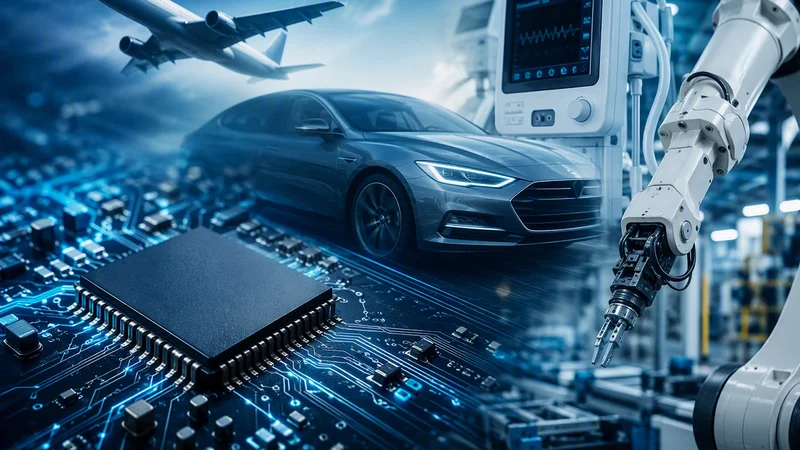
What happens when a car, a hospital infusion pump, or a fighter jet starts solving the same engineering problem? A decade ago, that question wouldn't have made sense. Today, it defines the future of every safety-critical industry.
Automotive manufacturers were the first to name this shift, coining the term "Software-Defined Vehicle" as modern cars began deriving their functionality from software rather than hardware alone. But automotive didn't invent the trend; it just gave it a name. Aircraft, medical devices, trains, industrial robots, factory automation systems, and military platforms are all undergoing the same transformation.
Software is no longer simply controlling hardware. It defines what a product can do, for as long as that product stays in service, and that changes the engineering mindset these industries need far more than it changes their technology stack.
This article explores why industries are moving toward software-defined systems and why continuous assurance is important for maintaining trust throughout the product lifecycle.
What Does "Software-Defined" Actually Mean?
“Software-defined” does not mean a product has an internet connection or supports over-the-air (OTA) updates. The more important shift is what determines the product’s capabilities. In a traditional embedded system, hardware and software are designed around a largely fixed set of functions. Once the product reaches the market, changes often require hardware modifications, recalls, or a new product generation.
A software-defined system is designed to evolve after deployment. Software updates can add features, improve performance, fix defects, respond to cybersecurity threats, and introduce new capabilities without replacing the underlying hardware. McKinsey describes software-defined hardware as programmable and flexible. They allow products to handle new tasks through software updates rather than costly hardware upgrades.
The automotive industry provides a clear example. Modern SDVs use centralized computing and software-hardware decoupling to support OTA updates and new applications throughout the vehicle’s life.
Why Industries Are Moving Toward Software-Defined Systems
Software-defined systems have become practical as several technologies have matured simultaneously. Companies are also seeing clear benefits from making software a larger part of the product.
What Made the Shift Possible
Key enablers include:
More powerful processors and cheaper storage support complex software and AI workloads.
Connectivity and cloud infrastructure make remote monitoring, data collection, and OTA updates possible at scale.
AI acceleration enables intelligent functions to run directly on embedded systems.
Virtualization and containers make software easier to deploy and manage across platforms.
Mature CI/CD practices allow teams to develop, test, and release updates more frequently.
Customer expectations are shifting toward products that improve through post-purchase updates.
Why Companies Are Embracing It
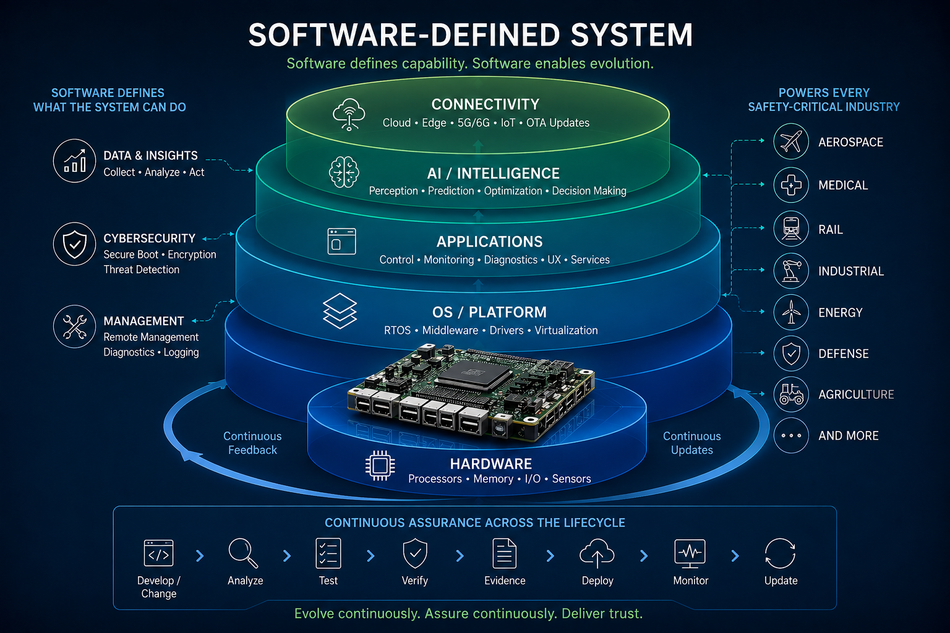
Software can add functionality without requiring a new hardware design. It can also extend product life, deliver security fixes faster, reduce maintenance through remote diagnostics, and help companies respond quickly to changing customer needs.
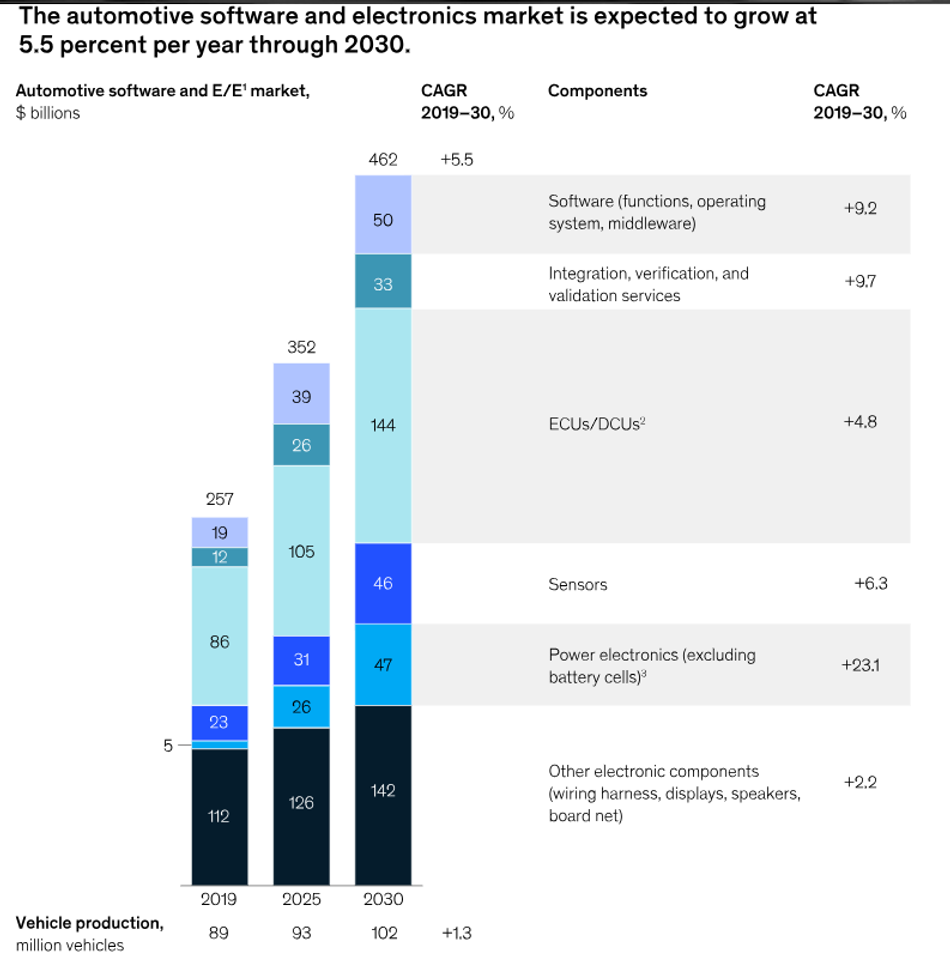
This makes software a direct source of product value. McKinsey estimates that automotive software and electronics could become a $462 billion market by 2030. This highlights the growing economic role of software in physical products.
New Business Models
Software-defined products also enable subscriptions, feature unlocks, predictive maintenance, fleet analytics, and remote diagnostics. These models allow companies to generate value throughout the product lifecycle rather than only at the initial sale.
As a result, software is no longer simply a supporting cost. It is becoming a competitive differentiator and a source of ongoing revenue.
Software-Defined Systems Are Transforming Every Safety-Critical Industry
The software-defined shift is not limited to the automotive industry. Across many different industries, software is taking a larger role in system behavior, connectivity, maintenance, and future upgrades.
1. Automotive
Vehicles are moving toward centralized computing, software-defined architectures, and advanced driver assistance systems (ADAS). It also includes autonomous driving and digital cockpits. Over-the-air (OTA) updates allow manufacturers to add features and improve vehicle software after delivery.
2. Aerospace and Defense
Aircraft rely on software for avionics, flight management, mission systems, predictive maintenance, and connected operations. Defense platforms similarly use software to deliver new mission capabilities and respond to changing operational needs.
3. Medical and Rail
Connected medical devices can receive software updates and security fixes throughout their lives. The FDA now expects manufacturers to address cybersecurity across the device lifecycle, including post-market vulnerabilities. Rail systems are also becoming more software-intensive, with standards such as EN 50716 supporting modern software development for railway control and protection systems.
4. Industrial Automation, Robotics, and Agriculture
Factories and agricultural systems are adopting robotics, digital twins, edge AI, and predictive maintenance. These technologies allow machines to use real-time data to improve operations and detect problems earlier. The International Federation of Robotics reported that 542,000 industrial robots were installed worldwide in 2024, more than twice the number installed a decade earlier.
Although each industry has unique regulations, they are solving the same engineering challenge: continuously evolving software without compromising safety or reliability.
The Engineering Lifecycle Has Fundamentally Changed
Traditional embedded development followed a mostly linear path:
Design → Develop → Verify → Release
After launch, engineering teams often shifted their focus to maintenance. They usually introduced major changes with a new hardware revision or product generation.
Software-defined systems change this model. Teams can now update products throughout their operational life with software updates, security patches, new features, and AI improvements. The lifecycle becomes continuous:
Define → Design → Implement → Integrate → Verify → Validate → Deliver → Operate → Maintain → Update
Products no longer have a clear “final” state. Each update can change system behavior or introduce new risks. Teams must engineer, test, verify, and validate every update before release with the same level of confidence as the original product.
This shift also changes how engineering teams work. Teams must move from release-focused development to continuous engineering. They must keep verification and compliance active throughout the product lifecycle as the software evolves.
 Infinity symbol. Source: AdobeStock
Engineering Software-Defined Systems: Required Capabilities
A continuous lifecycle introduces a new problem: how can teams prove that every software change remains safe, secure, and compliant? A CI/CD pipeline can automate delivery, but speed alone is not enough for safety-critical systems. Verification must become part of the pipeline so that defects and compliance gaps are identified before software reaches the product.
A software-defined engineering workflow therefore needs capabilities such as:
Static analysis and coding standards: Find defects, unsafe code patterns, and violations of rules such as MISRA, AUTOSAR, CERT, and CWE early in development.
Automated unit and regression testing: Check new code while confirming that existing functions still behave as expected after changes.
Structural code coverage: Measure how thoroughly tests exercise the code, including branch, condition, and, where required, MC/DC coverage.
Requirements traceability: Link requirements to test cases and results, creating evidence that can support safety and security assessments.
Automated reporting and evidence: Turn test, coverage, and analysis results into consistent, audit-ready compliance records.
AI-assisted remediation: Help developers address static-analysis findings faster while keeping verification under engineering control.
Parasoft C/C++test and C/C++test CT bring these activities into development and CI/CD workflows. C/C++test combines static analysis, unit testing, structural coverage, requirements traceability, and compliance reporting.
C/C++test CT extends automated testing and coverage into CI/CD environments. Both support verification practices used across standards including ISO 26262, ISO/SAE 21434, IEC 61508, IEC 62304, DO-178C, and EN 50716.
Safety and Security Can No Longer Be Separate
The boundaries between functional safety and cybersecurity become less clear as products become connected and continuously updated. A security weakness could affect a safety-related function. A software update that fixes a security issue could also change how the system behaves. The same risk applies when teams update AI models or other software components.
Safety and security standards still address different risks, but engineering teams need to consider them together. For example, ISO 26262 covers functional safety in road vehicles, while ISO/SAE 21434 covers cybersecurity risks across the vehicle lifecycle. ISO describes these standards as complementary. Similar links exist across other safety-critical industries:
Medical: IEC 62304 for medical software alongside cybersecurity practices such as IEC 62443 where applicable.
Aerospace: DO-178C for airborne software alongside DO-326B for aircraft cybersecurity.
Industrial: IEC 61508 for functional safety alongside IEC 62443 for industrial automation and control-system security.
Rail: EN 50716 establishes software development requirements for railway control and protection systems.
This also changes how organizations approach compliance. NIST SP 800-204D recommends integrating software supply-chain security into DevSecOps and CI/CD pipelines. This allows teams to find and address security risks during development instead of waiting until the final release.
AI's Dual Role: Accelerating Development and Demanding New Compliance
AI is changing software-defined systems in two ways. Engineering teams are using AI to speed up development, while AI itself is becoming part of safety-critical products.
During development, AI can help with code generation, defect analysis, static-analysis remediation, unit-test creation, and test optimization. These tools can help teams work faster, but AI-generated code is not automatically safe or compliant. It still needs code analysis, testing, review, and verification, just like software written by developers.
AI embedded in products creates a different challenge. Computer vision, ADAS, medical diagnostics, predictive maintenance, and industrial automation use machine learning. Unlike traditional software, an AI model can work as designed yet still produce an unsafe result when it encounters conditions not well represented in its training data. ISO/PAS 8800:2024 addresses AI-related safety risks in road vehicles and provides guidance for building safety assurance around AI-based functions.
Compliance is Now Continuous
Traditionally, most compliance work was completed before a product was released. Software-defined systems change this model. Products can continue to evolve through software updates, security patches, feature releases, AI model improvements, cloud service changes, and operational data.
Each change can affect safety, security, or system behavior. Teams therefore need to assess changes and maintain the required testing, documentation, and compliance evidence throughout the product lifecycle.
Frameworks such as the NIST AI Risk Management Framework support this lifecycle approach by addressing AI risks across development, evaluation, deployment, and use. For software-defined systems, the goal is to maintain confidence in safety, security, and compliance with every change.
The Next Competitive Advantage
Software-defined systems allow products to evolve continuously, but every update can introduce new risks to safety, security, reliability, and compliance. Engineering teams therefore need to move beyond simply delivering software faster. They need to verify every change with confidence.
Parasoft C/C++test and C/C++test CT help address this challenge by automating static analysis, testing, code coverage, traceability, and compliance activities across the development lifecycle. By embedding continuous verification into modern workflows, teams can enable faster software evolution without compromising safety and regulatory requirements.
Ready to build continuous assurance into your software lifecycle? Request a Parasoft demo today!