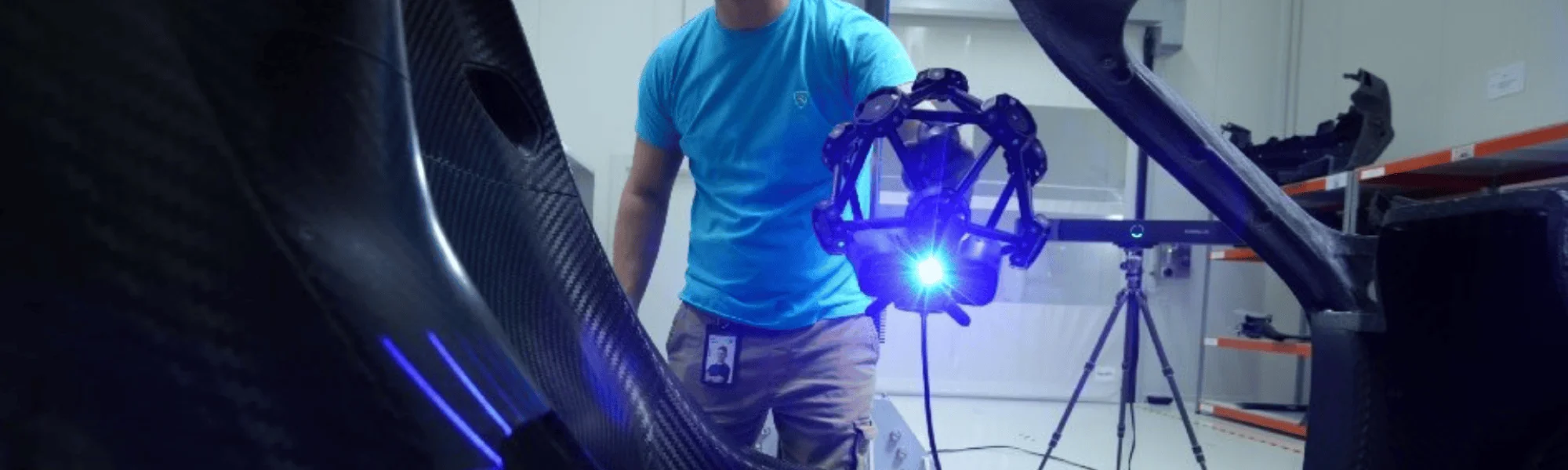
New Whitepaper: Advancing Quality with High-Accuracy 3D Metrology
Learn how Shining3D is driving precision in automotive and civil aviation.


Executive Summary
This white paper investigates the increasing need for high-precision metrology in highly regulated industries such as automotive and civil aviation. Where current metrology solutions are falling short in terms of efficiency, completeness, and scale, high-performance 3D scanning is emerging as a powerful solution. SHINING 3D’s 3D scanning systems offer myriad benefits to engineers and quality assurance (QA) teams in both the automotive and civil aviation sectors, including full-field, micron-level data capture, accelerated inspection times, repeatability, and traceability. This white paper illustrates these benefits and more in case studies from the automotive and aviation sectors, while also presenting different application areas for the technology. Finally, the white paper explores the question of integrating 3D scanning into existing QA or inspection processes with the goal of streamlining workflows and enhancing results.
Introduction
Precision has always been fundamental to manufacturing, but the way it is achieved has changed dramatically. Even as far back as the building of the pyramids in Ancient Egypt, measurement standards were used to ensure a consistent size of limestone or granite block, which resulted in a deviation of a mere 0.05% comparing all the sides of the structure. [1]
In today’s era of digital transformation, smart manufacturing, and zero-defect production, metrology has evolved from a supporting function into a core, data-driven capability. Today, advanced production technologies, such as Computer Numerical Control (CNC) machining and Additive Manufacturing (AM), have brought with them new design possibilities, such as highly complex assemblies whose performance and functionality are dependent on extremely tight tolerances. The proliferation of high-precision components has introduced an array of challenges for traditional quality assurance tools like calipers, gauges, and even coordinate-measuring machines (CMMs). As many manufacturers have experienced firsthand, these tools fall short when it comes to measuring and qualifying complex surfaces with extreme precision in a scalable, repeatable way.
Enter 3D metrology. 3D metrology solutions, such as SHINING 3D’s 3D scanners, have emerged as a powerful solution. Capable of capturing accurate surface data in a fast and non-contact manner, 3D metrology tools are transforming quality assurance workflows for the better and providing more exacting insights into a part’s form, fit, and function.
As we’ll explore in this white paper, advanced 3D metrology solutions are becoming increasingly indispensable in industries like automotive and civil aviation, where critical components require ultra-tight tolerances in order to ensure optimal safety and performance as well as regulatory compliance. Moreover, as both sectors pursue greater efficiency through the development and production of ultra-lightweight parts, engineers are discovering that many of these parts are susceptible to deformation during handling and contact-based inspection processes. 3D metrology tools provide a safe, non-contact solution in these cases.
Additionally, the integration of 3D metrology enables manufacturers to align the pace of quality control with that of production. In other words, 3D metrology solutions facilitate rapid, automated inspections that match with takt time requirements and unlock high-throughput production without compromising on precision or quality. Beyond qualification in automotive and aviation production lines, 3D metrology is also facilitating the inspection of legacy parts and supporting reverse engineering applications.
In this white paper, we will first look at the limitations of traditional metrology tools when it comes to advanced production applications in automotive and aviation. From there, we will examine the benefits of 3D scanning and explore specific applications in both industries where 3D metrology is playing a game-changing role. Finally, we will illuminate the impacts of integrating 3D metrology solutions into engineering and quality assurance workflows.
The Metrology Gap: The Limitations of Traditional Contact-Based Metrology
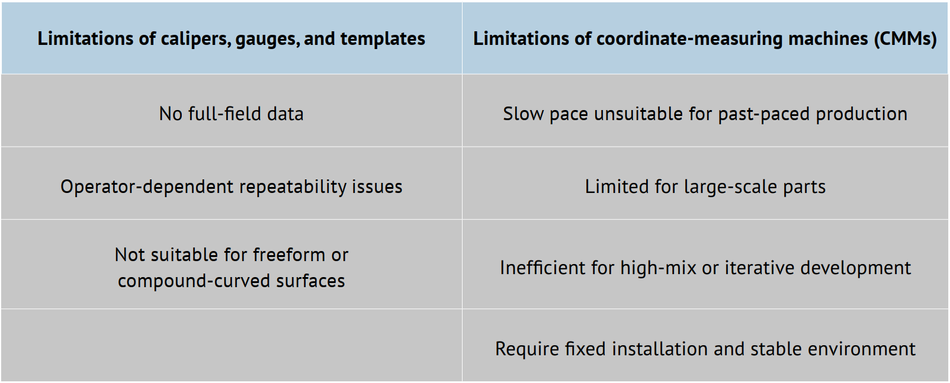
Before delving into the transformative capabilities of advanced 3D metrology, it is helpful to first understand how traditional metrology tools are falling short of modern manufacturing expectations. Though handheld instruments like calipers, gauges, and templates have long been used in quality control workflows and have the benefits of being simple to use and relatively low cost, their functionality, repeatability, and scalability are limited.
These rudimentary metrology tools effectively work by measuring a part’s dimensions (calipers) or checking whether a particular feature or dimension falls within allowable limits (gauges and templates). A major shortcoming with these metrology tools is that they can only measure individual dimensions and do not provide full-field data. Moreover, these tools are used manually and therefore bring with them the risk of human error and lack of repeatability, an issue that is magnified when extreme accuracy is required. These tools are also fundamentally unsuited for the inspection of freeform geometries and compound-curved surfaces, which limits their use to simple geometric structures.
Even sophisticated metrology technologies like coordinate-measuring machines (CMMs) present limitations when it comes to inspecting critical, high-precision parts in the automotive and aviation sectors. CMMs use a tactile probe to measure discrete points on a part, leveraging coordinate technology to determine dimensional accuracy in multiple axes.
While CMMs are known for their high level of accuracy, the approach has workflow limitations that hinder its adoption for many applications. For one, coordinate-measuring technology is slow and can create bottlenecks in fast-paced production environments. CMMs are also limited in size, meaning that they are unsuitable for inspecting body-in-white (BIW) structures, body panels, aerospace skins, and other large structures. The fixed nature of CMMs, which must operate in a controlled, vibration-free environment, also limits how and where they can be used. Similarly, long setup times inhibit flexibility and make CMMs inefficient for high-mix production and iterative development cycles.
Considering the limitations of these widespread metrology tools and the growing demand for high-precision, complex parts in demanding industries like automotive and aerospace, there is a strong need for fast, full-field, high-accuracy metrology. In many cases, 3D scanning is the answer.
The Need for High-Accuracy 3D Scanning for Metrology
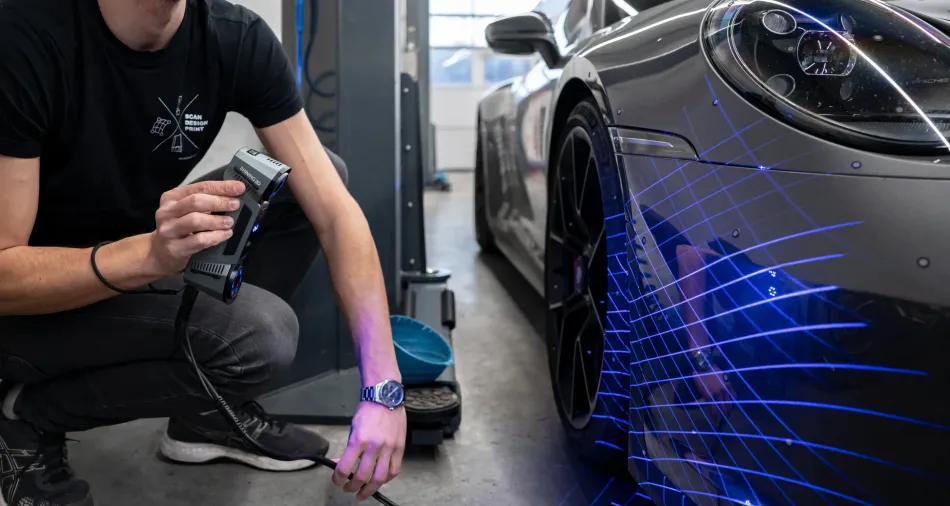
With technological roots dating back to the 1960s, 3D scanning is today at the cutting edge of industrial metrology. [2] On a basic level, the technology works by projecting light onto an object. Based on the way the light bounces back from the object, the scanning technology captures full-field data of the object’s surface and geometry. This data, in the form of thousands or even millions of points, can be used for metrology purposes or to reconstruct a high-fidelity digital twin of the object.
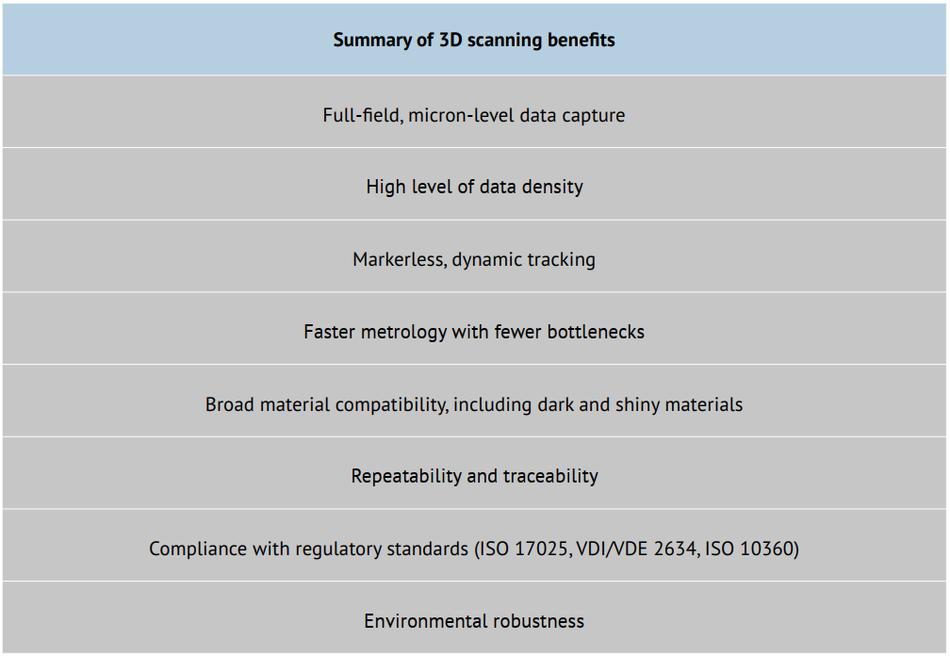
Professional and industrial-grade 3D scanning solutions, such as SHINING 3D’s dynamic tracking 3D measuring system, handheld laser scanning, and high-precision inspection systems, offer several benefits over traditional metrology approaches. With micron-level repeatability, broad material compatibility, dynamic tracking, and environmental robustness, SHINING 3D’s advanced scanning tools enable manufacturers across the most demanding industries to inspect and qualify parts with confidence.
One of the greatest benefits of 3D scanning is full-field, high-density data capture. While CMMs are the gold standard for point accuracy, their sparse measurements often miss global deviations. In contrast, laser scanners capture the entire surface geometry, enabling comprehensive shape and dimension analysis. This high-density data allows for the generation of chromatic deviation maps, which instantly visualize form errors like warpage or shrinkage. Instead of just checking isolated points, manufacturers can assess the entire surface profile to identify exactly where and by how much the part deviates from the CAD model.
The superior data density unlocked by 3D scanning is not only transformative for quality assurance and metrology, it also plays a critical role in informing engineering decisions related to geometric dimensioning & tolerancing (GD&T), part analysis, reverse engineering, computer-aided engineering (CAE) validation, and tool compensation loops.
SHINING 3D’s solutions offer manufacturers additional advantages, including markerless, dynamic tracking for large structures, ideal for inspecting BIW, fuselage, monocoque, and chassis structures without the setup hassle of placing markers or stickers. This, along with the elimination of any manual measurement, results in faster metrology workflows and overall fewer Advanced Product Quality Planning (APQP) bottlenecks.
Moreover, scanning systems that feature blue light laser technology can scan traditionally challenging parts, such as those with dark or shiny surfaces, with a high level of accuracy. This capability extends scanning material compatibility to dark carbon fiber composite structures as well as shiny metal surfaces, and beyond, without surface preparation.
In industries like automotive and civil aviation, which are bound by strict regulatory standards and frameworks, 3D scanning tools must meet stringent requirements when it comes to accuracy and repeatability. SHINING 3D solutions deliver repeatability and traceability backed by ISO 17025, VDI/VDE 2634 and ISO 10360 certifications. This is paired with a higher level of environmental robustness than sensitive metrology tools like CMMs.
Unlock the Full Potential of High-Accuracy 3D Scanning
You’ve seen how 3D scanning is transforming inspection and quality workflows—but this is only the starting point.
In the full whitepaper, explore detailed automotive and civil aviation applications, including carbon fiber monocoque validation, sheet metal deformation analysis, and aircraft damage detection. Learn how leading manufacturers are deploying high-precision 3D metrology to reduce inspection time, improve accuracy, and streamline production.
Download the complete whitepaper to access real-world use cases, technical workflows, and the measurable impact of integrating advanced 3D scanning into engineering and QA processes.