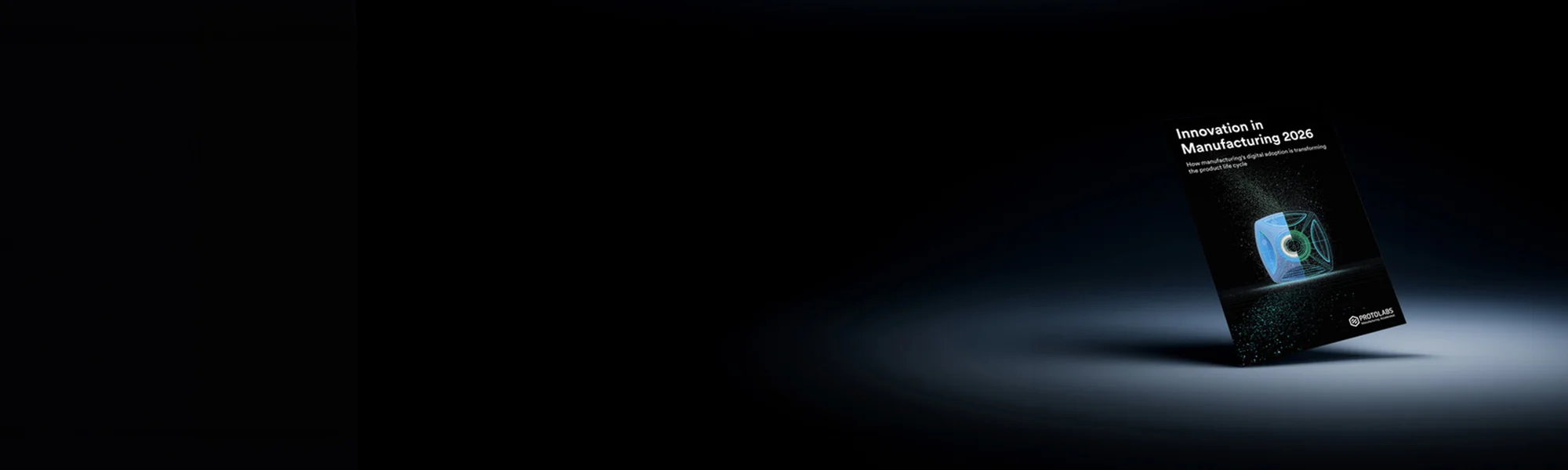
New Report: Innovation in Manufacturing 2026
Learn how manufacturing's digital adoption is transforming the product life cycle – download the new report today.


The Future of Manufacturing Is Already Taking Shape
Engineering teams today are under pressure to move faster than ever—from concept to production—while managing increasing complexity, cost constraints, and supply chain uncertainty. At the same time, a new generation of digital technologies is reshaping how products are designed, validated, and manufactured.
Protolabs’ latest report, “Innovation in Manufacturing 2026,” explores this shift in depth. It shows how tools like artificial intelligence, digital twins, and on-demand manufacturing are no longer emerging concepts, but are already delivering measurable impact across the product lifecycle.
For example, the report reveals that 72% of manufacturers using machine learning report improved efficiency and reduced costs, while digital twin technologies are enabling teams to cut development time by as much as 20–50%. At the same time, AI-enabled digital workflows are helping organizations achieve up to 50% lower development costs and 30% faster time-to-market.
Download the Report:
From Concept to Scalable Production
The report highlights a fundamental shift in how products are developed. Instead of linear processes, engineering teams are moving toward parallel, data-driven workflows, where design, simulation, and validation happen simultaneously.
In early-stage development, AI-powered tools are enabling engineers to explore a far broader design space and collaborate more closely with stakeholders. This is reflected in the growing adoption of co-creation models, with 58% of companies already piloting collaborative design approaches.
As products move closer to production, however, challenges remain. Despite advances in digital tooling, 97% of companies still report delays or failures when scaling from prototype to full production—highlighting a persistent gap between design validation and manufacturability.
Manufacturing in a More Flexible, Connected World
To address these challenges, manufacturers are increasingly turning to more flexible production models. Today, 72% of manufacturing leaders rely on on-demand manufacturing to adapt to changing requirements, reduce risk, and accelerate time-to-market.
At the same time, production environments themselves are becoming more intelligent and connected. AI-driven systems, IoT-enabled monitoring, and digital twins are enabling real-time optimization, predictive maintenance, and improved quality control across manufacturing operations.
This shift is also laying the foundation for more sustainable practices, from reducing material waste to enabling circular manufacturing models such as remanufacturing and reuse.
Why This Matters for Engineers
For engineers, these changes are not abstract trends—they directly impact how products are designed, tested, and brought to market.
A more connected, digital-first manufacturing approach enables:
- Faster iteration and validation cycles
- More accurate simulation and performance prediction
- Reduced reliance on costly physical prototyping
- Greater flexibility when scaling production
Understanding how these technologies fit together is becoming essential to navigating modern product development.
Download the Full Report
“Innovation in Manufacturing 2026” provides a detailed look at how these trends are reshaping engineering workflows, supported by real-world data and practical insights.
Download the full report to explore how AI, digital twins, and on-demand manufacturing are enabling faster, more efficient, and more resilient product development.