Navigating Europe's Manufacturing Dilemma Through Automated Metrology
Why traditional inspection can no longer keep pace with modern automotive production, and what to do about it


European automotive manufacturing is under structural pressure from multiple directions at once. Experienced metrologists are retiring. EV platforms demand entirely different inspection approaches. Global competitors have already automated. And production lines cannot slow down to wait for quality control to catch up.
For many facilities, the bottleneck is not the production technology. It is the inspection workflow sitting behind it.
Explore the whitepaper
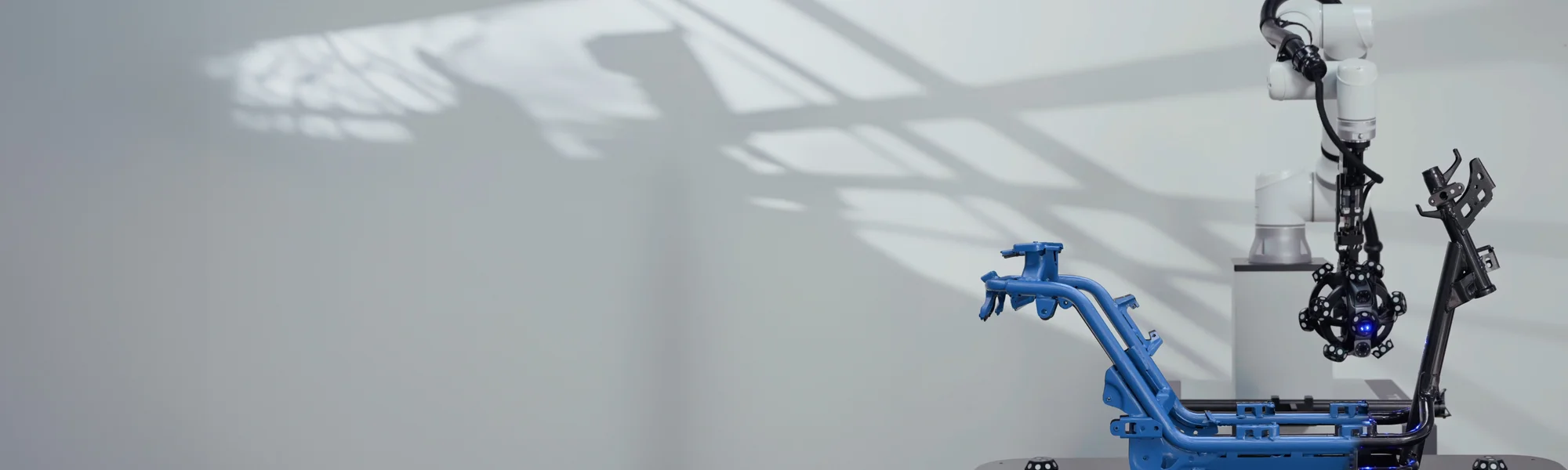
This whitepaper examines how automated 3D optical metrology helps automotive manufacturers close the gap between modern production and legacy quality control. It covers the real pressures driving the change, the practical limitations of coordinate measuring machines, and how optical scanning systems can be deployed directly on the shop floor.
You will learn:
- Why demographic decline across EU manufacturing hubs is making traditional CMM expertise harder to source and retain
How EV platforms, battery enclosures, thin-walled aluminum structures, and reflective surfaces expose the limits of point-based measurement
How optical scanners capture millions of geometrically linked data points in a single pass and compare them directly against CAD models
What it means to move inspection out of the metrology lab and into production, where feedback reaches engineers before defects compound into large batches
How stamping and casting operations can use accumulated scan data to track tooling drift and move from reactive maintenance to predictive intervention
What a full Industry 4.0 integration looks like, including MES connectivity, automated reporting, and modular robotic inspection cells deployable in two days
Why read it
Traditional inspection systems were built for a stable, high-volume world with a ready supply of skilled operators. That world has changed. EV production requires validation techniques that CMMs were not designed for. Customizable vehicles mean higher part variability. Supply chains spanning dozens of countries mean dimensional deviations that go undetected in one stage create assembly problems three steps later.
Late defect detection is not just a quality problem. Every rejected part costs energy, machine time, and labor. In the context of the European Green Deal, it is also a sustainability problem.
This whitepaper looks at inspection as a complete production system rather than a separate step, and shows how automated optical metrology turns quality control from a bottleneck into an active part of the manufacturing process.
Case study: stamping inspection at a tier-one supplier
A supplier producing 782 different stamped part types for Honda, Toyota, and Nissan was running out of road with CMM-based inspection. Manual setup, slow throughput, and the requirement to work directly on a live shop floor made the existing process unsustainable.
After deploying an automated 3D optical scanning system alongside the stamping lines, large sheet metal parts could be fully scanned in three minutes. Smaller parts took around one minute. Defects were caught earlier, corrective action happened faster, and scrap and rework both came down.
Learn from the source
Scanology develops automated 3D inspection systems used in automotive production environments across Europe and Asia. Their systems are certified to ISO 10360 standards and tested in CNAS ISO 17025 accredited laboratory conditions.
This whitepaper draws on that experience to give engineers and operations leaders a practical guide to modernising their inspection infrastructure.