Intelligent Radar Classification with Neuromorphic AI
Adding Intelligence to Radar with the BrainChip Real-Time Micro-Doppler Classification

14 Apr, 2026. 5 minutes read

Radar has long been a foundational sensing technology in defense and critical infrastructure. It excels at detecting objects at distance, operating reliably in darkness, smoke, fog, and adverse weather where optical systems fail. Yet traditional radar systems can determine where an object is, but not necessarily what it is. Addressing this challenge is central to Physical AI, where systems must interpret sensor data and act on it instantly in real-world environments.
The rapid proliferation of Unmanned Aerial Vehicles (UAVs) has introduced a new class of low-cost, highly mobile aerial threats. Commercial drones are widely available, inexpensive, and increasingly capable. At the same time, birds, debris, and environmental clutter continue to populate the skies. Distinguishing between a harmless bird and a hostile drone is no trivial problem. It is an operational requirement.
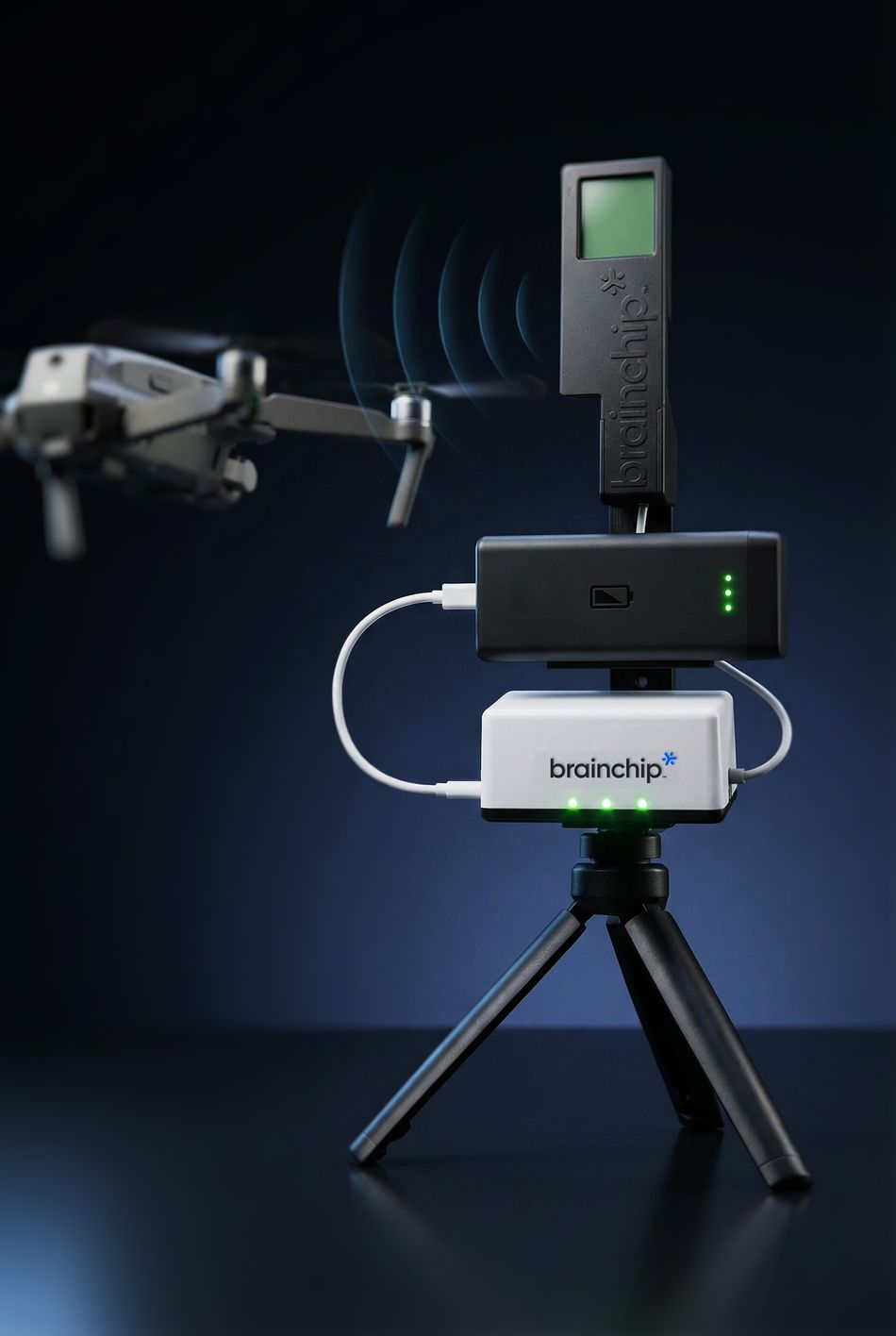
BrainChip’s Radar Reference Platform addresses this gap by embedding intelligent, low-power classification directly into the radar signal chain. Built around the Akida™ neuromorphic processor, the platform demonstrates how micro-Doppler analysis can enable real-time identification and classification of flying objects without relying on GPUs or cloud infrastructure, bringing Physical AI into operational radar systems.
The Identification Gap in Modern Radar Systems
Traditional radar systems detect motion and range using reflected radio waves. They provide position, velocity, and sometimes size estimations. While this can be good enough for many applications, in today’s aerial threat landscape, detection alone is insufficient.
Security operators face three compounding challenges:
Proliferation of UAVs introduces unpredictable aerial activity
Limitations of cameras and RF scanners in poor weather, night conditions, or spoofed environments
False alarm fatigue caused by radar systems unable to distinguish drones from birds or debris
Cameras depend on line-of-sight visibility, while RF scanners depend on signal emissions that can be spoofed or suppressed. Radar remains the most robust sensing modality across conditions. However, without classification capability, operators must manually interpret signals or escalate unnecessarily.
This results in wasted time, misallocated resources, and in defense scenarios, potentially expensive countermeasures deployed against low-cost targets. The missing capability is, therefore, intelligent classification at the sensor edge.
Micro-Doppler: Extracting Identity from Motion
When an object moves, radar detects Doppler shifts caused by its velocity. But complex objects, such as drones, produce additional fine-grained motion signatures. Rotating propellers create distinct micro-Doppler patterns embedded within the radar return.
These micro-motions act as a fingerprint. Bird wingbeats differ from propeller rotations, debris exhibits irregular motion, and fixed-wing drones differ from quadcopters. The information is present in the signal, but extracting and interpreting it in real time remains an engineering challenge.
Micro-Doppler classification requires continuous processing of high-resolution radar returns. Conventional AI hardware, particularly GPU-based systems, can perform this task but at a significant cost in power, size, and thermal complexity. Such architectures introduce cooling requirements, increased SWaP, and system-level constraints that limit field deployment.
The Akida Radar Reference Platform
BrainChip’s Radar Reference Platform combines:
The Akida AKD1500 neuromorphic co-processor
A compact FMCW radar module
A micro-Doppler classification model optimized for Temporal Event-Based Neural Networks (TENNs)
Raspberry Pi-based system integration
This reference design demonstrates real-time classification of flying objects using neuromorphic computing at the edge, providing a validated blueprint for intelligent radar integration.
Event-Driven Processing for Radar Signals
Akida processes radar data using TENNs and spatiotemporal CNN models, designed to capture both spatial and temporal features in dynamic signals. The architecture focuses on extracting meaningful temporal patterns from the signal without continuous, power-intensive computation.
The input to the system is a time-frequency spectrogram generated from Frequency Modulated Continuous Wave (FMCW) radar data. Within this representation, micro-Doppler signatures appear as distinct textures formed by periodic micro-motions, such as propeller rotations or wingbeats. These patterns can be learned and recognized efficiently by models optimized for temporal signal interpretation.
Micro-Doppler features manifest as repeating, time-dependent patterns, making them well-suited for TENN-based and spatiotemporal model architectures. This approach enables:
Sub-2W total system power consumption
Low-latency inference directly on-device
Elimination of GPU dependency
Fanless, compact system design
The result is a compact radar platform capable of classification within constrained power and thermal envelopes.
Smart Classification Without Cloud Dependency
A critical advantage of the Radar Reference Platform is complete on-device operation. All classification occurs locally with no reliance on cloud connectivity. This has significant implications, including:
Comms-denied environments: The system operates independently without network access.
Data privacy and security: Sensitive radar data does not leave the device.
Low latency: Classification decisions occur immediately at the sensor.
For defense and infrastructure monitoring, such autonomy is essential. In contested environments, transmitting data may reveal position. A system that can classify threats silently and locally preserves operational security while maintaining real-time responsiveness.
Strategic Applications
The Radar Reference Platform serves as a blueprint for deployments requiring real-time classification of motion signatures:
Aerial Object Classification for Drones and UAVs: Micro-Doppler signatures enable reliable distinction between drones, birds, and debris in real time. This allows defense systems to classify targets early and avoid unnecessary countermeasures.
Defense and Early Threat Detection: On-device object identification supports real-time awareness in comms-denied environments. Systems operate silently, without data transmission, preserving operational security while maintaining responsiveness.
Automotive In-Cabin Sensing and Human Activity Detection: Radar can capture fine human motion patterns such as breathing or posture. This enables occupancy detection and health-related monitoring without cameras, preserving privacy.
Marine and Autonomous Platform Awareness: Radar-based classification helps distinguish between vessels, obstacles, and environmental motion in low-visibility conditions, supporting safer autonomous navigation.
Drone Countermeasures: Detection of propeller micro-Doppler signatures enables targeted response, reducing false alarms and improving response accuracy.
Ultra-Low SWaP for Portable Deployment
Size, weight, and power are central constraints in field systems. The Akida-based radar platform delivers ultra-low SWaP characteristics:
Compact FMCW radar module
Fanless architecture
Sub-2W total system power consumption, including Raspberry Pi 5, radar module, and Akida processor
Portable, man-deployable design
This makes the system suitable for mobile early warning deployments, forward-operating environments, or temporary infrastructure setups. Conventional GPU-based solutions require active cooling and higher power budgets. The neuromorphic approach fundamentally reduces SWaP constraints while maintaining real-time classification capability.
Reliability in Harsh Environments
Radar inherently operates through smoke, fog, dust, and storms. By integrating classification directly into the radar platform, the system maintains robustness and performance.
Unlike camera-based systems, it does not depend on visibility. And unlike RF detection systems, it does not rely on emitted signals that can be suppressed or spoofed. The reference design demonstrates validated, low-latency classification in a fully integrated stack. This reduces integration risk for product teams looking to embed intelligent radar into their solutions.
A Blueprint for Intelligent Radar Products
The Radar Reference Platform is not a standalone product. It is a complete, validated design that combines hardware, software, and AI modeling into a reproducible architecture ready for product adaptation.
For defense contractors, infrastructure providers, and OEMs, it provides:
Proven micro-Doppler classification capability based on TENNs
Integration framework around the AKD1500
Clear path from reference to deployment
BrainChip’s ecosystem can adapt this design to specific product requirements, accelerating time to market while preserving low-power advantages.

Redefining What Radar Can Do
Radar has always provided visibility. The addition of intelligent classification transforms it into an autonomous decision-support system. Instead of reporting “an object detected at 300 meters,” intelligent radar can report “a quadcopter approaching.” That shift reduces false alarms, conserves resources, and increases operator confidence.
By combining compact FMCW radar with neuromorphic processing, BrainChip’s Akida enables micro-Doppler classification at the edge, without GPUs, without cloud dependency, and without high power overhead. This moves radar systems beyond detection toward real-time understanding at the edge.
For an exclusive deep dive into BrainChip’s Radar Reference Platform, check out the upcoming Webinar, April 20th: https://brainchip.com/leadgen-radar-platform-registration/