How Parasoft Unifies Software Verification
Discover how Parasoft helps engineering teams unify verification, automate compliance reporting, and accelerate testing using the tools they already trust.

28 Jul, 2026. 5 minutes read

Engineering teams already use a mix of static analysis, unit testing, code coverage, and compliance documentation tools. But the real challenge is that these activities often operate independently. This results in extra manual work, as engineers have to correlate results, quality teams have to gather evidence from multiple sources, and compliance preparation can become time-consuming.
A unified testing solution brings software verification activities into a single connected workflow. It does not force teams to abandon the tools they already trust. Parasoft delivers C/C++ software testing solutions that integrate with existing IDEs, CI/CD pipelines, and testing frameworks. This makes adoption intuitive and reduces the need for retraining or vendor lock-in.
Let’s explore how a unified testing solution like Parasoft helps engineering teams streamline verification while preserving the workflows and frameworks they've already invested in.
Why Traditional Software Testing Falls Short
Traditional software testing solutions were not built for today's distributed development environments. Companies now rely on diverse IDEs, open-source frameworks, automated pipelines, and collaborative development workflows. When verification tools cannot adapt to this ecosystem, they introduce unnecessary complexity instead of improving software quality.
Common challenges include:
Proprietary workflows: Many platforms now require teams to adopt vendor-specific workflows instead of integrating with existing development practices. This can make adoption more disruptive than beneficial.
Limited ecosystem support: Engineering teams often work across Eclipse, VS Code, CLion, GitHub, CMake, Dev Containers, Bazel, GoogleTest, and custom frameworks. Traditional solutions do not always support these diverse environments.
AI not integrated into verification: Many development teams already use AI coding assistants, but these tools are not designed to support end-to-end software verification. Activities such as static analysis remediation, coverage closure, and compliance documentation often remain manual, reducing the overall productivity gains.
Legacy testing approaches: Older platforms were designed around manual or centralized testing rather than continuous verification integrated into modern CI/CD pipelines.
Poor developer experience: Developers want static analysis, testing, and compliance checks to run inside the IDEs and pipelines they already use, not through separate tools that interrupt their workflow.
Weak support for open-source adoption: Companies depend on proven open-source technologies and want to extend them with verification and compliance capabilities rather than replace them entirely.
Modern verification platforms focus on integration rather than requiring companies to replace the tools they already trust. Parasoft extends existing development ecosystems by integrating with popular IDEs, CI/CD pipelines, GoogleTest, and custom testing frameworks, enabling teams to unify verification while preserving established workflows.
A Unified Testing Solution That Works With Your Existing Ecosystem
Effective software verification depends on more than individual testing activities. Static analysis, unit testing, code coverage, requirements traceability, and compliance reporting should work together throughout the development lifecycle. Parasoft connects these activities into a unified verification workflow without requiring teams to replace their existing toolchain.
Here’s how Parasoft connects each stage of the process:
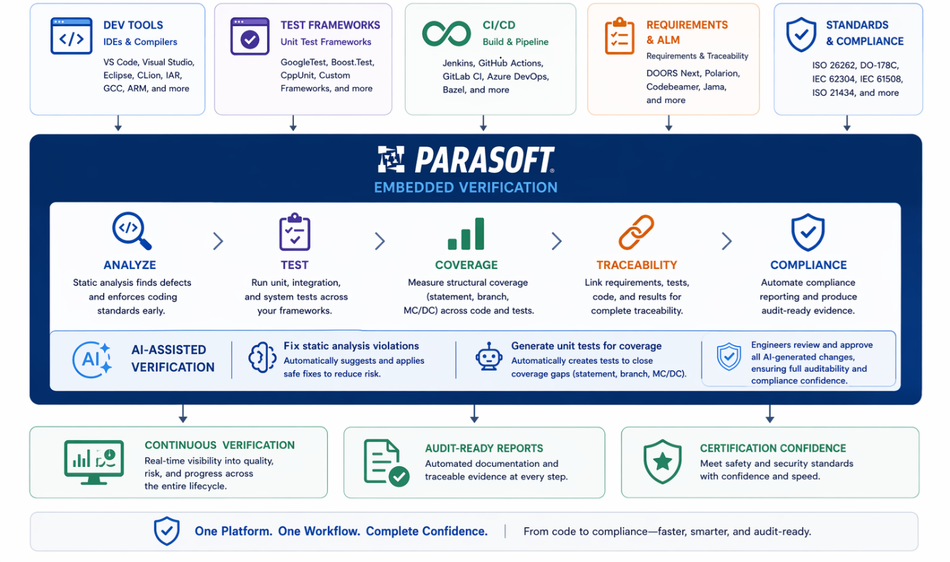
Static analysis: Helps to detect coding standard violations, security weaknesses, and software defects early in development. Support for standards such as MISRA, AUTOSAR C++14, CERT, and CWE helps organizations enforce secure coding practices while reducing security risks in connected and embedded systems.
Unit testing: C/C++test CT extends existing frameworks such as GoogleTest with enterprise-grade verification capabilities instead of replacing them. Teams can continue using their current test assets while adding coverage, traceability, and compliance reporting.
Code coverage: Measure statement, branch, and MC/DC coverage using existing test suites rather than creating new ones. This helps companies meet safety-critical coverage objectives while reducing manual verification effort.
Requirements traceability: Connect requirements to source code, test cases, coverage results, and verification artifacts in a single workflow. Automated traceability replaces manual spreadsheets and provides continuous visibility into development progress and release readiness.
Compliance reporting: Compliance evidence is generated as a byproduct of everyday verification activities. Because testing, coverage, traceability, and analysis remain connected, teams can produce audit-ready reports throughout development instead of preparing documentation at the end of a project.
Every verification activity contributes to the next. This helps engineering teams to improve software quality, accelerate certification readiness, and preserve the development environments, CI/CD pipelines, and testing frameworks they already trust.
Where AI Fits Into Software Verification
In safety and security-critical development, engineering judgment, code reviews, and validation are important. AI simply helps teams complete repetitive verification tasks more efficiently so the developers can focus on higher-value work.
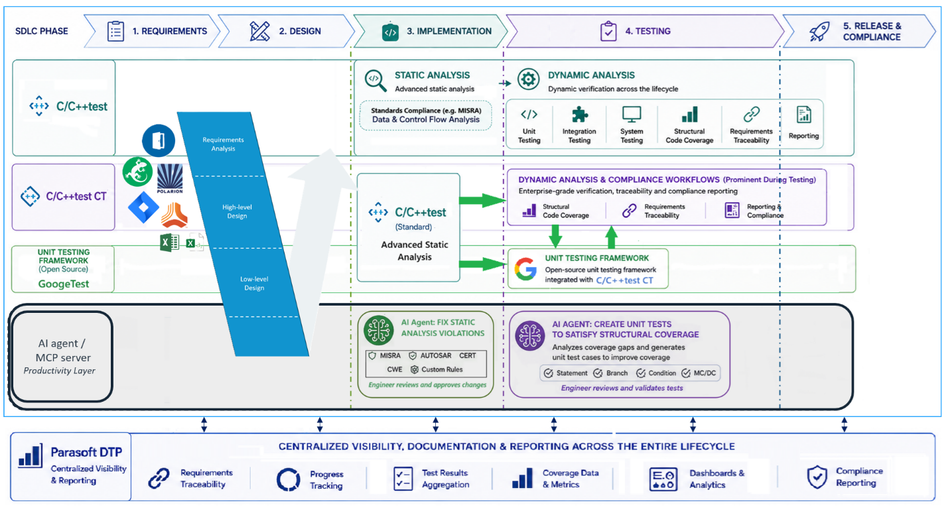
Parasoft applies AI to verification activities where it delivers the greatest value.
AI can help developers remediate static analysis violations by suggesting fixes that align with established coding standards.
It can also generate unit test cases to improve code coverage and make it easier to identify and verify untested paths without the manual effort of writing every test from scratch.
By accelerating test creation and helping close statement, branch, and MC/DC coverage gaps, AI supports faster verification while maintaining the quality expectations of modern software development.
AI-assisted workflows also help engineering teams scale verification across modern CI/CD pipelines, reducing manual effort while supporting embedded DevOps practices.
Moreover, AI-generated recommendations do not apply automatically. Engineers review, validate, and approve every suggested code change or test case before it becomes part of the software baseline. This human-in-the-loop approach preserves auditability and accountability while accelerating verification workflows.
A Dashboard View of Software Quality and Compliance
As verification activities become connected, teams also need a single place to track progress and demonstrate compliance. Parasoft DTP (Development Testing Platform) serves as the centralized reporting and analytics layer, bringing together results from static analysis, unit testing, code coverage, and requirements traceability into one dashboard.
With DTP, engineering and compliance teams can:
Monitor verification progress across projects from a single dashboard.
Track code coverage, traceability, and compliance with coding standards.
Identify quality trends and outstanding verification tasks.
Generate audit-ready compliance evidence without manually assembling reports.
Give developers, quality engineers, and compliance managers a shared view of project status.
Because the same dashboard serves multiple stakeholders, everyone works from a common source of truth. This helps teams make more informed decisions while keeping software quality and compliance visible throughout the development lifecycle.
How Day-To-Day Testing Changes With Parasoft
The impact of a unified verification workflow is most visible in day-to-day development. Rather than changing how teams work, Parasoft enhances the tools and processes they already use.
The comparison below highlights how everyday software verification becomes more connected, automated, and efficient.
Before | With Parasoft |
Multiple disconnected testing and verification tools | Connected verification workflow across the existing toolchain |
Separate reporting systems | Centralized reporting through a web dashboard (Parasoft DTP) |
Manual collection of compliance evidence | Continuous visibility into compliance and audit readiness |
Tool-specific workflows that require migration | Existing IDEs, CI/CD pipelines, and testing frameworks remain unchanged |
Manual investigation of defects and test creation | AI-assisted remediation and test generation to improve productivity |
Frequent context switching between tools | Integrated verification within existing development environments |
 Modernize Software Verification Without Rebuilding Your Toolchain
Engineering teams do not necessarily need more testing tools. They need better integration between the tools they already trust. Parasoft simplifies software verification without disrupting established development practices. It adds the visibility, automation, traceability, and TÜV SÜD-certified verification technologies needed to support safety- and security-critical software development.
Ready to simplify software verification?
Explore Parasoft's unified testing solutions to see how they fit into your existing development ecosystem. Schedule a demo to learn how your team can accelerate software quality and compliance.