From Blink to Think: Unveiling The Dual-Brain Bridging Advanced Computing with Precise Control
Arduino unveils the UNO Q — a powerful new board merging a Qualcomm MPU, and announces acquisition by Qualcomm, marking a bold next chapter in edge AI.

07 Oct, 2025. 3 minutes read
A continuation of Arduino’s commitment to open-source and community-driven development, the UNO Q board facilitates the integration of AI into a breadth of edge AI applications. Source: Arduino.
Almost 20 years on from the launch of the original UNO form factor board, an arguable ignition for the maker movement, Arduino has today unveiled the spark of a bold new chapter – the UNO Q board. Combining high-performance computing and precise real-time control in one compact board, the UNO Q is designed to enhance technology with real-time intelligence and edge AI capabilities.
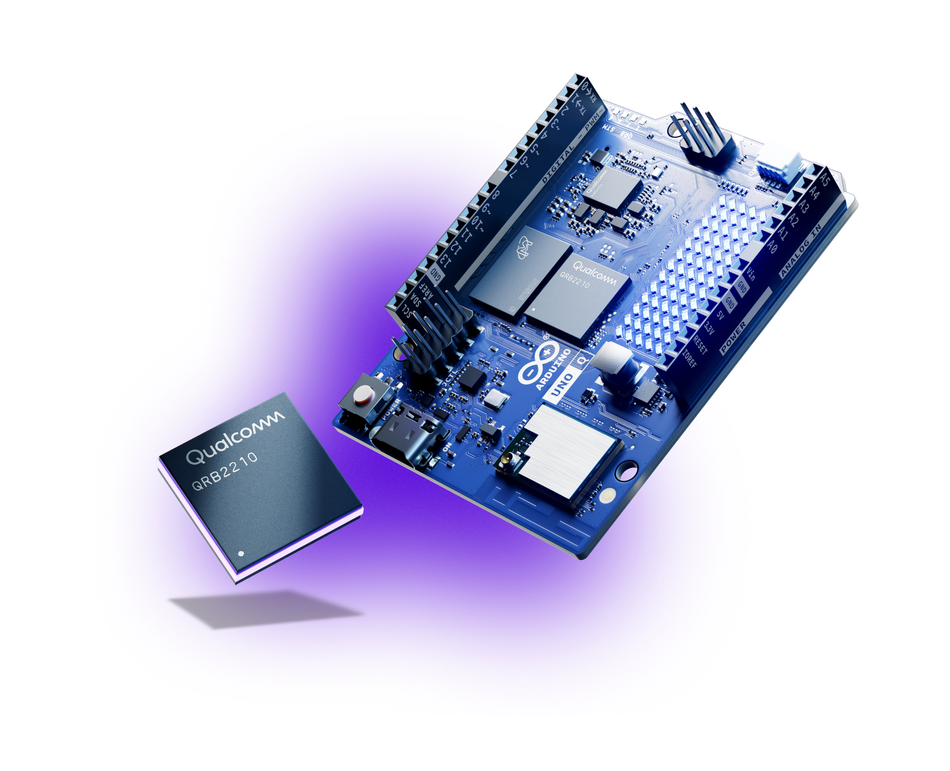
At its heart is the Qualcomm DragonwingQRB2210 microprocessor (MPU), delivering AI acceleration, graphics, and connectivity alongside a real-time STM32U585 microcontroller (MCU). This unique hybrid design makes UNO Q as versatile as it is powerful: from running Linux® apps to handling robotics tasks, all with the simplicity that Arduino is known for.
A New Standard for Making and Innovating
A continuation of Arduino’s commitment to open-source and community-driven development, the UNO Q board facilitates the integration of AI into a breadth of edge AI applications, from machine vision and sound recognition to intelligent IoT devices. Combined with the new Arduino App Lab–an entirely new, unified development environment by Arduino –developers can seamlessly explore real-time, Linux®, Python®, and AI programming, lowering barriers to innovation and creativity.
For users, this means a seamless leap from blinking an LED to building AI-driven applications — all with the same tools and community they already know.
Powering Millions of “Blinks” for the Next Era
Arduino UNO Q is the latest innovation in the Arduino UNO family, having transformed makers into innovators for nearly twenty years, powering millions of “blinks”. With their latest product, Arduino is redefining technology for a new era – one shaped by real-time intelligence, edge AI, and the rise of “vibe coding” and easy-to-build applications.
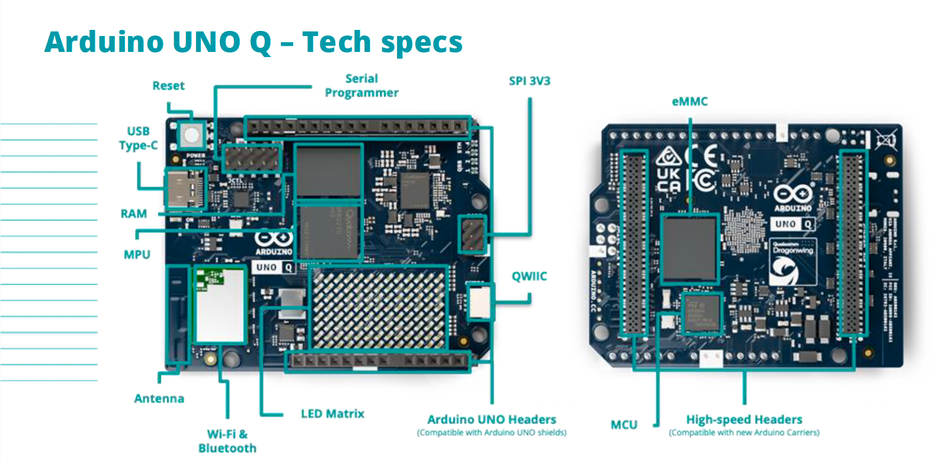
The technical specifications highlight the powerful features and capabilities of the UNO Q board.
Microprocessor: Qualcomm Dragonwing QRB2210 with quad-core Arm® Cortex®-A53 @ 2.0 GHz and Adreno GPU.
RAM: 2GB LPDDR4, with a 4GB variant coming soon.
Storage: 16GB eMMC, with a 32GB variant coming soon.
Connectivity: Wi-Fi® 5 and Bluetooth® 5.1 with onboard antennas.
Dimensions: 68.85 mm x 53.34 mm, maintaining the UNO form factor.
Software and Operating Systems Supported
UNO Q supports various operating systems and software environments for versatile development.
MPU Operating System: Linux Debian OS with upstream support.
Real-time Operating System: Arduino Core on Zephyr OS.
Supported Operating Systems for Arduino App Lab include Windows 10 or later, macOS 11 or later, and Ubuntu 22.04 or later.
Hardware
Microprocessor (MPU) |
| Microcontroller (MCU) |
| |
RAM |
| Power Supply |
| |
Storage |
| USB |
| |
Connectivity |
| Interfaces | I2C/I3C SPI PWM CAN UART | PSSI GPIO JTAG ADC |
Camera |
| |||
Video |
| Extra |
| |
Audio |
| Dimensions |
|
Software
MPU Operating System |
| Containerization |
|
Real-time Operating System |
| Supported Operating Systems for Arduino App Lab | Windows: Windows 10 or later (64-bit) macOS: macOS 11 or later (64-bit) Linux: Ubuntu 22.04 or later, and Debian Trixie (64-bit) |
The New Arduino App Lab
With UNO Q comes the launch of the new Arduino App Lab. An entirely new environment made by developers, for developers, that unifies the journey across real-time, Linux®, Python®, and AI, making development faster, easier, and more seamless than ever. With UNO Q, anyone can explore, prototype, and deploy intelligent solutions, from hobbyists and students to researchers and manufacturers.
A New Era for Makers and Developers
Qualcomm Technologies, Inc. announced today its agreement to acquire Arduino, bringing together Qualcomm’s leading-edge processing, AI, graphics, and connectivity capabilities with Arduino’s open-source hardware and vast developer community. The deal aims to accelerate developer productivity by embedding Qualcomm’s advanced technology across Arduino’s platform, while maintaining Arduino’s independent brand, tooling, and open philosophy. With over 33 million active users, the integration is positioned to enable seamless transition from prototyping to commercial deployment, uniting a full-stack environment for real-time, AI-enabled edge applications.
“Joining forces with Qualcomm Technologies allows us to supercharge our commitment to accessibility and innovation,” said Fabio Violante, CEO, Arduino. “The launch of UNO Q is just the beginning— we’re excited to empower our global community with powerful tools that make AI development intuitive, scalable, and open to everyone.”
To learn more, join Arduino’s “From Blink to Think” event livestream on October 7, 2025, at 7:00 a.m. PT / 4:00 p.m. CEST: https://www.arduino.cc/from-blink-to-think.