Enhancing Combat Equipment with Printed Sensors, Antennas, Displays
The NOVA platform by Voltera is a versatile tool that can empower defence organizations in the integration of increasingly sophisticated electronics in combat equipment.

06 Nov, 2025. 6 minutes read
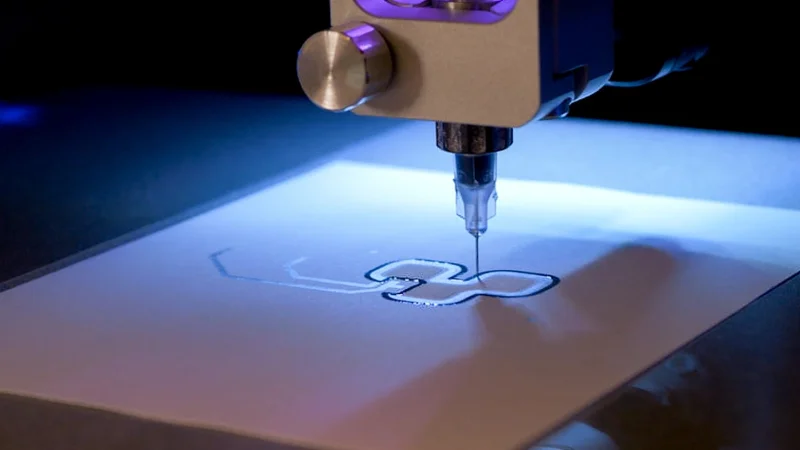
NOVA Printing a Multilayer EL Display using Conductive, Dielectric, and Phosphor Inks
The defense industry and military organizations have been behind some of the most impactful innovations in recent history, from duct tape (initially developed to seal ammunition crates in WWII and now used for everything) to GPS navigation systems (pioneered by the U.S. Department of Defense in the 1970s). [1] It’s no surprise why: the defense sector has the resources required to accelerate innovation and an urgent drive to advance technologically for ever-evolving combat readiness.
Today, printed electronics are at the forefront of defense innovation, and technologies like Voltera’s NOVA direct ink writing (DIW) solution are enabling defense organizations to increase vital metrics like efficiency, adaptability, and miniaturization when it comes to both wearables and combat equipment. In a previous article, we looked at several combat wearable applications for Voltera printed electronics, including discreet sensors for health monitoring and wearable heaters. In this article, we are turning to combat equipment to understand how Voltera’s technology can help defense organizations address an increasing demand for advanced integrated electronics that augment equipment functionality without adding bulk.
The NOVA platform, launched by Canadian company Voltera in 2022, is a materials dispensing system designed to accelerate the development of advanced flexible circuits and sensors. The process selectively deposits screen-printable inks (i.e., conductive, dielectric, and functional inks) onto a wide variety of substrates, including both rigid and flexible materials. This printing approach eliminates the need for tooling and masks, resulting in faster iteration cycles and greater agility for applications such as electronics development, materials testing, and low-volume production runs.
In the context of combat equipment, NOVA has the potential to be a game-changer in the development of circuits, sensors, and displays that enhance the functionality of critical military gear, including communication devices, navigation systems, robotics, vehicles, and more. In the following sections, we’ll be looking at a selection of use cases for the electronics printing technology that showcase this potential.
Remote Robotic Control
In the field, there are many environments and scenarios that can pose a risk to humans, from underwater equipment repairs, to bomb disposal, to reconnaissance in remote or difficult terrain. In the continual effort to make troops safer and minimize risk, defense organizations are becoming more and more interested in leveraging robots to carry out these challenging and potentially hazardous tasks.
Electronics printing platforms such as NOVA can play an important role in the development of remotely controlled robotic devices that can operate in these environments, performing reconnaissance and logistical tasks under human control without any risk to human life.

In one relevant use case, NOVA was used to print a wearable glove that remotely controls the movements of a robotic hand.[2] Voltera’s platform printed conductive strain gauges using stretchable silver conductive ink on a flexible TPU substrate. These strain gauges were integrated into a glove and programmed to send haptic signals from the glove to a 3D printed robotic hand, which resulted in the robotic hand mimicking the human hand movements in real time.
In the defense sector, enabling robots to move and respond in real time based on human input has a number of potential uses, including the remote handling of dangerous materials and hazardous items, like improvised explosive devices (IEDs) and other explosives, conducting maintenance in a high-risk environment, or gathering intel or data from dangerous or hard-to-reach zones such as collapsed structures, underground tunnels, contaminated zones, or active combat areas..
In the case of IED disposal, the use of advanced explosive ordnance disposal (EOD) robots can ensure that the expertise and skill of bomb disposal professionals is still being used, just without any risky proximity. This offers a distinct advantage compared to earlier EOD robots, which are controlled via video-game controllers.[3] In addition to enabling human-controlled actuation interfaces, NOVA can print custom sensors, interconnects, and flexible circuits for the robots themselves, which can be encapsulated in moisture-resistant materials that protect devices from harsh environments.
Electroluminescent Displays
Another important application for Voltera’s NOVA solution is in the development of high-quality display technologies, which play a pivotal role in military operations by promoting situational awareness and facilitating how troops and communications operators receive crucial information. It goes without saying that optimal displays for defense applications must offer a combination of clarity and robustness, particularly when used in the field. Electroluminescent displays (ELDs) are thus a perfect fit.
ELDs are flat panel displays that utilize the principles of electroluminescence—a phenomenon where specific types of material, such as phosphors, emit light when exposed to an alternating current or electrical field. This phenomenon can be harnessed to create displays that are characterized by a thin profile, flexibility, temperature resistance, vibration resistance, overall durability, highly uniform light, and low cost.
In a defense context, ELDs are already well established due to their high visibility and robustness[4], being used in control panels and instrument clusters in aircrafts, submarines, and road vehicles. ELDs also have great potential in other areas, such as in the production of rugged keypads and portable electronics that require visibility in both dark and light environments.

Voltera has demonstrated NOVA’s capability for printing electroluminescent displays. In a recent use case, the company printed a blue-light emitting pattern on two different substrates, exploiting NOVA’s ability to print multiple layers. The EL pattern, printed on flexible paper and PET substrates, consisted of four printed layers: a base conductive layer, a dielectric layer, a phosphor layer, and a top conductive layer. When connected to an alternating current, the thin flexible circuit glows blue.[5] Notably, the paper substrate delivered consistent results in the use case, which opens up the door to integrating ELDs into for example uniforms, sensor and vehicle panels, as well as equipment surfaces for covert, durable and low-signature illumination and situational awareness.
It’s also worth noting that NOVA can also print additional material layers, including optical inks that can add anti-glare properties to a range of displays for glare-resistant maps, control panels, and electronics.
Stealth Antennas
As communications and tracking devices become more sophisticated, they are also getting smaller and more flexible. These intersecting trends towards greater miniaturization and flexibility in electronics are highly beneficial for the defense industry, which can pack greater functionality into a smaller, more versatile footprint, thus simplifying logistics and deployment without compromising performance.

Voltera demonstrated this capability by printing an ultra-high frequency radio-frequency identification (RFID) antenna using a paper substrate and a nano-copper ink. The result of this proof of concept was an RFID tag suitable for long-range reading capabilities with a performance that exceeded off-the-shelf counterparts.[6] In terms of specific application, this type of RFID antenna is largely intended for inventory tracking, which could directly benefit militaries by streamlining the management and tracking of their weapons, communications gear, vehicles, or medical supplies. NOVA can also print antennas with more sophisticated functionality that can be folded to achieve even greater compaction.
Overall, the possibilities for printed antennas are vast in the defense sector: among other things they can be used in portable surveillance kits, in ultra-high frequency tracking, and to enhance radar evasion for stealth aircraft and vehicles.[7]
Conclusion
Ultimately, Voltera’s NOVA printing platform has the ability to empower defense organizations as they seek to develop increasingly sophisticated combat equipment while benefiting from production agility and supply chain independence. Using materials dispensing to prototype and develop remote-controlled robotics, EL displays, and compact antennas is just the tip of the iceberg: by putting such a powerful tool in the hands of some of the most innovative minds in defense R&D, the possibilities for new devices are limitless.
To learn more about NOVA and its defense applications, get in touch with the Voltera team today.
References
[1] Military inventions that we use every day [Internet]. NATO, 2025. https://www.nato.int/cps/fr/natohq/declassified_215371.htm
[2] Printing Strain Gauges on TPU laminated on a Glove for Remote Hand Control [Internet]. Voltera, 2025. https://www.voltera.io/use-cases/white-papers/printing-strain-gauges-tpu-laminated-glove-remote-hand-control
[3] Thatcher, Cory. Robots to help TF Muleskinner Soldiers counter IED threat [Internet]. U.S. Army, February 22, 2012. https://www.army.mil/article/74292/robots_to_help_tf_muleskinner_soldiers_counter_ied_threat
[4] Monarchie D, Budzilek RA, Cupero F. Sunlight-viewable electroluminescent displays for military applications. InCockpit Displays 1994 Jun 17 (Vol. 2219, pp. 60-67). SPIE. https://doi.org/10.1117/12.177807
[5] Printing Electroluminescent Ink on Paper and PET [Internet]. Voltera, 2025. https://www.voltera.io/use-cases/white-papers/printing-electroluminescent-ink-paper-pet
[6] Printing an RFID Tag with Copper Ink on Paper [Internet]. Voltera, 2025. https://www.voltera.io/use-cases/white-papers/printing-rfid-tag-copper-ink-paper
[7] Gupta, Srishti. China shrinks jet antenna to 0.047 times wavelength to boost fighter’s stealth power [Internet]. Interesting Engineering, February 26, 2025. https://interestingengineering.com/military/china-shrinks-jet-antenna-stealth-power